Great Pyramid of Giza: Khufu’s History, Inside & How to Visit
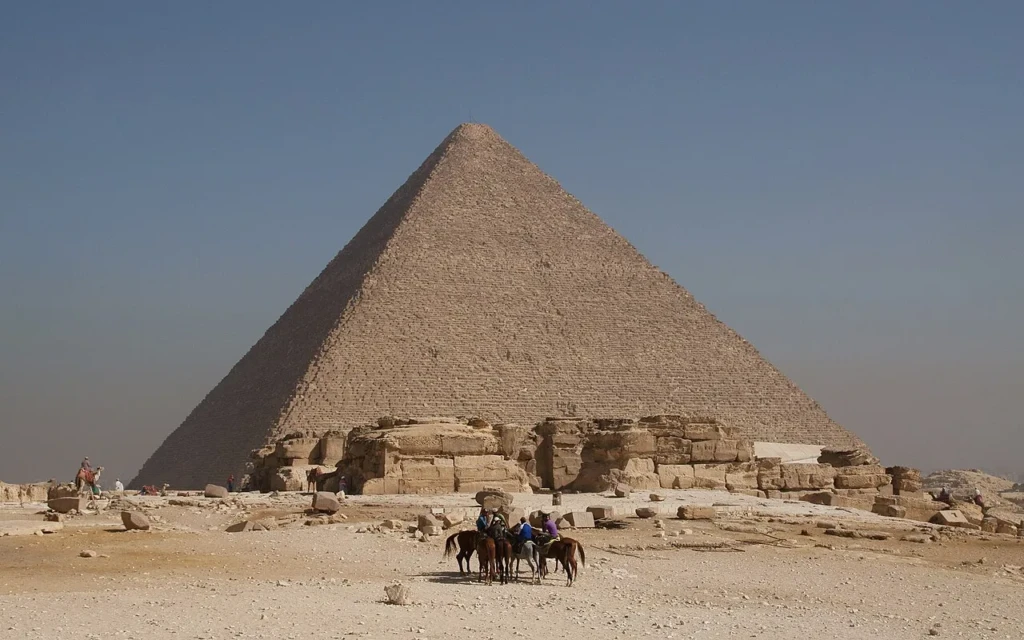
The Great Pyramid of Giza is the tomb of King Khufu, a 4th Dynasty pharaoh who reigned around 2589–2566 BC. It rose to an original height of about 146.5 meters and was the tallest structure on Earth for some 3,800 years, and it is the only one of the Seven Wonders of the Ancient World still standing. You can walk around it on a standard Giza plateau ticket, but going inside needs a second, separate ticket.
Most visitors see Khufu’s pyramid as one stop in a busy morning at Giza. It rewards a slower look. Below, we cover how it was built and why it matters, the route you follow inside, official ticket prices, and the practical choices that decide whether the climb to the King’s Chamber is right for you.
Great Pyramid of Giza: Quick Facts
| Fact | Details |
|---|---|
| Location | Giza Plateau, at the edge of the Western Desert, about 13 km southwest of central Cairo |
| Built for | King Khufu (Cheops to the Greeks), 4th Dynasty, Old Kingdom |
| Date | Reign of Khufu, c. 2589–2566 BC |
| Height | About 146.5 m originally; about 138.5 m today after the loss of its outer casing |
| Base | Each side about 230 m long |
| Inside | Three main chambers, the Grand Gallery and Khufu’s granite sarcophagus |
| Time needed | Our planning suggestion: 45–60 minutes for the outside and interior, within a half day at Giza |
| Foreign adult ticket (interior) | EGP 1,000 (student EGP 500), plus the plateau entry ticket |
Why the Great Pyramid Matters
Khufu’s pyramid is the oldest and largest of the three big pyramids at Giza. The other two belong to his son Khafre and his grandson Menkaure. Together they mark the high point of pyramid building in Egypt’s Old Kingdom, a period when royal tombs grew from stepped stone mounds into true, smooth-sided geometric forms.
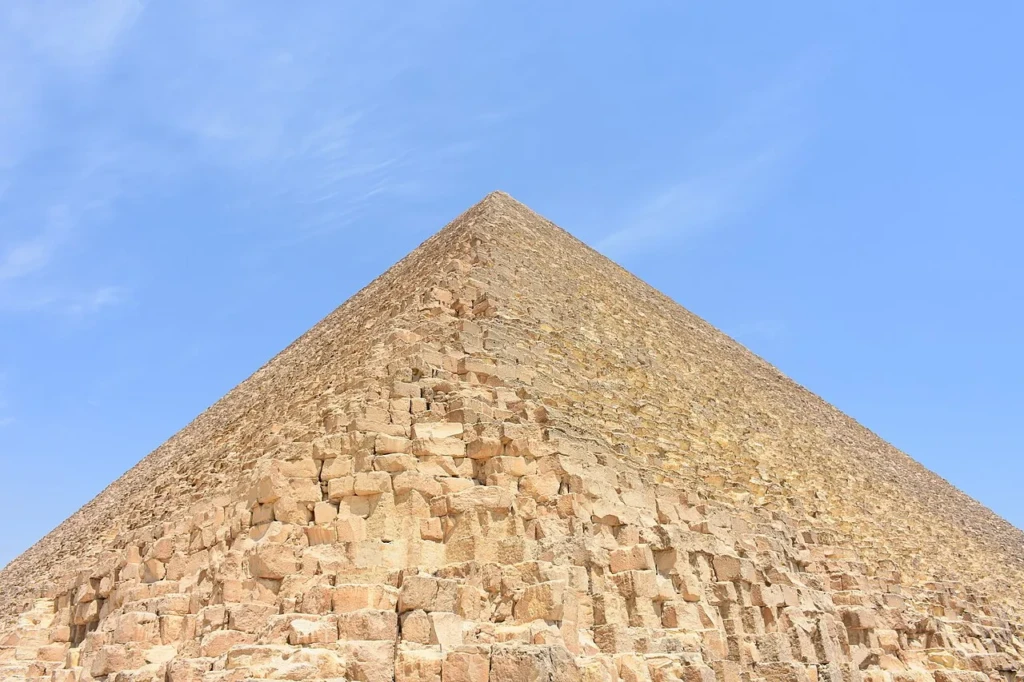
The pyramid was never a stand-alone monument. According to the Ministry of Tourism and Antiquities, each king’s pyramid at Giza sat inside a larger complex. That included small queens’ pyramids, a satellite pyramid, noble tombs, boat burials, and two temples joined by a causeway. Priests kept the king’s cult alive in those temples long after his burial.
How big is it, really?
The numbers are hard to picture until you stand at a corner. The structure is estimated to contain around 2.3 million blocks of stone. Most of the core is local limestone. The smooth white outer casing came from the Tura quarries south of modern Maadi, carried by boat. Almost all of that casing was stripped away in later centuries, which is why the pyramid is now about 8 meters shorter than it was.
The precision is just as striking as the size. Surveys show the four sides of the base differ in length by only a few centimeters on average. Builders achieved that with copper chisels, wooden mallets, ropes and stone tools.
How long did it take to build?
The Ministry estimates construction took between 10 and 20 years. Exactly how the blocks were raised is still debated. Ramps of various shapes are the leading explanation, but no single theory accounts for every stage. Be wary of anyone at the site who tells you the question is settled.
Who built it?
The pyramid was built by organized Egyptian work crews, not by slaves in the sense often shown in films. Archaeologists have excavated a planned workers’ town and a workers’ cemetery beside the plateau. Work gangs even left their names in red paint on hidden blocks above the King’s Chamber, alongside Khufu’s name. The Ministry lists the Workers’ Cemetery as a separate ticketed site at Giza.
What You See Inside, in Visiting Order
The interior is plain stone with no painted scenes. What impresses is the engineering and the sense of being deep inside the mass of the structure. Here is the route most visitors follow today.
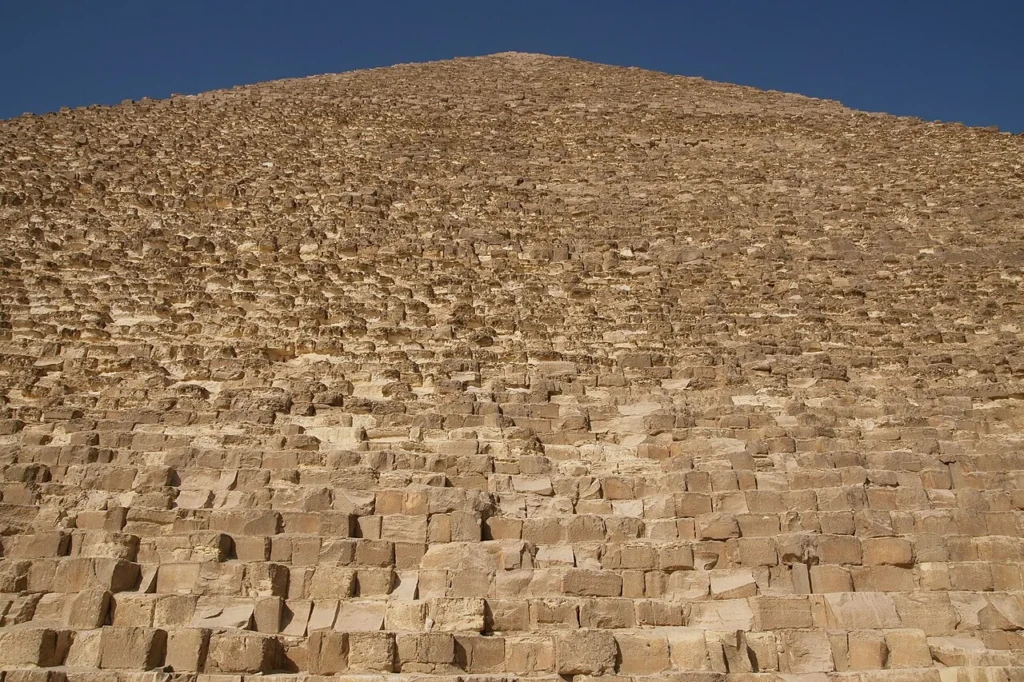
1. The Robbers’ Tunnel entrance
You do not use the original entrance, which sits higher on the north face. Visitors go in through a forced tunnel cut lower down on the same side. Tradition credits it to workmen of the Abbasid caliph al-Ma’mun in the 9th century AD. Many scholars think it is older and was dug by ancient tomb robbers. Either way, it runs roughly straight into the masonry for about 27 meters.
2. The Ascending Passage
The tunnel joins the Ascending Passage just above three granite plugging blocks. These were slid down to seal the tomb after the burial. The passage itself is low and steep. Most adults climb it bent nearly double, on a modern walkway fitted over the ancient floor.
3. The Grand Gallery
This is the highlight for most people. The Grand Gallery is a tall, narrow, sloping hall about 47 meters long and 8.6 meters high. Its walls step inward as they rise, a technique called corbelling. The Ministry describes it as a masterpiece of ancient engineering, and once you are inside it is easy to see why. After the cramped passage below, the sudden height feels like stepping into a stone cathedral.
4. The King’s Chamber
At the top of the gallery, a short low passage leads to the King’s Chamber. It is lined entirely with granite and holds Khufu’s lidless granite sarcophagus. The room is bare and quiet, and it is often warm and humid. Above its flat ceiling lie five stacked relieving chambers, roofed with granite beams weighing tens of tonnes, that spread the enormous weight of the stone overhead. These are not open to visitors.
What you will not see
The pyramid has two more chambers. The so-called Queen’s Chamber sits halfway up, and an unfinished chamber is cut into the bedrock below. The Ministry notes that having two chambers high within the masonry is a feature no other pyramid has. The steep Descending Passage to the lower chamber is usually closed to visitors. Your guide will confirm on the day which parts of the interior are open.
Recent Discoveries Inside Khufu’s Pyramid
The Great Pyramid is still producing news. The ScanPyramids project used muon detectors, which read cosmic particles passing through stone, to map hidden spaces. In 2023 researchers confirmed a sealed corridor about 9 meters long behind the chevron-shaped stones above the original entrance. A larger cavity known as the “Big Void” has also been detected above the Grand Gallery. Neither space is accessible, and their purpose is unknown.
The Khufu Boat: Now at the Grand Egyptian Museum
In 1954, two boat pits were found at the south side of the pyramid. One held a large cedar ship, dismantled but almost complete. The Ministry suggests these vessels may have carried the king’s body and burial goods to the tomb. For decades the reassembled ship sat in a small museum beside the pyramid. In August 2021 it was moved to the Grand Egyptian Museum, a few kilometers away. If you want to see it, read our Grand Egyptian Museum guide and plan the museum on the same day.
Great Pyramid Tickets and Opening Hours
Entry to the Giza Plateau and entry into the Great Pyramid are two separate tickets. The prices below are as listed on the official Ministry of Tourism and Antiquities site in October 2026; check before you go.
| Ticket (foreign visitors) | Adult | Student |
|---|---|---|
| Giza Plateau area entry | EGP 700 | EGP 350 |
| Great Pyramid interior (area ticket also required) | EGP 1,000 | EGP 500 |
| Total to enter the Great Pyramid | EGP 1,700 | EGP 850 |
The plateau ticket does not cover entry into any of the three main pyramids, the Tomb of Meresankh III or the Workers’ Cemetery. Each of those has its own ticket. The official listings also show a vehicle fee for cars entering the plateau.
On opening hours, the official listings differ slightly. The Great Pyramid’s own page shows daily hours of 7:00 to 5:00, while the Giza Plateau page shows 8:00 to 4:00. Treat the shorter window as the safe one and confirm on the day. If you travel with us, your guide will handle timing and tickets.
Should You Go Inside?
Going inside is worth it if you want to experience the scale of the structure from within. It is not a visit for everyone. Think about these points before you buy the extra ticket:
- Space: The Ascending Passage is narrow and low. If tight spaces bother you, the Grand Gallery will feel open, but you must get through the passage first.
- Effort: The climb is steep and continuous. Expect to use the handrails and to stop to let people pass.
- Air: The interior is warm and can feel stuffy, especially around midday and in summer.
- Expectations: There are no carvings or paintings. If decorated walls interest you more, the Pyramid of Unas at Saqqara has the earliest Pyramid Texts carved inside.
If you skip the interior, you still see the pyramid’s full mass from the base and from the panoramic viewpoint on the plateau. Many travelers find that enough.
How to Get to the Great Pyramid
The pyramid sits on the Giza Plateau, roughly 13 km southwest of central Cairo and about 9 km west of the Nile. Most visitors come by private car or taxi. Drive time depends heavily on Cairo traffic and your hotel’s location, so your driver or guide will confirm timing. Staying near the plateau cuts the journey to minutes. Our guide to hotels with a pyramid view in Cairo covers the options.
Best Time to Visit
Arrive at opening time. Mornings are cooler, the light on the east face is soft, and the interior is less crowded before tour buses build up. Late afternoon also works for outside photos, though you lose the chance of a quiet interior.
Season matters as much as the hour. The cooler months from roughly October to April are the most comfortable for walking the plateau. Our month-by-month guide to the best time to visit Egypt explains the trade-offs between weather and crowds.
Practical Tips for Your Visit
- Wear shoes with good grip. The interior walkway is worn smooth in places.
- Carry small bills in Egyptian pounds for restrooms and tips, plus water for the plateau.
- Keep your ticket with you after entering. You may need to show it again at the pyramid door.
- Bring sun protection. There is little shade anywhere on the plateau.
- Book a licensed Egyptologist guide. The interior has no signs, and the story makes far more sense with context.
Combining the Great Pyramid With Nearby Sites
The Great Pyramid is one part of a larger site. Our Giza Pyramids Complex guide covers the full plateau, including Khafre’s and Menkaure’s pyramids and the panoramic viewpoint. Downhill, the Great Sphinx of Giza sits beside Khafre’s causeway and is usually the last stop of the morning.
With a full day, add Saqqara and Dahshur to the south. There you can trace pyramid history from the Step Pyramid of Djoser to the Bent and Red Pyramids at Dahshur, built by Khufu’s father Sneferu. Seeing those first makes Khufu’s achievement easier to understand. For more ideas around the plateau, see our Giza travel guide.
Visit With Delta Tours Egypt
Our private Giza Pyramids tour with guide and car starts from $55 per person and is the simplest way to see the Great Pyramid with an Egyptologist. If you want more in one day, the Grand Egyptian Museum and Pyramids tour starts from $95 per person and pairs the plateau with the museum that now holds the Khufu boat. The Giza, Saqqara and Dahshur pyramids day tour starts from $105 per person for travelers who want the full pyramid story.
Short on time? Our Cairo airport layover tour starts from $180 per person. To see the plateau again after dark, the Pyramids Sound and Light Show starts from $53 per person. Browse all our private Cairo day tours to compare options.
Frequently Asked Questions
Can you go inside the Great Pyramid of Giza?
Yes. You need a Giza Plateau entry ticket plus a separate Great Pyramid ticket. The official site lists the interior ticket at EGP 1,000 for foreign adults in October 2026.
How old is the Great Pyramid?
It was built for King Khufu, who reigned around 2589–2566 BC. That makes it roughly 4,500 years old.
What is inside the Great Pyramid?
Visitors climb through the Ascending Passage and the Grand Gallery to the King’s Chamber. That granite-lined room still holds Khufu’s empty sarcophagus. The walls are undecorated.
Is going inside the Great Pyramid worth it?
It is worth it if you want to feel the scale of the structure and see the Grand Gallery. Skip it if you dislike tight, steep, warm spaces, since the climb is cramped and there are no carvings to see.
How long does a visit take?
Our planning suggestion is 45–60 minutes for the outside and the interior climb. Allow a half day to see the rest of the Giza Plateau and the Sphinx.
Where is the Khufu boat now?
The reassembled Khufu ship was moved from its museum beside the pyramid to the Grand Egyptian Museum in August 2021. You can see it there on the same day as the plateau.
Ready to stand at the foot of the last ancient wonder? Explore our private Cairo and Giza tours, and we will plan your morning at the Great Pyramid around the hours and crowds.
Featured image: Great Pyramid of Giza. Photo: kallerna / Wikimedia Commons, CC BY-SA 3.0