
Catacombs of Kom el Shoqafa: Alexandria Visitor Guide
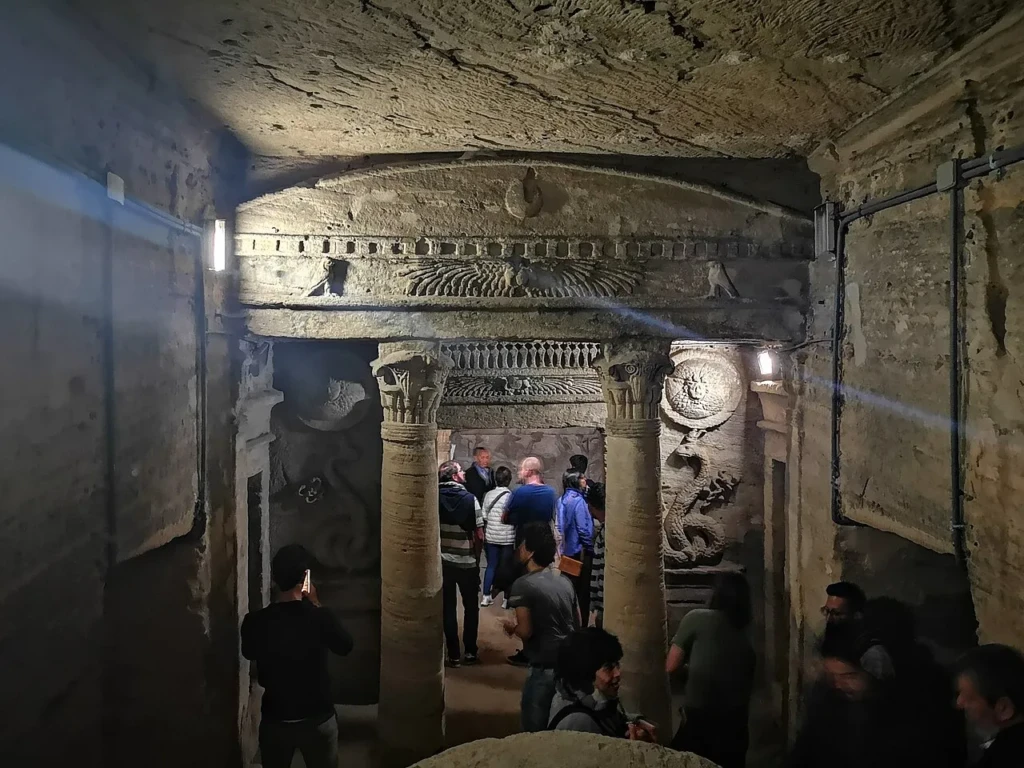
The Catacombs of Kom el-Shoqafa are a Roman-era underground burial complex in Alexandria, cut into the rock from around the 2nd century CE and rediscovered in 1900. Their carvings blend Egyptian, Greek and Roman art, with Egyptian gods shown in Roman dress. The site is open 9:00 am to 5:00 pm, and foreign adults pay EGP 200, according to the Ministry of Tourism and Antiquities.
Our Alexandria travel guide gives the catacombs a short overview among the city’s sights. This article goes underground in more detail: what each level holds, how to read the strange mix of styles, and how to fit the visit into a day.
Kom el-Shoqafa at a Glance
| Fact | Details |
|---|---|
| Location | Western Alexandria, near the Serapeum and Pompey’s Pillar (Diocletian’s Column) |
| Period | Roman era; cut in the 2nd century CE and used for burials into the 4th century |
| Built for | Believed to have begun as a tomb for a single wealthy family, later expanded for many burials |
| Layout | Three levels cut into solid rock, reached by a spiral staircase around a central shaft |
| Rediscovered | 1900 |
| Hours | 9:00 am – 5:00 pm |
| Foreigner ticket | Adult EGP 200, student EGP 100 |
| Time on site | Our planning suggestion: 45 minutes to 1 hour |
| From Cairo | A full-day trip by road; Delta’s day trip allows around three hours each way, depending on traffic |
What the Catacombs Are and Why They Matter
Alexander the Great founded Alexandria in 331 BC, and under the Ptolemies and then Rome it became the leading city of the eastern Mediterranean. Very little of that city stands today. The lighthouse and the great library are gone, and much of the royal quarter lies under the harbor.
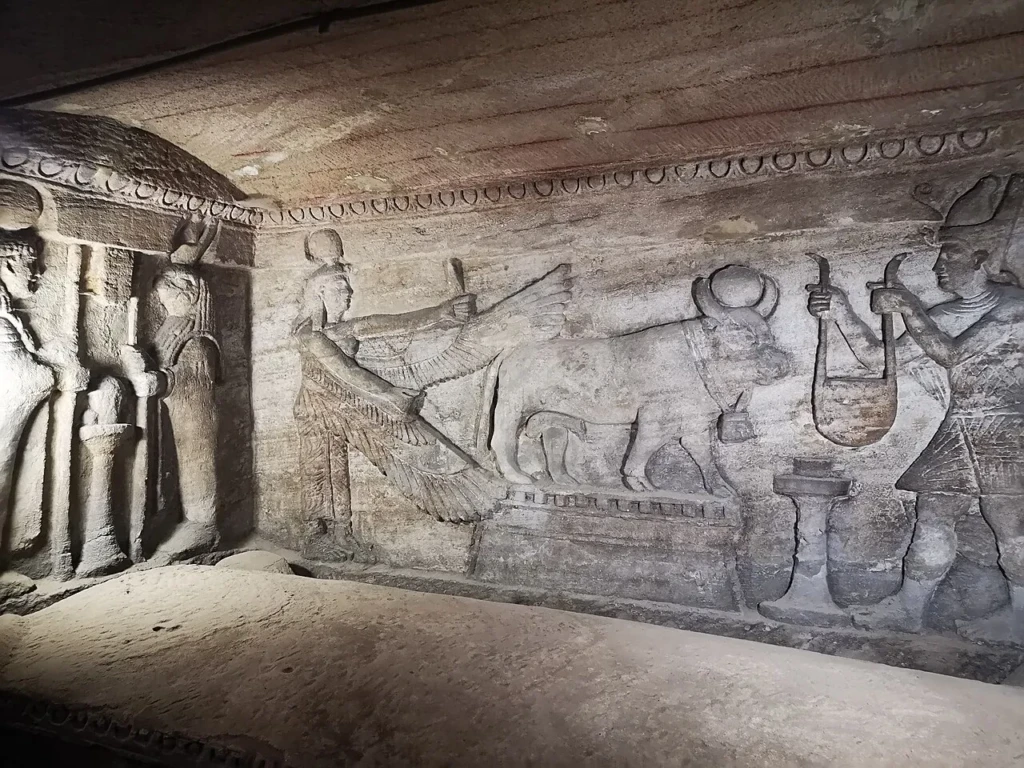
The Ministry of Tourism and Antiquities notes that most of Alexandria’s surviving ancient monuments are its cemeteries. Kom el-Shoqafa is the best known of them. The ministry describes it as a Roman-era complex of Greek-style catacombs, a chapel and a banqueting area used during funerals, with paintings and reliefs that combine Egyptian and Greek beliefs.
That mix is the reason to come. In most of Egypt you see either pharaonic temples or Greco-Roman ruins. Here, in one family tomb, a jackal-headed Egyptian god wears the armor of a Roman soldier, and Greek Medusa heads guard an Egyptian-style doorway. It is a snapshot of a city where several cultures lived side by side and borrowed from each other.
The name and the discovery
Kom el-Shoqafa means “Mound of Shards.” The hill above the tombs was once covered in broken pottery. One explanation is that mourners brought food and drink in clay vessels for meals at the tomb, then broke the containers rather than carry them home from a place of death.
The complex was forgotten for centuries. It was found again in 1900, and the story most often told is that a donkey pulling a cart fell through the ground into the access shaft.
What to See, in Visiting Order
The visit follows the natural route downward. Expect steps, low light and some uneven floors.
1. The spiral staircase and central shaft
You enter by a staircase that winds around a round central shaft. It is often said that bodies were lowered down the middle of the shaft on ropes while mourners walked the stairs. As you descend, the street noise fades and the air changes. Pause at the bottom to let your eyes adjust before moving on.
2. The rotunda and vestibule
The staircase opens into a rotunda around the central shaft, which is ringed by six pillars. From here a vestibule and passages lead to the rest of the first level. Look for the old breach in the rotunda wall, made at an unknown date, which now gives access to the Hall of Caracalla.
3. The triclinium (funeral banquet hall)
To the left of the rotunda is the triclinium. Stone benches cut from the rock line three sides of the room. Families reclined here on cushions to share a meal at the time of burial and again on later anniversaries. It is a very Roman custom set inside an Egyptian-style tomb, and it explains all those broken dishes on the hill above.
4. The Hall of Caracalla
Through the breach in the rotunda wall you reach the area known as the Hall of Caracalla, named after the Roman emperor. Bones of both humans and horses were found here. Ask your guide to explain the competing theories about how and why horses ended up in a human cemetery.
5. The principal tomb chamber
A second staircase leads down to the main tomb, the highlight of the site. Its entrance is designed like a small Egyptian temple. Two columns with papyrus, lotus and acanthus capitals carry a lintel with a winged sun disk flanked by Horus falcons.
Look closely at each side of the doorway:
- Two guardian serpents: Each carved snake represents the Agathodaemon, a protective spirit. It wears the Egyptian double crown and carries a Roman caduceus and a Greek thyrsus, with a Medusa shield above.
- A man and a woman: Two figures carved into the walls stand in the stiff pose of Egyptian sculpture. His head is carved in a lifelike Greek manner, and she has a Roman hairstyle.
6. The three sarcophagi and the Anubis relief
Inside, three large stone sarcophagi line the sides of the chamber. Their lids cannot be lifted, and scholars think bodies were placed in them from a passage behind. The sarcophagi are decorated with garlands and heads from Greek mythology.
Each sarcophagus has a relief panel above it. The central one is the scene most visitors remember. Anubis, the jackal-headed god of embalming, is dressed as a Roman soldier as he tends a body on a lion-shaped bed, with three canopic jars below. The side panels show the sacred Apis bull receiving a gift.
7. The burial corridors
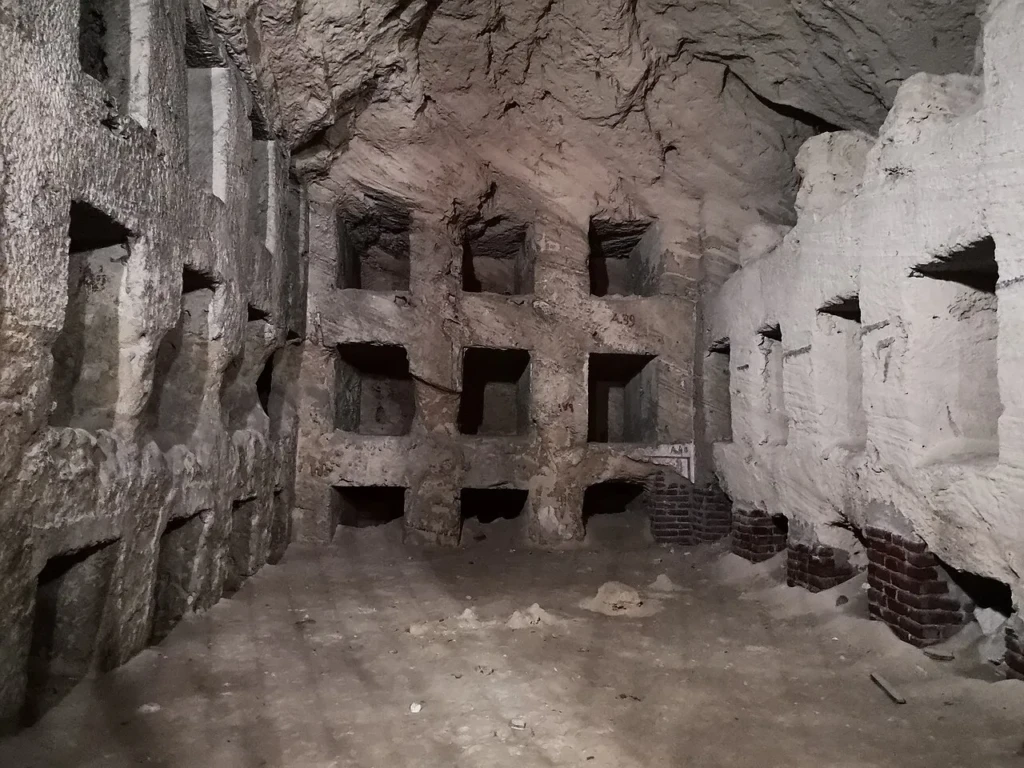
Around the main chamber runs a passage lined with carved recesses, each with room for three mummies. Walking it gives a sense of how many people were eventually laid to rest here, far beyond the single family the tomb may first have served. The lowest, third level was underwater until restoration work lowered the water.
8. The painted tomb with Persephone
Nearby, a painted burial chamber shows two traditions stacked one above the other. The upper scene is Egyptian funerary imagery. The lower one shows the Greek myth of Persephone’s abduction to the underworld. If it is open on your visit, it is one of the clearest examples of Alexandria’s double cultural language.
Opening Hours and Tickets
As listed in the Ministry of Tourism and Antiquities’ official ticket price list in October 2026 (the latest version we could find, dated November 2024), check before you go:
| Ticket | Price |
|---|---|
| Foreign adult | EGP 200 |
| Foreign student | EGP 100 |
| Hours | 9:00 am – 5:00 pm |
The same list shows Pompey’s Pillar at the same EGP 200 foreign adult price and the same hours. The ministry’s monuments website does not have a separate page for the catacombs, and we found no official photography rules for the site, so ask at the ticket office before taking pictures.
Practical Tips for Your Visit
- Footwear: Wear closed shoes with good grip. The route is all stairs and stone floors.
- Mobility: The only way down is by stairs. Travelers who find steps difficult may prefer to spend the time at one of Alexandria’s museums instead.
- Light: Some areas are dim. Move slowly and let your guide point out the details on the carvings.
- Guide: The meaning here lies in small symbols, so an Egyptologist makes a real difference. Without one, the chambers can feel like a series of dark rooms.
- Timing: Arrive close to the 9:00 am opening if you want quieter chambers and plenty of time for the rest of the city.
Best Time to Visit
The catacombs stay underground, so the season matters less inside than it does on the drive and at Alexandria’s open-air sites. Alexandria has a Mediterranean climate, and our month-by-month guide to the best time to visit Egypt covers the months when walking the Corniche is most comfortable.
Safety Notes
Alexandria is a large, busy city that receives many visitors. Official travel advice from the UK and US governments covers Egypt as a whole and is updated often, so read the current pages before you travel. The UK advice, last updated in August 2026, lists shooting attacks in Alexandria in 2023 and 2024 among recent incidents, and notes that places visited by foreign nationals could be targets. Your guide and driver follow local security arrangements throughout the day. Our guide Is it safe to travel to Egypt right now? explains how to read those advisories calmly.
How to Combine Kom el-Shoqafa With Nearby Sites
The catacombs sit in the same part of the city as the Serapeum and the red granite column known as Pompey’s Pillar. The ministry notes that this column was actually raised for the emperor Diocletian in the late 290s CE. Seeing the two together shows Alexandria’s public temple life and its private funeral customs within a short distance.
A typical day from Cairo adds the 15th-century Qaitbay Citadel on the waterfront. With more time, add the Graeco-Roman Museum or Kom el-Dikka, with its small Roman theater (odeion) and bath complex. See our page of Egypt tours with Alexandria for multi-day options.
Visit With Delta Tours Egypt
The simplest way in from Cairo is our Alexandria day trip from Cairo by private car, from $130 per person. It visits Pompey’s Pillar, the Catacombs of Kom el-Shoqafa and the Citadel of Qaitbay with an English-speaking guide, then returns you to your Cairo hotel in the evening.
If you would rather stay overnight or combine Alexandria with a longer trip, compare these packages:
- 4-day Cairo and Alexandria budget tour, from $390 per person
- Cleopatra 10-day Cairo, Nile cruise and Alexandria tour, from $1,190 per person
- Alexander the Great 10-day tour with Nile cruise and Alexandria, from $1,310 per person
- Ptolemy 10-day luxury tour with Nile cruise, Cairo and Alexandria, from $3,210 per person
You can also browse all our Egypt day tours and private excursions.
Frequently Asked Questions
How much is the ticket for the Catacombs of Kom el-Shoqafa?
The ministry’s official price list shows EGP 200 for foreign adults and EGP 100 for foreign students. Prices change from time to time. Check the current figure before you travel.
What are the opening hours of Kom el-Shoqafa?
The ministry lists 9:00 am to 5:00 pm. Arriving at opening time gives you quieter chambers. It also leaves the rest of the day for other Alexandria sights.
How old are the Catacombs of Kom el-Shoqafa?
They were cut into the rock in the 2nd century CE, during the Roman period. Burials continued into the 4th century. The site was rediscovered in 1900.
Why do Egyptian gods wear Roman clothes in the catacombs?
Roman Alexandria mixed Egyptian, Greek and Roman traditions. Wealthy families wanted Egyptian protection in the afterlife but expressed it in the art style of their own time. The result is Anubis in Roman armor and Medusa heads beside Egyptian sun disks.
Can I visit Kom el-Shoqafa on a day trip from Cairo?
Yes. Delta’s private day trip pairs the catacombs with Pompey’s Pillar and the Qaitbay Citadel. Plan for a long day, with around three hours on the road each way depending on traffic.
Is Kom el-Shoqafa suitable for people with limited mobility?
The site is reached only by stairs, and floors are stone and uneven in places. Travelers who find stairs hard should think carefully. A museum visit may be a better use of that time.
Kom el-Shoqafa is small, but few places in Egypt show so clearly how its cultures met and mixed. To see it with a private Egyptologist on a day out of Cairo, start with our Alexandria day trip.
Featured image: Catacombs of Kom El Shoqafa, Alexandria. Photo: Following Hadrian / Wikimedia Commons, CC BY-SA 2.0