The Aswan High Dam: Why It Was Built and What You See
The Aswan High Dam is a giant rock-and-clay embankment across the Nile, built between 1960 and 1970 to end Egypt’s cycle of floods and droughts, store water for farming and generate electricity. A visit takes you onto the crest road, with Lake Nasser on one side and the Nile valley on the other, plus a lotus-shaped monument to Soviet-Egyptian cooperation. We suggest planning 30 to 60 minutes here as part of a wider Aswan day.
This guide explains why Egypt built the dam, what it changed for better and worse, what you actually see on a stop today, and how to pair it with Philae, Kalabsha and the other sights south of the city.
| Quick facts | Details |
|---|---|
| Location | Across the Nile south of Aswan, about 13 km (8 miles) from the city according to Lonely Planet |
| Built | Construction began on 9 January 1960; the dam was completed on 21 July 1970 |
| Built by | The Egyptian government with Soviet financing and engineering; designed by Nikolai Malyshev of Moscow’s Hydroproject Institute with Egyptian engineers |
| Size | 3,830 m (12,570 ft) long, 111 m (364 ft) tall, 980 m (3,220 ft) wide at the base |
| Reservoir | Lake Nasser, about 500 km (310 miles) long |
| Time needed | 30 to 60 minutes (our planning suggestion) |
| Ticket | Not listed on the Ministry of Tourism and Antiquities site; see the tickets section below |
| Delta tour | Aswan Day Tour, 1 day, from $85 per person |
What is the Aswan High Dam?
The High Dam, called as-Sadd al-Aali in Arabic, is one of the largest embankment dams in the world. When it was finished it was the tallest earthen dam anywhere. It is not a concrete wall like the Hoover Dam. It is a mountain of rock, sand and clay, about 43 million cubic meters of fill, sealed by a deep grout curtain under its base.
The dam holds back Lake Nasser, one of the largest artificial lakes on Earth. About 83% of the lake lies in Egypt. The Sudanese part is known as Lake Nubia. At its widest the lake reaches about 35 km (22 miles), and it covers roughly 5,250 square kilometers.
Do not confuse it with the older Aswan Low Dam, which sits about 7 km downstream. The British built that granite dam between 1898 and 1902, to a design by Sir William Willcocks, and it was raised twice in the following decades. Ask your guide to point it out, since the two are easy to mix up.
Why was the Aswan High Dam built?
For thousands of years Egyptian farming depended on the annual Nile flood. A good year spread water and silt across the fields. A high year could wash crops away. A low year meant drought and hunger. The Low Dam helped a little, but it was too small to store water from one year to the next.
After the 1952 revolution, Egypt’s new leaders wanted full control of the river. A plan by Greek-Egyptian engineer Adrian Daninos for a much larger dam at Aswan was adopted within months. The goals were simple to state and huge to deliver:
- Flood control. A reservoir big enough to absorb the highest floods.
- Multi-year storage. Water saved in wet years could be released in dry ones.
- More farmland. Year-round irrigation instead of one flood season.
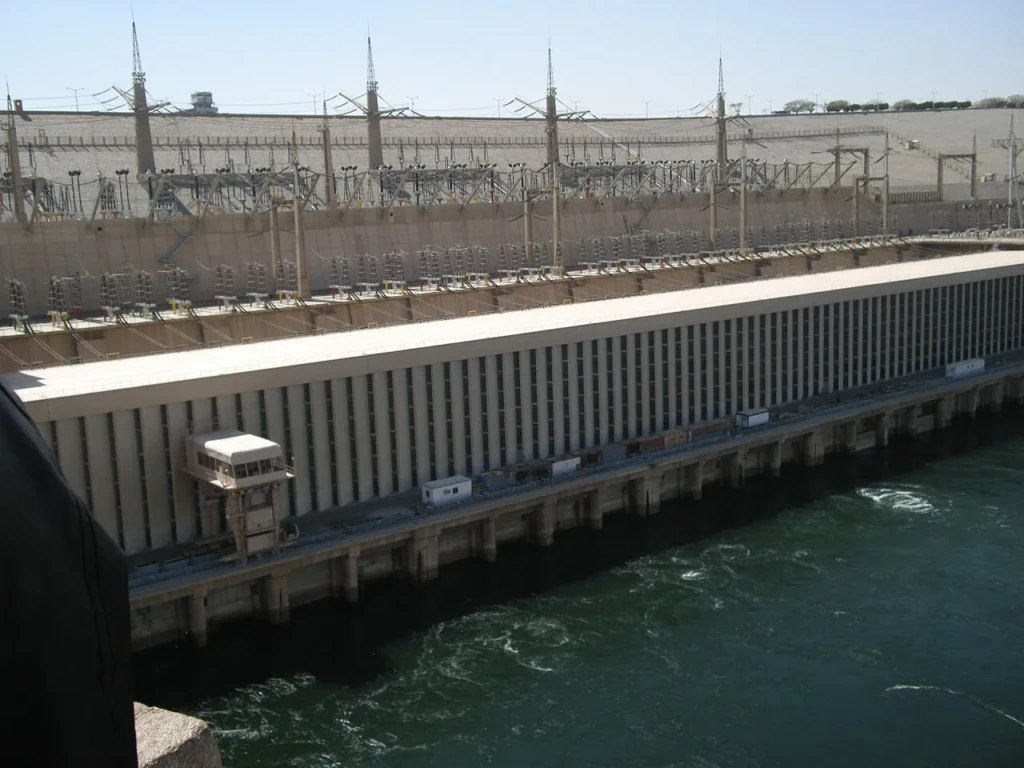
- Electricity. A hydropower station to power industry and villages.
The Cold War story behind the dam
Funding turned the dam into a global political drama. In late 1955 the United States and Britain pledged money toward the project. Relations soured over the following months, and on 19 July 1956 the US State Department withdrew its offer. One week later, on 26 July 1956, President Gamal Abdel Nasser nationalized the Suez Canal, planning to use its revenue for the dam. The Suez Crisis followed.
The Soviet Union stepped in. A first Soviet loan in 1958 paid for the coffer dams that diverted the river, and more credit followed in 1960. Soviet engineers supervised and supplied heavy equipment, while Egyptian firms did the construction. The largest Egyptian contractor was Osman Ahmed Osman’s Arab Contractors. Around 25,000 Egyptian engineers and workers took part.
A short timeline
| Year | Milestone |
|---|---|
| 1902 | Aswan Low Dam opens on 10 December |
| 1956 | US withdraws funding offer; Suez Canal nationalized |
| 1958 | First Soviet loan for the project |
| 1960 | Construction begins on 9 January; UNESCO rescue campaign for Nubian monuments starts |
| 1964 | First construction stage complete; the reservoir begins to fill |
| 1967 | Power generation begins |
| 1970 | Dam completed on 21 July |
| 1976 | Lake Nasser reaches capacity |
What did the dam change?
The High Dam is still debated decades later. Here is a balanced summary so you can ask good questions on site.
The gains
- Protection from floods and droughts. The dam softened the effects of floods in 1964, 1973 and 1988. It also shielded Egypt from the severe droughts of 1972 to 1973 and 1983 to 1987 that hit East and West Africa.
- More farmland. About 2 million feddans (roughly 840,000 hectares) were reclaimed, increasing Egypt’s irrigated area by about a third.
- Power. Twelve turbines of 175 megawatts each give the plant 2,100 megawatts of capacity. When it first reached peak output in 1970, it produced around half of Egypt’s electricity and brought power to many villages for the first time.
- Navigation. Steadier water levels made river travel more reliable, which is one reason Nile cruises between Luxor and Aswan can run through the winter.
The costs
- Displaced communities. Lake Nasser flooded much of Lower Nubia. Between 100,000 and 120,000 people were resettled in Egypt and Sudan. In Egypt, most of about 50,000 Nubians were moved to new villages near Kom Ombo, known as New Nubia. Egypt began paying compensation in 2019 and 2020.
- Lost silt. The fertile sediment that once reached the fields and the Delta now settles in the lake. Farmers rely on fertilizer, and the Delta coastline has suffered erosion.
- Soil salinity. With no annual flood, groundwater stays high, and salts can build up in poorly drained fields.
- Fisheries. The Mediterranean sardine catch off Egypt collapsed in the 1960s, then partly recovered.
How the dam reshaped ancient Egypt’s map
For many travelers this is the most surprising part of the story. Rising water threatened dozens of temples in Nubia. From 1960, UNESCO led an international rescue campaign. Twenty-two monuments and complexes were dismantled and moved, including the Abu Simbel temples, the temples of Philae, Kalabsha and Amada.
Several countries that helped received a temple as thanks. That is why the Temple of Dendur now stands in the Metropolitan Museum of Art in New York and the Temple of Debod stands in Madrid. Some sites, such as the fortress of Buhen, could not be saved and now lie under the lake.
When you visit Philae Temple or Abu Simbel, you are seeing the direct result of the High Dam. A stop at the dam itself helps the whole southern itinerary make sense.
What you see at the Aswan High Dam today
Set honest expectations. This is a working piece of national infrastructure, not an archaeological site. The appeal is scale, views and history rather than carvings. Here is what a typical stop includes, in the order most drivers approach it.
The crest road and the two views
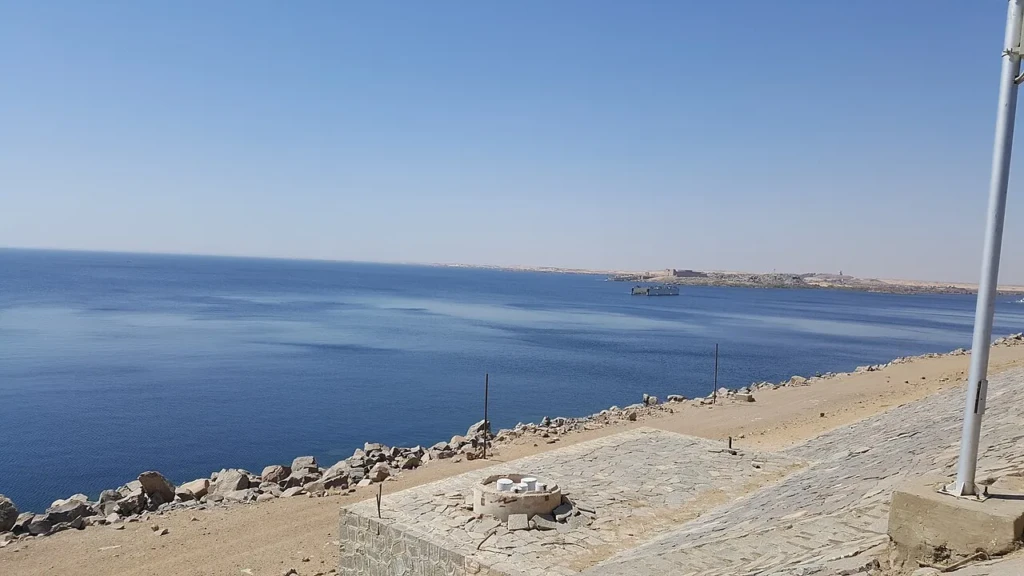
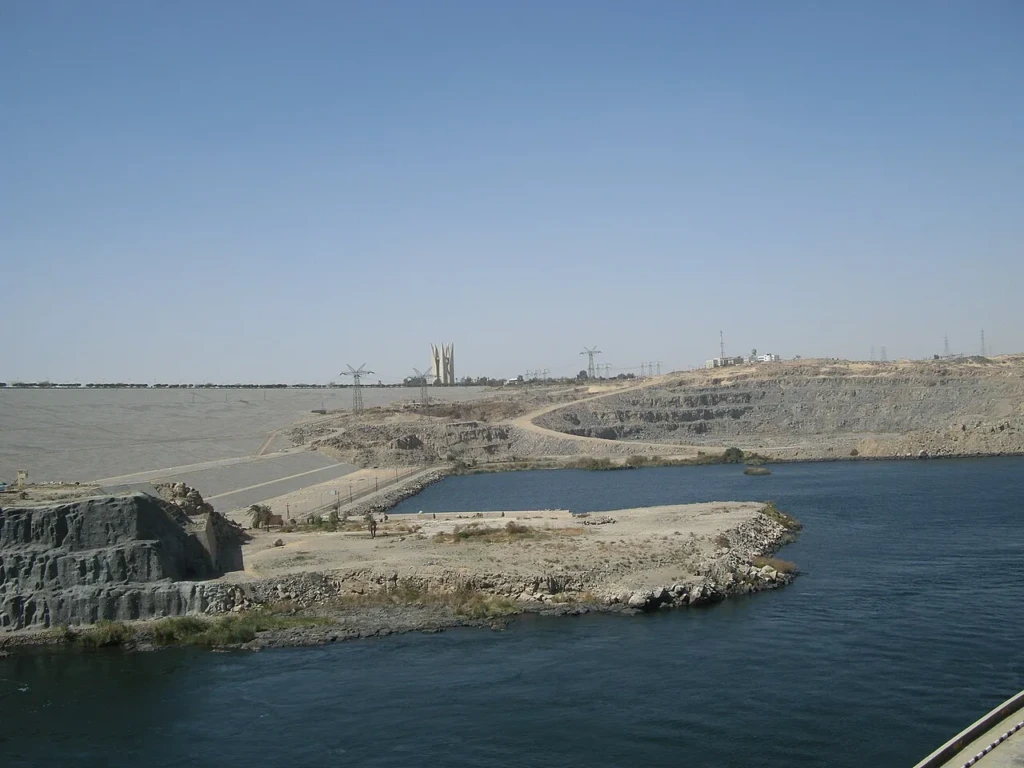
Vehicles drive along the top of the dam, which is about 40 m (130 ft) wide at the crest. Your driver will usually pull over at a viewing area. Look south and you see Lake Nasser stretching toward the desert horizon. Look north and you see the Nile narrowing back into its valley toward Aswan. The contrast between the two sides is the reason to come.
The lotus monument
On the western side stands the tall monument to Soviet-Egyptian friendship. It takes the form of an open lotus flower with five petals, a symbol chosen for its meaning in ancient Egyptian religion. The lotus opened at sunrise and closed at sunset, rising above the water each day. The monument was built by the Egyptian Reinforced Cement Company.
The information pavilion
Lonely Planet describes a small pavilion with displays on the dam’s dimensions and construction. If it is open on your visit, it adds useful context in ten minutes or so.
Photography
Security is present, as at any major dam. Lonely Planet reports that video cameras and zoom lenses are not allowed on site. Phone photos from the viewing area are the norm. Follow any instruction from police or your guide, and never photograph military or security staff.
How do you get to the High Dam?
The dam lies south of Aswan city. The official Ministry of Tourism and Antiquities overview of Aswan places it beyond Philae, with New Kalabsha Island farther on. The easiest way to visit is by private car with a driver, either alone or as part of a guided day.
Drive time depends on traffic and on how many stops you make. Your driver or guide will confirm timing on the day. Plan the dam together with Philae, since both sit on the same side of the city.
Opening hours and tickets
The High Dam is not an antiquities site, so the official Ministry of Tourism and Antiquities website does not list opening hours or a ticket price for it. We could not find a current official figure from the dam authority either, so we do not quote one here. If you book a tour, ask whether any dam fee is included. If you travel independently, ask your hotel or driver the day before.
Nearby antiquities do have official listings. As listed on the official Ministry of Tourism and Antiquities site in October 2026; check before you go:
| Site | Hours | Foreign adult | Foreign student |
|---|---|---|---|
| Philae Temple | 7:00 am to 4:00 pm | EGP 550 | EGP 275 |
| Kalabsha Temple | 7:00 am to 4:00 pm | EGP 200 | EGP 100 |
| Unfinished Obelisk | 7:00 am to 4:00 pm | EGP 220 | EGP 110 |
| Nubia Museum | 9:00 am to 5:00 pm | EGP 400 | EGP 200 |
When is the best time to visit?
Aswan is one of the hottest and driest cities in the world. Average summer highs stay above 40°C (104°F) from June through September. October to April is far more comfortable, with average highs in the coldest month a little above 23°C (73°F).
The crest road is fully exposed, with no shade. In any season, aim for early morning or late afternoon. Seeing the dam first, then Philae, keeps both stops ahead of the midday heat. For a month-by-month view, see our guide to the best time to visit Egypt.
Practical tips for your stop
- Carry your passport. It is sensible to have ID with you at any security-controlled site.
- Wear sun protection. A hat, sunglasses and water make a short stop much nicer.
- Keep it short. Thirty minutes covers the views and the monument. Engineering fans may want an hour.
- Ask about the Nubian story. A good guide will explain resettlement as well as the engineering.
How to combine the High Dam with nearby sites
The dam fits naturally into a south-of-Aswan loop. A common order is the Unfinished Obelisk in the granite quarries, then the High Dam, then a short boat ride to Philae. With more time, add Kalabsha, a Roman-era temple dedicated to the Nubian god Mandulis. It was moved from its original island to New Kalabsha in 1962 and 1963 because of the dam.
Back in the city, the Nubia Museum tells the human side of the flooding through artifacts and a reconstructed Nubian house. Our Aswan travel guide covers the full list of things to do and how to split them across one or two days.
If you are cruising, most ships between Luxor and Aswan include an Aswan sightseeing day. Our Nile cruise itinerary guide shows how the days usually run. Many travelers also continue south to Abu Simbel, which you can reach on a private day trip by car from $120 per person or by air from $360 per person.
Visit with Delta Tours Egypt
Our Aswan Day Tour is a one-day excursion from $85 per person, and the natural starting point for a day that pairs the High Dam with Philae. Tell us when you book that the dam is a priority, and we will confirm the exact stops for your date. For other options, including the Nubian Village Tour from Aswan by Boat from $50 per person, browse our Aswan day tours and excursions.
Planning a longer trip? The Jewels of Egypt 6-day luxury journey covers Cairo, Giza, Luxor, Aswan and Abu Simbel from $1,075 per person.
Frequently Asked Questions
Is the Aswan High Dam worth visiting?
Yes, as a short stop rather than a destination. The views of Lake Nasser and the story behind Philae and Abu Simbel make it worthwhile. We suggest 30 to 60 minutes.
How tall and long is the Aswan High Dam?
The dam is 111 m (364 ft) tall and 3,830 m (12,570 ft) long. It is 980 m wide at the base and 40 m wide at the crest.
What is the difference between the Aswan Low Dam and the High Dam?
The Low Dam is the older granite dam, built by the British from 1898 to 1902. The High Dam is the much larger embankment dam about 7 km upstream, completed in 1970, which created Lake Nasser.
Who paid for the Aswan High Dam?
Egypt covered all local costs, and the Soviet Union provided loans for foreign exchange, equipment and engineers. The US and Britain had pledged funding but withdrew it in 1956.
Can I take photos at the High Dam?
Phone photos from the viewing areas are normal. Lonely Planet reports that video cameras and zoom lenses are not allowed. Always follow security staff instructions.
How much is the ticket for the Aswan High Dam?
The Ministry of Tourism and Antiquities does not publish a ticket price for the dam, because it is not an antiquities site. Ask your tour operator or hotel whether a fee applies on the day you visit.
The High Dam is the key that unlocks southern Egypt’s modern map, from Lake Nasser to the rescued temples. To build it into a relaxed private day with Philae and more, explore our private Aswan tours and tell us what matters most to you.
Featured image: Lake Nasser seen from the Aswan High Dam. Photo: Ovedc / Wikimedia Commons, CC BY-SA 4.0