

Delta Tours Egypt
Egypt Solar Eclipse 2027: Luxor Totality Times & Trip Guide
On Monday, August 2, 2027, a total solar eclipse crosses Egypt from the Western Desert to the Red Sea. Luxor sits close to the center of the path and gets about 6 minutes 20 seconds of totality around 1:02 p.m. local time, with the Sun almost straight overhead. Aswan, just south of the path, sees a deep partial eclipse only.
This page covers where totality falls in Egypt, the timings for Luxor and nearby towns, how to cope with August heat, how to watch and photograph the eclipse safely, and how to build a Nile Valley trip around the day.
What Is a Total Solar Eclipse?
A total solar eclipse happens when the Moon passes directly between the Earth and the Sun and covers the Sun’s bright disk completely. The Moon’s shadow then sweeps across the ground in a narrow band called the path of totality. On August 2, 2027, NASA puts that band at about 258 km (160 miles) wide.
Outside the band, people see only a partial eclipse, where part of the Sun stays visible. The difference is not small. Even 99% coverage leaves enough sunlight that the sky stays bright. Only inside the path does the day turn to deep twilight, the temperature drop, and the Sun’s outer atmosphere, the corona, appear as a pale glow around the black Moon.
Each eclipse unfolds in stages. The partial phase starts when the Moon first touches the Sun’s edge and lasts well over an hour. Totality begins at second contact and ends at third contact. Then a second partial phase runs until the Moon leaves the Sun’s disk.
Where in Egypt Will the Eclipse Be Total?
The path enters Egypt from Libya and runs southeast across the country. It crosses the Nile Valley in Upper Egypt, then the Eastern Desert, and reaches the Red Sea coast before heading on to Saudi Arabia. NASA’s path table places the central line near 26.9°N 31.0°E at 10:00 UTC and near 25.6°N 33.0°E at 10:06 UTC, which takes it just north of Luxor.
For travelers, the practical result is simple. The stretch of the Nile from Asyut south through Sohag, Qena, Luxor, Esna and Edfu sits inside the path. Kom Ombo is inside, but close to the southern edge, so its totality is much shorter. Aswan falls just outside the southern limit. Cairo and Hurghada are also outside the path and see a partial eclipse.
NASA lists the longest totality anywhere on this eclipse as 6 minutes 23 seconds. That point lies in Egypt, on the west side of the Nile Valley roughly between Asyut and Sohag. The point of greatest eclipse lies in the Eastern Desert east of Luxor, at about 25.5°N 33.2°E.
Why Luxor Is the Natural Base for the Eclipse
Several eclipse paths cross remote deserts. This one passes over one of the most visited archaeological areas in the world, and three things set Luxor apart.
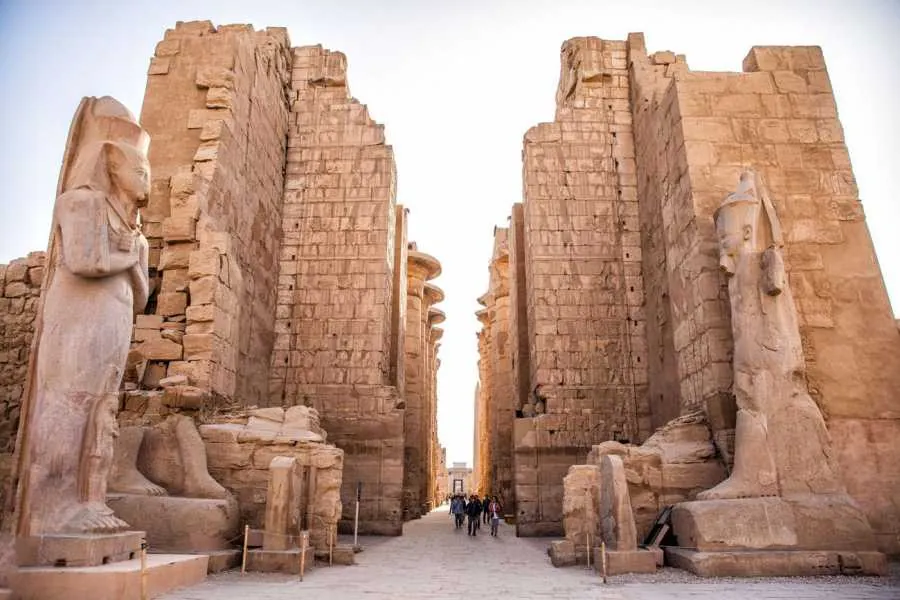
- Long totality. Luxor is close to the central line, so it gets about 6 minutes 20 seconds of totality. That is only a few seconds short of the eclipse maximum.
- A high Sun. At mid-eclipse the Sun stands about 82° above the horizon in Luxor. Buildings, hills and trees will not block the view, and nearly any open space works as a viewing spot.
- Infrastructure. Luxor has an international airport, a large stock of hotels on both banks, and the river cruise fleet that sails between Luxor and Aswan. Visitors can plan sightseeing, accommodation and transport from one base.
There is also the setting. Seeing the Sun disappear above the temples of ancient Thebes, built for a civilization that worshipped the Sun god Ra, gives the event an added layer of meaning. Our Luxor travel guide covers the city’s main sites and how to split time between the East and West Banks.
Eclipse Timings and Totality Duration in Egypt
The times below come from NASA’s Javascript Solar Eclipse Explorer, run with NASA’s eclipse elements for each town center. They are rounded to the minute, and durations may shift by a few seconds depending on your exact position. Your spot within a town matters most near the edge of the path, as in Kom Ombo.
Local times assume Egyptian summer time (UTC+3). Under a 2023 law, Egypt keeps summer time from the last Friday in April to the last Thursday in October. If that schedule holds in 2027, August 2 falls inside it. Check again closer to the date, because Egypt has changed its clock rules before.
Luxor: Eclipse Stages
| Stage | UTC | Egypt summer time (UTC+3) |
|---|---|---|
| Partial eclipse begins | 08:40 | 11:40 a.m. |
| Totality begins | 10:02 | 1:02 p.m. |
| Maximum eclipse (Sun about 82° high) | 10:05 | 1:05 p.m. |
| Totality ends | 10:08 | 1:08 p.m. |
| Partial eclipse ends | 11:26 | 2:26 p.m. |
| Length of totality | About 6 minutes 20 seconds | |
Other Egyptian Towns on or Near the Path
| Place | What you see | Totality length | Totality begins (UTC+3) |
|---|---|---|---|
| Sohag | Total | About 6 min 22 s | 12:59 p.m. |
| Luxor | Total | About 6 min 20 s | 1:02 p.m. |
| Qena | Total | About 6 min 11 s | 1:01 p.m. |
| Asyut | Total | About 6 min 7 s | 12:57 p.m. |
| Esna | Total | About 5 min 44 s | 1:03 p.m. |
| Marsa Alam (Red Sea) | Total | About 5 min 31 s | 1:08 p.m. |
| Edfu | Total | About 5 min 29 s | 1:04 p.m. |
| Kom Ombo | Total, near the southern edge | About 3 min 36 s | 1:06 p.m. |
| Aswan | Partial, about 99.8% of the Sun covered | No totality | Maximum at 1:08 p.m. |
| Hurghada | Partial, about 98.6% covered | No totality | Maximum at 1:05 p.m. |
| Cairo | Partial, about 95% covered | No totality | Maximum at 12:56 p.m. |
The Aswan figure is the one most likely to catch travelers out. A sky with 99.8% of the Sun covered still looks like daytime, and you will not see the corona. If your trip is based in Aswan that day, drive north into the path. Edfu and Esna both offer roughly five and a half minutes or more.
Weather and Heat in Luxor in August
Clear skies are the main reason so many eclipse watchers are looking at Upper Egypt. Luxor is one of the driest places on Earth. Climate normals for 1991–2020 show almost no rain in August and about 91% of possible sunshine hours. Cloud is rarely a concern on any given day.
Heat is the real issue. The average daily high in Luxor in August is about 41 °C (106 °F), and the average low is about 26 °C (78 °F). Totality falls around 1 p.m., near the hottest part of the day, and the full eclipse from first to last contact lasts close to three hours. Plan for heat the same way you plan for the sky.
Practical Heat Advice for Eclipse Day
- Do your sightseeing at dawn on eclipse day and rest in the shade or indoors from mid-morning.
- Choose a viewing spot with shade for the partial phases. You only need open sky for the few minutes around totality, and the high Sun means shade from awnings or trees is directly overhead.
- Carry more water than you think you need, and drink before you feel thirsty. Add oral rehydration salts if you sweat heavily.
- Wear a wide-brimmed hat, loose long sleeves in light colors, and high-factor sunscreen. NASA’s safety guidance also reminds viewers that they may spend hours in direct sun.
- Keep electronics out of direct sunlight. Phones and cameras can overheat and shut down before totality.
- Know the signs of heat exhaustion: dizziness, headache, nausea and heavy sweating. Move to shade and cool down at once if they appear.
How to Watch the Eclipse Safely
Looking at the partly eclipsed Sun without proper protection can permanently damage your eyes. NASA and the American Astronomical Society (AAS) agree on a short list of rules.
- Use certified solar viewers. Eclipse glasses and handheld viewers must meet the ISO 12312-2 international standard. The AAS keeps a list of suppliers of verified solar viewers. Buy from that list before you travel rather than from street sellers on the day.
- Sunglasses are not enough. Ordinary sunglasses, however dark, are not safe for looking at the Sun.
- Inspect before use. Throw away any viewer that is scratched, torn, punctured or otherwise damaged.
- Remove them only during totality. You can look with the naked eye only once the Moon fully covers the Sun’s bright face. Put your glasses back on as soon as any bright Sun reappears.
- Never use glasses behind optics. Cameras, binoculars and telescopes need their own solar filter fixed securely to the front. Concentrated sunlight from a lens will burn through eclipse glasses.
- Supervise children. Keep a close eye on children wearing solar viewers.
- Pinhole projection works too. A small hole in a card projects the Sun’s image onto the ground. Stand with your back to the Sun and look at the projection, never through the hole.
NASA’s eclipse safety page explains these rules in more detail. With the Sun at about 82° in Luxor, you will be looking almost straight up. A reclining chair or a mat makes the experience safer and far more comfortable.
Photographing the Eclipse: The Basics
Six minutes feels long until it starts. Many first-time viewers spend totality fiddling with settings and barely look up. Keep the plan simple.
- Filter on for the partial phases. Fit a proper solar filter to the front of the lens, never between lens and sensor. The same ISO 12312-2 glasses are not designed for this job.
- Filter off for totality only. Remove it at second contact and put it back before third contact. Set a phone timer for a minute before totality ends as a reminder.
- Use a tripod. With the Sun overhead, you need a head that tilts to near-vertical. Test this before the day.
- Bracket exposures. The corona has a wide brightness range. A burst of shots at different shutter speeds gives you more usable frames than guessing one setting.
- Turn off the flash and set focus manually on a distant point before the eclipse begins.
- Phones work for wide shots. They capture the darkened sky and the light along the horizon, but not detail in the corona.
- Look with your eyes. Set the camera to shoot automatically if you can, and spend most of totality watching.
Combining the Eclipse With a Nile Cruise and Luxor’s Monuments
The eclipse lasts a few hours, so most visitors build a longer trip around it. Luxor and the Nile between Luxor and Aswan lend themselves to this well.
The West Bank and the Valley of the Kings
The royal tombs of the New Kingdom lie in the hills across the river from the city. Our Valley of the Kings visitor guide explains which tombs to prioritize. In August the best plan is an early start, finishing before the late-morning heat. Our private Valley of the Kings tour from Luxor starts from $150 per person. The West Bank also includes the Temple of Hatshepsut at Deir el-Bahari.
Karnak and Luxor Temple
On the East Bank, Karnak Temple is the largest religious complex of ancient Egypt, and Luxor Temple stands in the center of town. Our private Karnak and Luxor Temple tour starts from $70 per person. If you have only one full day for sightseeing, the Luxor East and West Bank tour starts from $128 per person.
Dendera and Abydos
Both temples lie inside the path of totality, north of Luxor. A private Dendera and Abydos day tour from Luxor starts from $150 per person. Dendera’s Temple of Hathor is known for its carved astronomical ceiling, a fitting stop on an eclipse trip.
A Nile Cruise or Dahabiya
Ships on the Luxor to Aswan route stop at Esna, Edfu and Kom Ombo. Esna and Edfu sit well inside the path. A cruise timed so that eclipse day falls in Luxor or on the Luxor to Edfu stretch gives you long totality and a cabin to retreat to from the heat. Our Luxor to Aswan cruise guide sets out the day-by-day route, and our Nile cruise packages page compares ships. For a smaller boat, see our dahabiya cruises.
Eclipse Trips With Delta Tours Egypt
We run two dedicated programs for August 2, 2027, both with an English-speaking Egyptologist and a planned viewing day inside the path of totality:
- 9-day Solar Eclipse Tour with Nile Cruise: Cairo, Aswan, Abu Simbel and a 3-night Nile cruise, with eclipse day in Luxor. From $4,445 per person.
- 8-day Cairo & Siwa Solar Eclipse Tour: Cairo and the Giza Pyramids, then three nights in Siwa Oasis, with eclipse viewing in the Siwa desert. From $3,900 per person.
Prefer your own route? Our tailor-made team can build a private trip around the date, or contact our Cairo office with your group size and how many days you have.
Planning Timeline for an August 2027 Eclipse Trip
The eclipse date is fixed, and a single date draws travelers from around the world. Booking early is sensible in general terms, especially for hotels and cruise cabins in Luxor for the nights around August 2.
- 12 months or more ahead: Decide on a cruise or a land stay, set your dates, and register interest for a program or a tailor-made plan.
- 9 to 6 months ahead: Confirm accommodation and international flights. Check passport validity and Egypt’s current visa rules for your nationality.
- 3 months ahead: Buy ISO 12312-2 eclipse glasses from a verified supplier, and solar filters for any camera or binoculars. Practice with your camera gear.
- 1 month ahead: Confirm Egypt’s clock schedule for 2027, check travel advice from your government, and arrange travel insurance that covers heat-related illness.
- The week before: Plan your exact viewing spot, how you will reach it, and where you will find shade and water.
- Eclipse day: Sightsee early, be in place well before 11:40 a.m. local time, and keep your glasses on until totality begins.
Frequently Asked Questions
When is the total solar eclipse in Egypt?
The eclipse is on Monday, August 2, 2027. In Luxor, totality starts at about 10:02 UTC, which is 1:02 p.m. if Egypt keeps summer time (UTC+3) in 2027. The partial phases run from about 11:40 a.m. to 2:26 p.m. local time.
How long will totality last in Luxor?
About 6 minutes 20 seconds, based on NASA’s eclipse calculator for the city center. That is close to the eclipse maximum of 6 minutes 23 seconds. The exact figure varies by a few seconds across the city.
Will Aswan see the total eclipse?
No. Aswan lies just south of the path and sees a partial eclipse with about 99.8% of the Sun covered. To see totality from Aswan, travel north to Kom Ombo, Edfu or Esna. Edfu and Esna offer longer totality than Kom Ombo.
Can I see the total eclipse from Cairo or Hurghada?
No. Both cities are outside the path and see only a partial eclipse, about 95% in Cairo and about 98.6% in Hurghada. On the Red Sea coast, Marsa Alam is inside the path, with about 5 minutes 31 seconds of totality.
Is it too hot to visit Luxor in August?
It is very hot, with average highs around 41 °C (106 °F), but it is manageable with planning. Sightsee at dawn, rest in the middle of the day, and drink water steadily. A cruise cabin or hotel with air conditioning near your viewing spot helps a lot.
Do I need special glasses to watch the eclipse?
Yes, for every partial phase. Use viewers that meet the ISO 12312-2 standard, from a supplier on the AAS list. You may take them off only during totality and must put them back on as soon as the Sun’s bright edge reappears.
Eclipse day in Luxor will be busy, hot and very short at the moment that matters. A well-planned trip lets you enjoy all six minutes of it. To hear first when our 2027 eclipse programs are published, or to plan a private trip around August 2, start with our tailor-made Egypt tours.
Last updated: October 20, 2026




Our Clients Feedback
Offers valuable insights straight from the source, capturing the voices and experiences of those who matter most – our cherished clients
DebbieMel
“Our Egypt trip was perfectly organized with excellent guides, smooth transfers, and constant support from arrival until departure.”
Luciano M
“Professional service, knowledgeable guides, and excellent communication made our experience smooth, enjoyable, and completely stress-free throughout."”
Deepam L
“The customized itinerary matched exactly what we wanted, with attentive staff and outstanding service during every part of our trip.”
Isadora R
“Every detail was handled professionally, from airport assistance to transportation, making us feel comfortable and cared for every day.”
Maria S.
“Excellent organization, punctual drivers, and friendly staff created an unforgettable experience across Cairo, Luxor, and the Nile Valley”
Peter D.
“Knowledgeable Egyptologists and carefully planned sightseeing tours made every destination fascinating, educational, and easy to explore comfortably”
Laura C
“Private transportation, responsive support, and flexible arrangements helped create a relaxing journey that exceeded all our expectations completely.”