The Meidum Pyramid: Egypt’s Collapsed Pyramid
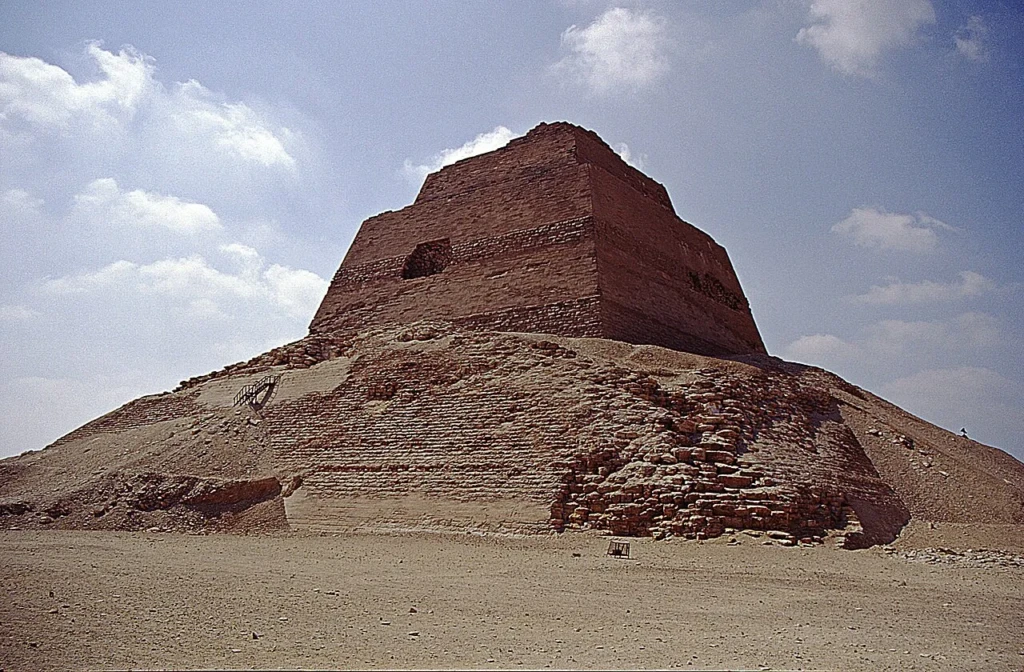
Rising from a desert mound about 72 km south of Cairo, the Meidum Pyramid looks like a stone tower rather than a pyramid. It was built by Sneferu, first king of the 4th Dynasty (c. 2613 to 2589 BC), as a step pyramid that was later converted into Egypt’s first attempt at a true, smooth-sided pyramid. Its outer casing has since fallen away, leaving the inner core standing above a skirt of rubble, which is why it is often called the “collapsed pyramid.”
Meidum is where the pyramid shape as most people picture it was first tried. If you have seen Djoser’s Step Pyramid at Saqqara and Sneferu’s later pyramids at Dahshur, this is the missing link between them. This guide covers its history, what you can see inside and out, official tickets and hours, and how to plan a visit from Cairo.
Meidum Pyramid Quick Facts
| Fact | Details |
|---|---|
| Location | Meidum, Beni Suef Governorate, about 72 km (45 miles) south of Cairo |
| Period | Old Kingdom, early 4th Dynasty (c. 2600 BC) |
| Built by | Sneferu (c. 2613 to 2589 BC); older theories credited Huni, his predecessor |
| Ancient name of the site | Djed Sneferu, “Sneferu Endures” |
| Final planned size | About 92 to 95 m high, with a base length of 144 m |
| Height today | About 65 m in its ruined state |
| Opening hours | Daily, 8:00 AM to 5:00 PM |
| Foreign ticket | EGP 150 adult, EGP 75 student |
| Time on site | Our planning suggestion: 1 to 1.5 hours, including the interior |
What Is the Meidum Pyramid?
The Meidum Pyramid is the first of the three great pyramids attributed to Sneferu. The other two, the Bent Pyramid and the Red Pyramid, stand at Dahshur. Together they show a single king and his builders working out, in stone, how to move from the stepped design of the 3rd Dynasty to the smooth-sided pyramid that his son Khufu would perfect at Giza.

Locals call it el-haram el-kaddab, “the false pyramid,” because of its odd shape. What you see today is a steep, three-stepped tower of pale limestone emerging from a huge mound of debris. That tower is most of the original core. The smooth outer layers that once turned it into a true pyramid have gone.
Sneferu or Huni?
For a long time, scholars believed the pyramid was begun by Huni, the last king of the 3rd Dynasty, and only finished by Sneferu. According to the Ministry of Tourism and Antiquities, that is no longer the consensus. Sneferu’s name appears in texts at Meidum, and the ancient name of the site, Djed Sneferu, means “Sneferu Endures.” Dates from his reign are also attested at the pyramid itself.
Three Building Phases
Egyptologists divide the construction into three stages, labeled E1, E2 and E3:
- E1: Sneferu began a seven-step pyramid that would have reached about 65 m.
- E2: Before it was finished, the plan was enlarged to an eight-step pyramid. Completed, it would have stood about 85 m high on a base of 120.75 m.
- E3: After building his two pyramids at Dahshur, Sneferu returned to Meidum and turned the stepped design into a true pyramid. Filling the steps and adding a smooth casing raised the planned height to between 92 and 95 m, with a base of 144 m.
The order matters. In the Ministry’s account, the conversion of Meidum into a true pyramid came after the Bent and Red Pyramids, not before. Meidum was both the first experiment and a late update.
Why Did the Meidum Pyramid Collapse?
This is the question most visitors arrive with, and the answer is still debated.

An older and well-known theory holds that the outer casing failed suddenly, possibly while the E3 phase was under construction. Supporters point to weak points in the design: the outer layer rested on sand rather than rock, and the earlier step surfaces were not built to carry a new skin. Some writers have linked such a failure to the shallower angle used for the upper part of the Bent Pyramid at Dahshur.
The Ministry of Tourism and Antiquities takes a different view. Its description notes that the debris around the base lies in layers, or strata. That pattern points to gradual erosion and stone removal over a long period, not one sudden collapse. A scribe who visited during the reign of Thutmose III, more than a thousand years after Sneferu, wrote that he had come “to see the marvellous temple of Horus Sneferu.” That suggests the monument still impressed visitors in the New Kingdom.
When you stand at the base, look at the rubble mound and the clean faces of the tower above it. Your guide can show you the different bands of masonry that mark the building phases.
What to See at Meidum
1. The Pyramid Exterior
Start by walking toward the pyramid from the north side so you can take in its full profile. The contrast between the smooth upper faces and the debris below is the clearest lesson in pyramid construction you will find in Egypt. Around the east side, early excavators found a small mortuary temple under the rubble at the base of the pyramid.
2. The Interior and the First Corbelled Ceiling
The entrance is on the north face, as usual for pyramids of this age. Unusually, it sits around 15 m above the ground, so expect a climb up to it before you start down. From there:
- A long, steep descending passage runs down through the masonry into the bedrock.
- It levels out into a horizontal corridor and passes two small niches.
- A vertical shaft then rises into the burial chamber.
The burial chamber is the highlight. Its roof is corbelled: each course of stone steps inward over the one below, spreading the enormous weight of the pyramid above. According to the Ministry, Meidum is the first place where corbelling was used for a stone ceiling. The same technique was later used on a grand scale in the Grand Gallery and burial chamber of the Great Pyramid of Khufu. Hidden corbelled relieving spaces above the niches and the lower passage were discovered only in 1998.
The passage is steep and enclosed. Skip it if you have heart, knee or back problems, or if you are uneasy in confined spaces; the exterior and the mastabas are rewarding on their own.
3. The Mastaba Tombs of Sneferu’s Family
The desert around the pyramid holds large mud-brick mastaba tombs built for members of the royal family. Two of them produced some of the most famous works of Old Kingdom art:
- Nefermaat and Itet: Nefermaat was Sneferu’s eldest son and a vizier. His mastaba used an unusual technique of deeply cut images filled with colored paste. Its painted frieze known as the “Meidum Geese,” discovered in 1871, was removed to Cairo and is catalogued in the Egyptian Museum’s collection.
- Rahotep and Nofret: Prince Rahotep, another son of Sneferu, was buried at Meidum with his wife Nofret. Their painted limestone statues, among the best-known portraits from ancient Egypt, are now in Cairo.
The original works are no longer at the site. Ask your guide which tombs are open on the day and where the Meidum pieces are currently displayed in Cairo at the time of your trip, as museum displays in Cairo change.
Opening Hours and Ticket Prices
As listed on the official Ministry of Tourism and Antiquities site in October 2026, the Pyramid of Meidum is open daily from 8:00 AM to 5:00 PM. Foreign visitors pay EGP 150 per adult and EGP 75 per student. Check the Ministry’s official Meidum page before you go, as prices are reviewed from time to time.
The listing does not show a separate interior ticket. Confirm at the ticket office whether the inside of the pyramid is open on the day of your visit.
How to Get There From Cairo
Meidum lies about 72 km south of Cairo, in Beni Suef Governorate. For most visitors the practical choice is a private car with a driver, usually as part of a guided day.
Driving time depends on traffic leaving Cairo, your starting point and the route your driver takes. Your driver or guide will confirm timing when you plan the day. Many travelers combine Meidum with Dahshur on the way, which turns a long drive into a full pyramid-focused day.
Before you go, read the current official travel advice for Egypt. The UK government’s FCDO travel advice for Egypt lists areas west of the Nile Valley where it advises against all but essential travel, with named exceptions. Check the latest wording against your planned route, read your own government’s advice as well, and travel with a licensed operator who knows the area.
Best Time to Visit
The site is exposed, with little shade around the pyramid or the mastabas. Arrive soon after the 8:00 AM opening, especially from May to September. The cooler months from October to April are the most comfortable time for the climb to the entrance and the walk around the site. Our best season to visit Egypt guide covers what to expect month by month.
Practical Tips
- Wear shoes with grip and comfortable clothes. The interior passage is steep and enclosed.
- Bring a small flashlight. It helps in the passages and for looking at the corbelling in the burial chamber.
- Carry water and snacks. Facilities at smaller sites can be limited, so come prepared.
- Plan a full day. With the drive from Cairo and a stop at Dahshur, this is not a half-day outing.
- Ask about photography. Camera rules at Egyptian sites can change, so check at the ticket office.
How to Combine Meidum With Other Pyramid Sites
Meidum makes most sense as one chapter in the story of the pyramid. Seeing the sites in historical order is the best way to understand it:
- Step Pyramid of Djoser at Saqqara, the first large stone pyramid, designed by Imhotep.
- Meidum, where Sneferu built a step pyramid and later converted it into a true pyramid.
- The Bent and Red Pyramids at Dahshur, where Sneferu’s builders changed the angle partway up one pyramid and then built a second with smooth, even sides.
- The Giza Pyramids, built by Sneferu’s son Khufu and his successors.
For more on the area between Cairo and Meidum, see our Saqqara visitor guide and our guide to Memphis at Mit Rahina.
Visit the Meidum Pyramid With Delta Tours Egypt
Delta Tours Egypt does not sell a set Meidum tour. We can arrange a private visit on request through our tailor-made tours, with a private car, driver and Egyptologist guide, and plan the day around Dahshur or other sites you want to include.
If you would like to start from an existing Cairo day tour and discuss adding Meidum, these are the closest matches:
- Giza, Saqqara and Dahshur Pyramids Day Tour, 1 day, from $105 per person
- Pyramids Day Tour, 1 day, from $55 per person
- Grand Egyptian Museum and Pyramids, 1 day, from $95 per person
You can also see our full range of private Cairo day tours.
Frequently Asked Questions
Who built the Meidum Pyramid?
The Ministry of Tourism and Antiquities attributes it to Sneferu, the first king of the 4th Dynasty. Older studies credited his predecessor Huni, but Sneferu’s name appears in texts at Meidum and the site was called “Sneferu Endures.”
Why is it called the collapsed pyramid?
Its smooth outer layers have fallen away, leaving a tall stepped core above a mound of rubble. Some scholars argue for a sudden collapse during construction. The Ministry points to layered debris that suggests gradual decay instead.
Can you go inside the Meidum Pyramid?
The interior route runs from an entrance about 15 m up the north face, down a steep passage and up a shaft into the corbelled burial chamber. Access can change, so confirm at the ticket office that it is open on the day you visit. Expect a physically demanding route.
How far is the Meidum Pyramid from Cairo?
It is about 72 km (45 miles) south of Cairo, in Beni Suef Governorate. Travel time depends on traffic and route, so your driver will confirm it when you plan the day.
How much is the Meidum Pyramid ticket?
The official Ministry listing in October 2026 shows EGP 150 for foreign adults and EGP 75 for foreign students. Hours are 8:00 AM to 5:00 PM daily. Check the official page before you travel.
Is the Meidum Pyramid worth the trip?
For travelers interested in how the pyramids developed, yes. It is the clearest example of a step pyramid turned into a true pyramid. If you only have one day for pyramids, Giza and Saqqara are the better first choice.
If you have already seen Giza and want to go deeper into the story of the pyramids, Meidum is the next step. Tell us your dates and the sites you have in mind, and we will plan a private route south of Cairo through our tailor-made Egypt tours.
Featured image: The Meidum Pyramid. Photo: Zezinho68 / Wikimedia Commons, CC BY-SA 4.0