Pyramid of Khafre: The Second Pyramid of Giza Explained
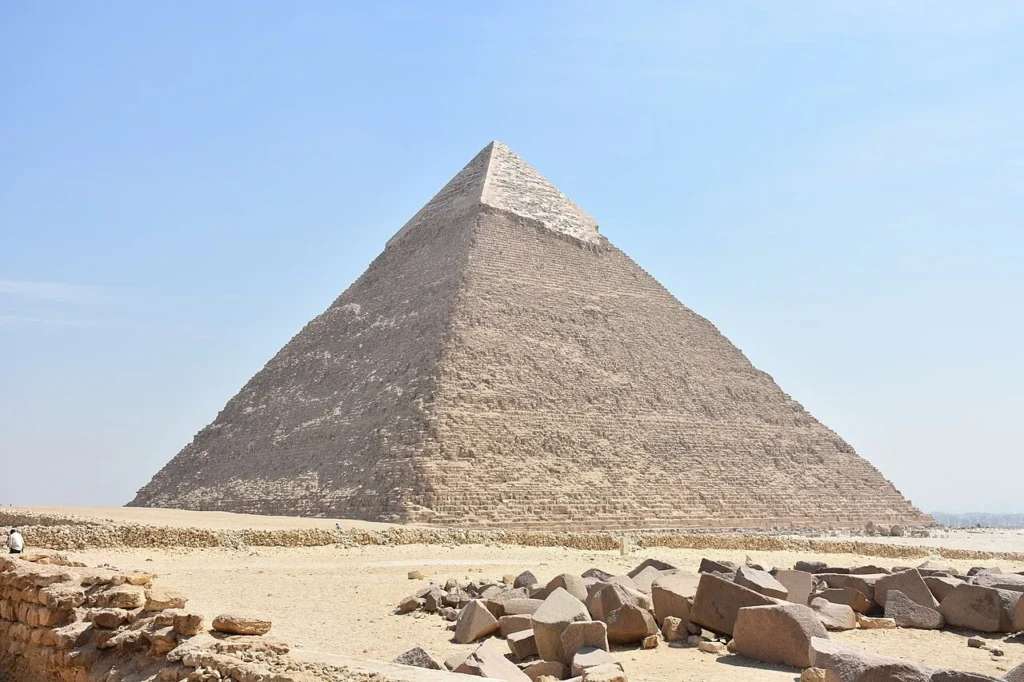
The Pyramid of Khafre is the second pyramid of Giza, built for King Khafre (c. 2558–2532 BC), the son of Khufu. It was originally 143.5 m (471 ft) tall, only slightly shorter than the Great Pyramid, but it stands on higher ground, so it often looks like the tallest of the three. It is also the only Giza pyramid that still keeps a cap of its smooth outer casing near the top.
This guide explains who built it, how it differs from its neighbors, what lies inside, what the official site says about hours and tickets, and how to fit it into a day on the Giza Plateau.
Pyramid of Khafre: Quick Facts
| Fact | Details |
|---|---|
| Location | Giza Plateau, between the Great Pyramid and the Pyramid of Menkaure |
| Period | Old Kingdom, 4th Dynasty; reign of Khafre, c. 2558–2532 BC |
| Built for | King Khafre (Khefren or Chephren to the Greeks), son of Khufu |
| Original height | 143.5 m (471 ft); about 136.4 m (448 ft) today |
| Base side | About 215.5 m (707 ft) |
| Casing | Fine Turah limestone, still visible near the summit |
| Time needed | About 1 hour for the outside and temples; add 30–45 minutes if you go inside (our planning suggestion) |
| Delta tour | Giza, Saqqara and Dahshur pyramids day tour, from $105 per person |
Who Built the Pyramid of Khafre?
Khafre ruled Egypt during the 4th Dynasty, the great age of pyramid building. The Ministry of Tourism and Antiquities dates his reign to about 2558–2532 BC. He was a son of Khufu, whose Great Pyramid already dominated the plateau.
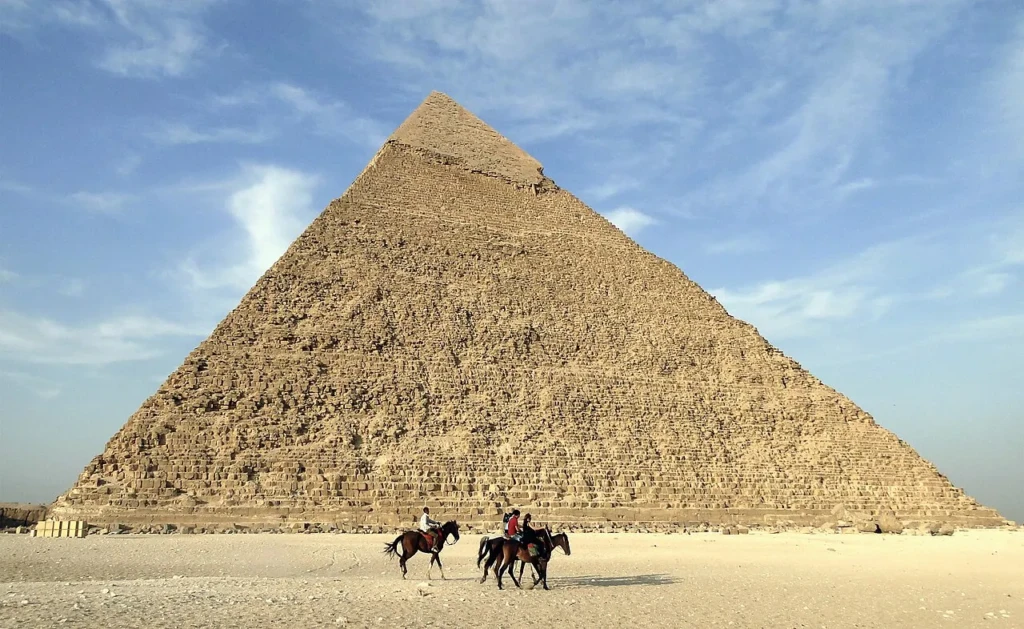
Khafre chose a site just southwest of his father’s tomb. The ground there sits about 10 m (33 ft) higher than the base of the Great Pyramid. Builders cut away bedrock at the northwest corner and built up the southeast corner to create a level platform. The result is a pyramid that is smaller than Khufu’s but appears just as tall from most angles.
The Greeks called him Khefren or Chephren. You will see all three spellings on signs, in books and in museum labels. They refer to the same king.
Why it matters
Khafre’s pyramid is not just “the second one.” His whole funerary complex set a new standard. According to the Ministry, his mortuary temple and valley temple were larger than any built for earlier pyramids and are among the best preserved from the Old Kingdom. The layout of his mortuary temple became the model later Old Kingdom kings followed.
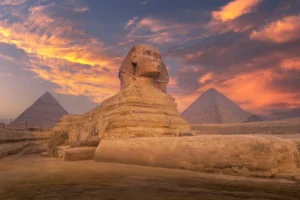
His complex is also the one linked to the Great Sphinx. The Ministry notes that the Sphinx stands beside Khafre’s valley temple and that its face shares features with his statues. If you remember one thing about Khafre, make it this: the pyramid, the causeway, the valley temple and the Sphinx were planned as one ensemble.
How Big Is the Pyramid of Khafre?
The pyramid originally rose to 143.5 m. The Great Pyramid was 146.5 m, so the difference was only 3 m (about 10 ft). Today Khafre’s pyramid stands at about 136.4 m because its very tip and part of the apex are missing.
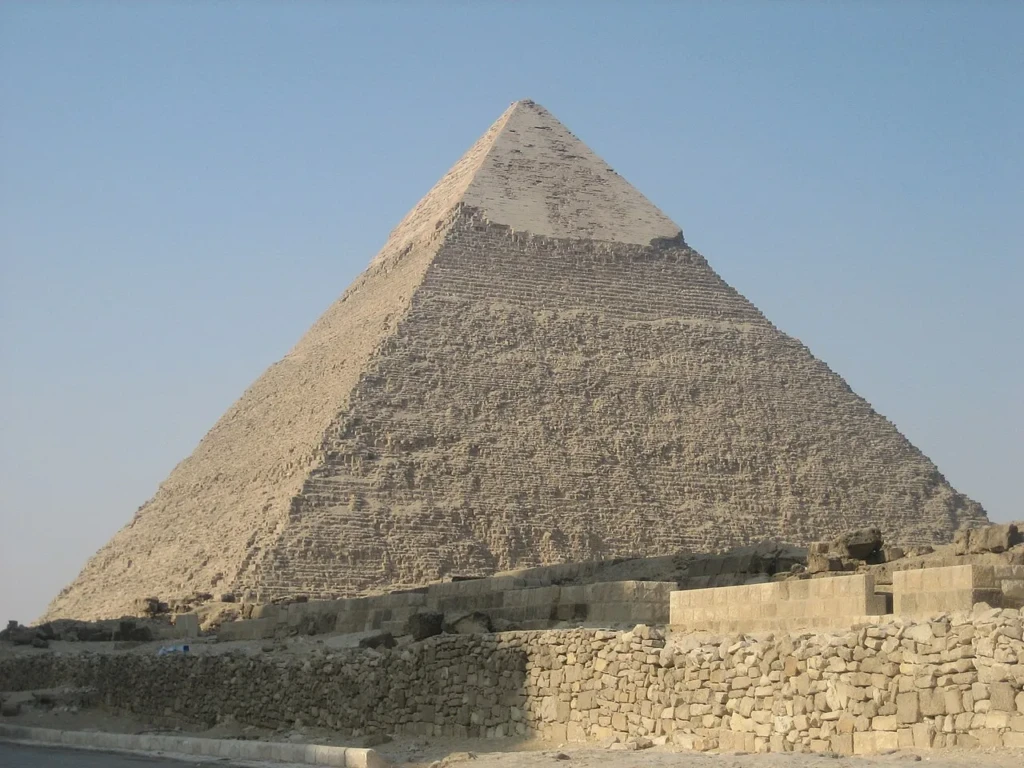
Its base sides measure about 215.5 m. Its faces rise at roughly 53 degrees, a little steeper than the Great Pyramid’s roughly 52 degrees. That steeper angle, combined with the higher ground, is why many visitors guess wrong about which pyramid is tallest.
The casing at the top
Look up at the summit and you will see a lighter, smoother band of stone. This is what remains of the original casing. The Ministry explains that the core is local limestone, while the outer skin was high-quality white limestone quarried at Turah, south of Maadi, and moved to Giza by boat. The lowest course of casing was granite.
Over the centuries, almost all of this polished stone was stripped from all three pyramids and reused. Khafre’s cap is the most visible stretch that survives. It gives you the best idea of how the pyramids once looked: smooth, bright and sharp-edged rather than stepped.
What Is Inside the Pyramid of Khafre?
The interior is simple compared with the Great Pyramid. There are no painted walls and no inscriptions to read. What you experience is the descent, the narrow passages and a large, plain burial chamber cut into the bedrock.
Two entrances on the north side
The pyramid has two entrances, both on the north face. One sits about 11.5 m (38 ft) up the face. The other opens at ground level in front of the pyramid. Both corridors lie slightly east of the pyramid’s center line.
The lower passage is cut entirely from bedrock. It descends, levels out, then climbs again to meet the upper route. A side chamber opens off it, and its purpose is still debated. Scholars have suggested storage for offerings or burial equipment. Why there are two entrances at all is also unresolved. One theory holds that the pyramid was first planned farther north; another holds that the design simply changed during construction.
The burial chamber
Both routes lead to a horizontal passage and then to the burial chamber. The room measures about 14 by 5 m (46 by 16 ft) and has a gabled roof of limestone beams. Khafre’s granite sarcophagus is sunk partly into the floor.
The Italian explorer Giovanni Belzoni reached this chamber on March 2, 1818. He hoped to find an untouched burial. Instead he found an open, empty sarcophagus with its lid broken on the floor. The tomb had been robbed long before. An Arabic graffito on the chamber wall, probably from a medieval opening of the pyramid recorded in 1372, shows Belzoni was not the first visitor in later times either.
Is going inside worth it?
It depends on what you want. Going inside gives you a physical sense of the scale and engineering, and the descent itself is memorable. It does not reveal art or treasure. The route follows narrow, sloping corridors, and the descent is physical. Skip it if you are uncomfortable in tight spaces, have knee or back problems, or dislike warm, still air.
The interior requires a separate ticket from the general site entry. The official Ministry site did not publish a price for the Khafre interior in October 2026, so confirm it at the ticket office or with your guide on the day.
Opening Hours and Ticket Prices
The following figures are as listed on the official Ministry of Tourism and Antiquities site in October 2026; check before you go.
| Item | Foreign adult | Foreign student |
|---|---|---|
| Giza Plateau area entry | EGP 700 | EGP 350 |
| Great Pyramid interior (area ticket also required) | EGP 1,000 | EGP 500 |
| Pyramid of Menkaure interior (area ticket also required) | EGP 280 | EGP 140 |
| Pyramid of Khafre interior | Separate ticket; no price published on the official site | |
The official Giza Plateau page states that the area ticket does not cover the Great Pyramid, the Pyramid of Khafre, the Pyramid of Menkaure, the Tomb of Meresankh III or the Workers’ Cemetery. Each of those needs its own ticket on top of area entry.
That same page lists the plateau as open daily from 8:00 AM to 4:00 PM. The individual pages for the Great Pyramid and the Pyramid of Menkaure list 7:00 AM to 5:00 PM. Because the official listings differ, plan to arrive by 8:00 AM and ask your guide or the ticket office to confirm closing time on your date.
What to See at the Khafre Complex, in Visiting Order
Most visitors approach Khafre’s pyramid by road from the Great Pyramid area. Here is a sensible order for seeing the whole complex, though your driver or guide will adapt it to the day’s traffic and crowds.
1. The north face and the entrances
Start on the north side, where the two entrances are. Even if you do not go in, stand back and compare the height of the upper entrance with the ground-level one. Notice how the lower courses of stone are rougher and more irregular than you might expect.
2. The bedrock cuttings on the west and northwest
Walk toward the northwest corner. Here you can see where the builders carved the bedrock away to level the base. It is a clear, practical lesson in how the plateau’s natural slope was handled.
3. The mortuary temple on the east side
Against the pyramid’s east face lie the remains of the mortuary temple, where priests kept the king’s cult alive. It is largely ruined, but the huge limestone blocks give a sense of the original scale. This temple introduced the standard plan that later Old Kingdom kings repeated.
4. The causeway
From the mortuary temple, a causeway of nearly half a kilometer runs downhill to the east. It once linked the pyramid to the valley temple near the river’s edge. Following its line helps you understand that the pyramid was the end point of a ritual route, not a standalone building.
5. The valley temple and the Sphinx
At the bottom of the causeway stands Khafre’s valley temple, built of massive limestone blocks faced with granite. Right beside it is the Great Sphinx. The Ministry notes that the valley temple was finished before work on the Sphinx began. For more on the Sphinx itself, read our Great Sphinx of Giza guide.
The Famous Statue of Khafre
The niches of Khafre’s valley temple once held statues of the king. The finest of them shows Khafre seated on a throne, with the falcon god Horus perched behind his head and wrapping its wings around it in protection. The sides of the throne carry the symbol for the union of Upper and Lower Egypt.
The Ministry describes this statue as one of the masterpieces of ancient Egyptian art. Its official collection listing places it in the Egyptian Museum. If you want to see the king’s face before or after visiting his pyramid, include the museum in your plans. Our Egyptian Museum Cairo (Tahrir) guide covers how to plan that visit.
How to Get to the Pyramid of Khafre
The pyramid is part of the Giza Plateau on the western edge of Greater Cairo. There is no separate entrance for Khafre. You enter the plateau through one of the main gates, buy your area ticket and any interior tickets, then move between the monuments.
Driving times from central Cairo depend heavily on traffic and the time of day. Your driver or guide will confirm timing on the day.
The plateau is large. Distances between the three pyramids are longer than they look in photos, and there is little shade. A car between the main viewpoints saves energy for the parts you actually want to walk.
Best Time to Visit
Arrive as close to opening as you can. The light is softer, the stone is cooler and the site is calmer before large tour groups arrive. Early starts matter most from late spring through early fall, when Giza can be very hot by midday.
The cooler months are the most comfortable for walking around the pyramids. Our month-by-month guide to the best time to visit Egypt explains how weather and crowds change through the year.
Practical tips
- Check current payment options for tickets with your guide before you arrive.
- Wear closed shoes with good grip. The ground around the pyramids is uneven, sandy and rocky.
- Carry water, sun protection and a hat. Shade is scarce away from the entrance areas.
- If you plan to go inside, leave bulky bags with your driver. The passages are narrow.
How to Combine Khafre’s Pyramid With Nearby Sites
Khafre’s pyramid is best seen as one stop in a full Giza visit. A typical half day covers the Great Pyramid, Khafre’s pyramid, the Pyramid of Menkaure, a panoramic viewpoint and the Sphinx. Our Giza Pyramids Complex guide gives the full map and overview.
If you have a full day, add the older pyramid fields to the south. Saqqara has the Step Pyramid of Djoser, and Dahshur has the Bent and Red Pyramids. Seeing them helps you understand how pyramid design developed before Khafre’s time. Start with our Saqqara visitor guide.
Another natural pairing is the plateau with the Grand Egyptian Museum, which is also in Giza. One of the tours below combines the two in a single day.
Visit With Delta Tours Egypt
Our Giza, Saqqara and Dahshur pyramids day tour (from $105 per person) lets you see Khafre’s pyramid alongside the earlier pyramids that led up to it. If you only have a few hours, the private Giza pyramids tour with guide and car starts from $55 per person. To pair the plateau with the museum, see the Grand Egyptian Museum and pyramids tour, from $95 per person. For an evening view of the same monuments, there is the Pyramids Sound and Light Show, from $53 per person. If you want several days in Cairo, the Taste of Egypt 4-day Cairo tour starts from $535 per person.
Frequently Asked Questions
Is the Pyramid of Khafre taller than the Great Pyramid?
No. Khafre’s pyramid was originally 143.5 m tall, about 3 m shorter than the Great Pyramid’s 146.5 m. It looks taller because it stands on ground about 10 m higher and still has its pointed casing near the top.
Why does the Pyramid of Khafre still have casing at the top?
Nearly all the fine limestone casing on the Giza pyramids was stripped away and reused over the centuries. A section near Khafre’s summit survived. It is the clearest surviving example of original casing high on a Giza pyramid.
Can you go inside the Pyramid of Khafre?
Interior access needs a separate ticket in addition to Giza area entry, according to the official Giza Plateau listing. The official site did not publish the price in October 2026. Ask your guide or the ticket office to confirm whether the interior is open and what it costs on your date.
What is inside the Pyramid of Khafre?
Two passages lead from the north face to a large burial chamber cut into the bedrock. The chamber holds Khafre’s empty granite sarcophagus, sunk partly into the floor. There are no wall paintings or inscriptions from the king’s time.
Is the Sphinx part of Khafre’s complex?
Most evidence points that way. The Ministry of Tourism and Antiquities says the Sphinx was most likely carved during Khafre’s reign, sits beside his valley temple and shares facial features with his statues. The valley temple was finished before the Sphinx was carved.
How long should I spend at the Pyramid of Khafre?
Our planning suggestion is about an hour for the outside, the mortuary temple and the causeway, plus 30 to 45 minutes if you go inside. Most travelers see it as part of a half-day or full-day Giza visit.
Khafre’s pyramid makes the most sense when you see it as part of the full complex, from the summit casing down to the valley temple and the Sphinx. To plan your Giza day with a private guide and driver, explore our private Cairo day tours, and we will shape the visit around your interests.
Featured image: Pyramid of Khafre at Giza. Photo: MusikAnimal / Wikimedia Commons, CC BY-SA 3.0