Abu Simbel Sun Festival: Dates, Tickets and How to Attend
The Abu Simbel Sun Festival happens twice a year, on 22 February and 22 October. At sunrise on those mornings, light travels the full length of Ramesses II’s Great Temple and falls on three of the four statues in the sanctuary. The fourth, Ptah, stays in shadow. To attend, you need a special-date ticket, an early start from Aswan or a night in Abu Simbel, and patience with large crowds.
The next festival mornings are Thursday, 22 October 2026, and Monday, 22 February 2027. Below we explain what actually happens inside the temple, what the official ticket costs on those days, and how to plan your trip so you are at the gate before dawn.
Abu Simbel Sun Festival: Key Facts
| Fact | Details |
|---|---|
| Dates | 22 February and 22 October each year |
| Next dates | Thursday, 22 October 2026; Monday, 22 February 2027 |
| Where | Great Temple of Ramesses II, Abu Simbel, on the west bank of Lake Nasser, Aswan Governorate |
| Built by | Ramesses II, 19th Dynasty, around 1264 BC |
| What happens | Sunrise light reaches the sanctuary and lights the statues of Ramesses II, Amun-Re and Ra-Horakhty |
| Festival-day ticket (foreign adult) | EGP 1,200 (student EGP 600) |
| Distance from Aswan | About 230 km in a straight line; about 300 km by road |
| Time needed | Our planning suggestion: a full day from Aswan, or one night in Abu Simbel |
What Happens During the Sun Festival
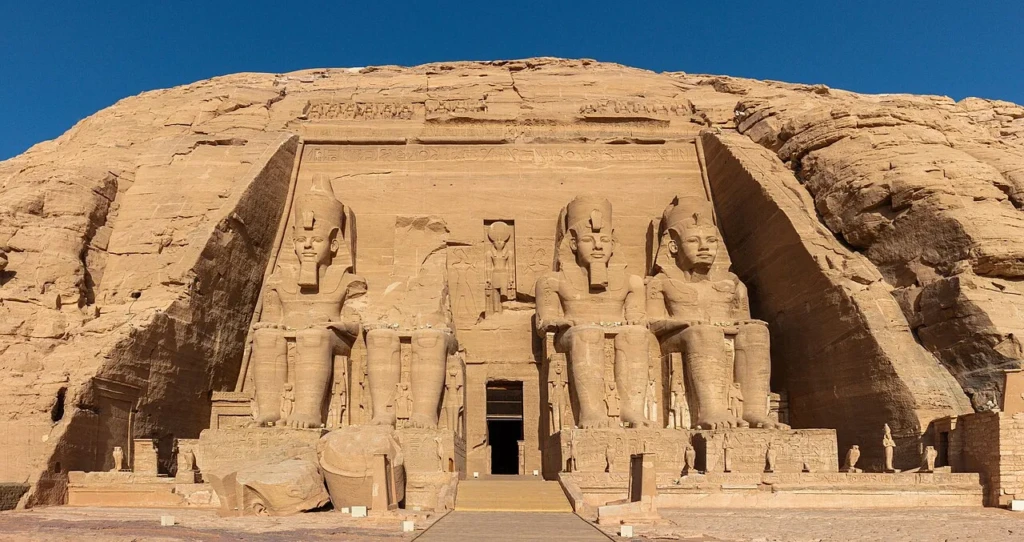
The Great Temple is cut straight into a sandstone cliff. Its entrance faces east, toward the sunrise over the water. Behind the four seated colossi of Ramesses II, a single axis runs through two pillared halls and a vestibule to a small sanctuary deep inside the rock.
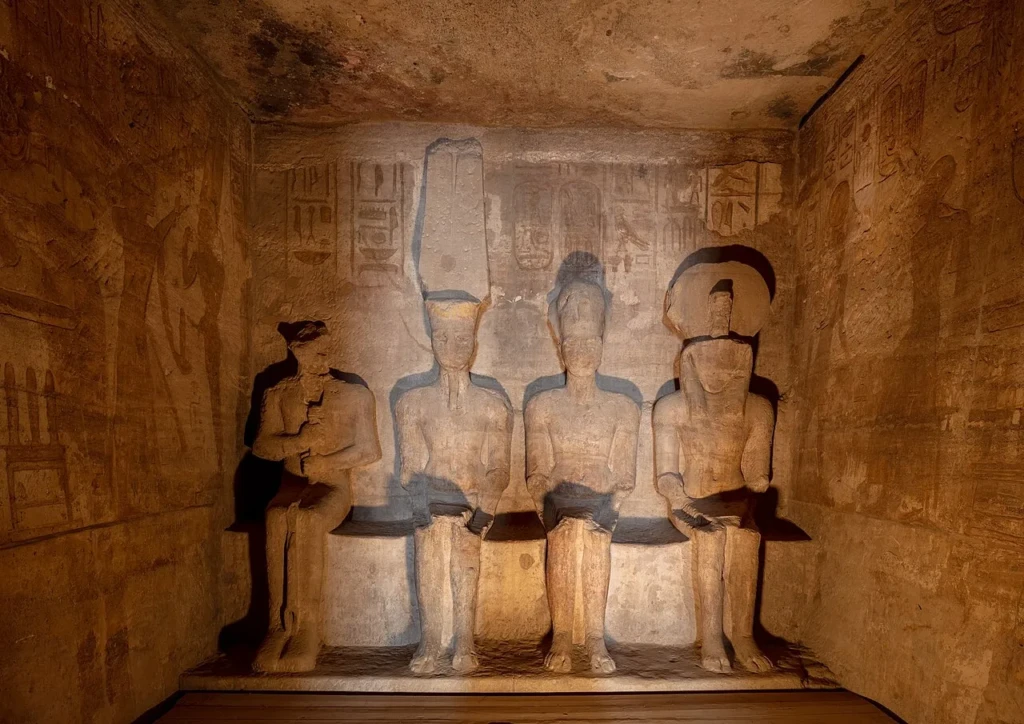
Four seated statues sit against the sanctuary’s back wall. They are Amun-Re, Ra-Horakhty, Ptah and Ramesses II himself, shown as a god. On most days, morning sunlight stops well short of them. On the two festival mornings, the Ministry of Tourism and Antiquities explains, the rays cross the main hall and reach the innermost statues.
The light falls on Ramesses, Amun-Re and Ra-Horakhty. Ptah, a god connected with the underworld, stays in darkness. That contrast of lit and unlit gods is the moment the crowd waits for.
Why 22 February and 22 October?
You will often hear that the dates mark Ramesses II’s birthday and his coronation. There is no direct evidence for that. It is a popular story, not an established fact. What we can say is that the temple axis was set to catch the rising sun on two days in the year, and that these dates likely had religious meaning for its builders.
Two other points matter. First, the sun’s position on a given calendar date shifts very slowly over thousands of years. So the original alignment would have fallen on slightly different dates in Ramesses’s time. Second, the temple you visit is not in its original spot, which brings us to the 1960s.
How the Alignment Survived the Temple’s Move
The building of the Aswan High Dam would have drowned Abu Simbel under the new Lake Nasser. Between 1964 and 1968, an international campaign led by UNESCO cut both temples into more than 1,000 blocks. Teams then rebuilt them on higher ground, about 65 meters above and more than 200 meters back from the original site.

The engineers took the solar alignment seriously. They oriented the reconstructed Great Temple to keep the twice-yearly event, with a permitted error of only a few millimeters. On the morning of 22 February 1966, members of the team gathered at sunrise to check that the light still reached the statues of Ramesses, Amun and Ra-Horakhty, and not Ptah. They repeated the check on 22 October. The complex joined UNESCO’s World Heritage List in 1979.
For the temple’s wider history, the Small Temple of Nefertari, and the rescue campaign, read our full Abu Simbel Temples guide.
Sun Festival Tickets and Opening Hours
Abu Simbel charges a higher ticket price on the two alignment days. The prices below are as listed on the official Ministry of Tourism and Antiquities site in October 2026; check before you go.
| Ticket (foreign visitors) | Adult | Student |
|---|---|---|
| Regular day | EGP 750 | EGP 375 |
| 22 February and 22 October | EGP 1,200 | EGP 600 |
The official site lists regular daily hours of 6:00 to 5:00. It does not publish special gate times for the festival mornings. Because the event is at sunrise, plan to be at the site well before dawn. Your guide will confirm the gate time for that year. The official listing also shows a vehicle entry fee for cars and buses.
How to Attend: Your Three Options
Option 1: By road from Aswan, leaving at night
This is the most common approach. Abu Simbel is about 300 km from Aswan by road. To reach the temple before sunrise, you leave Aswan in the middle of the night. Your driver or guide will confirm the departure time, which depends on the year’s arrangements. Bring a warm layer, since desert nights can feel cool.
Option 2: Fly from Aswan
Abu Simbel has its own small airport about 2 km from the town, with flights from Aswan. Flying saves the long drive in each direction. Check whether a scheduled flight reaches Abu Simbel early enough for sunrise on your date. If not, a flight is still a good way to return to Aswan after the event.
Option 3: Stay the night in Abu Simbel
Sleeping in Abu Simbel village the night before puts you close to the temple gate. You avoid the overnight drive and can be among the first in line. Book early for festival dates, when demand is high.
What to Expect on the Day
The festival draws large numbers of Egyptian and foreign visitors. On one past alignment morning, the Ministry reported 6,500 visitors. Expect queues to enter the temple. Space near the sanctuary is limited, so not everyone sees the light on the statues at its best.
The atmosphere outside is part of the experience. In past years, the Ministry has paired the celebrations with the Abu Simbel sound and light show. Program details are not published in advance on the official site, so treat any extras as a bonus rather than a promise.
Tips for a better festival morning
- Arrive as early as you can. Your place in the line decides how close you get to the sanctuary.
- Bring a flashlight or use your phone light for the walk in the dark.
- Pack water, a snack and a warm layer. You may wait a long time before sunrise.
- Keep your camera ready but put it down for a moment. The light changes quickly.
- Once the alignment is over, stay to see the Great Temple’s halls and Nefertari’s temple at a slower pace.
Is it worth going on the festival day?
Go on the festival day if seeing the alignment itself is the point of your trip and you accept crowds, early hours and a higher ticket. If your main goal is to see the temples in peace, pick a regular day. You will see every carving, and the morning light on the facade is still striking.
Safety and Travel Advice
Abu Simbel lies in southern Egypt, near the Sudan border. The UK Foreign, Commonwealth and Development Office (FCDO) advises against all but essential travel to much of the area west of the Nile Valley. It explicitly lists Aswan and Abu Simbel among the exceptions to that advice. Check the current FCDO travel advice for Egypt before you book, and our guide to whether it is safe to travel to Egypt right now.
Combining the Sun Festival With Aswan
Most visitors base themselves in Aswan for the festival. Plan at least one more day there. You can visit Philae Temple by boat, sail by felucca, and spend an afternoon in a Nubian village. Our Aswan travel guide lists the best options.
The October festival also fits neatly into a Nile cruise. Many cruises begin or end in Aswan, so you can add Abu Simbel before or after sailing. Our day-by-day Luxor to Aswan Nile cruise guide shows how the river days work. For weather in late October and February, see our best time to visit Egypt guide.
Visit With Delta Tours Egypt
Our Abu Simbel tours page compares every way to reach the temples. For a day trip, choose Abu Simbel by private car from Aswan, from $120 per person, or Abu Simbel by flight from Aswan, from $360 per person. If you want a festival morning, tell us when you book and we will plan your Abu Simbel day for 22 February or 22 October.
Prefer a full trip? The 5-day Cairo, Luxor and Abu Simbel tour starts from $1,030 per person. The Jewels of Egypt 6-day luxury journey starts from $1,075 per person. For more time on the river, the Sun Ray 10-day tour with Nile cruise and Abu Simbel starts from $3,060 per person.
Frequently Asked Questions
When is the Abu Simbel Sun Festival?
It takes place every year on 22 February and 22 October, at sunrise. The next dates are Thursday, 22 October 2026, and Monday, 22 February 2027.
How much is the Abu Simbel ticket on Sun Festival days?
The official site lists EGP 1,200 for foreign adults and EGP 600 for students on 22 February and 22 October. On other days the foreign adult ticket is EGP 750.
Which statues does the sun light up?
The rays light the statues of Ramesses II, Amun-Re and Ra-Horakhty. The statue of Ptah, a god linked to the underworld, stays in the dark.
Is it true the dates mark Ramesses II’s birthday and coronation?
That is a popular claim, but there is no direct evidence for it. The dates were clearly important to the builders, but their exact meaning is unknown.
Did moving the temple change the solar alignment?
Engineers in the 1960s oriented the rebuilt temple to keep the event, and checked it at sunrise on 22 February 1966. The alignment may be less precise than in Ramesses’s day, but it still works.
Can I see the alignment on a day trip from Aswan?
Yes. Most visitors leave Aswan by road in the middle of the night to arrive before sunrise. Staying overnight in Abu Simbel is a calmer alternative.
The Sun Festival is a rare chance to see an ancient temple work as its builders intended. Start with our Abu Simbel tours, and we will help you get to the gate before the sun does.
Featured image: Great Temple of Ramses II at Abu Simbel. Photo: Diego Delso / Wikimedia Commons, CC BY-SA 4.0