Elephantine Island: Temples, Nilometer and Nubian Villages
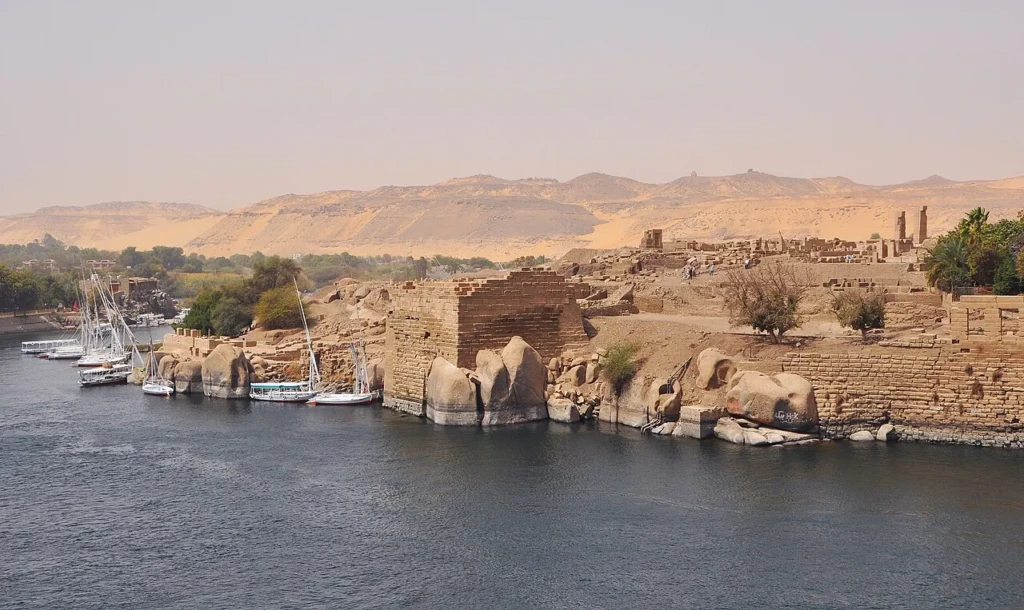
Elephantine Island sits in the Nile at Aswan, just below the First Cataract, and was ancient Egypt’s southern gateway to Nubia for thousands of years. Its southern end is an open-air archaeological site with the ruins of the temples of Khnum and Satet, one of Egypt’s oldest Nilometers and a small museum, while Nubian villages fill the middle of the island. Plan on one and a half to two hours for the ruins.
This guide explains why the island mattered, what to see in a sensible order, the official opening hours and ticket prices, and how to combine Elephantine with the rest of Aswan.
Elephantine Island: Quick Facts
| Fact | Details |
|---|---|
| Location | In the Nile at Aswan, just downstream of the First Cataract |
| Period | Settled before 3000 BC; temples rebuilt again and again until the Ptolemaic and Roman periods |
| Dedicated to | Khnum, the ram-headed god of the cataract, and Satet, goddess of the annual flood; Anuket completed the local triad |
| Ancient name | Abu (Yebu), meaning “elephant” |
| World Heritage status | Inscribed by UNESCO in 1979, according to the Ministry of Tourism and Antiquities |
| Opening hours | 8:00 AM to 4:00 PM daily |
| Foreigner ticket | EGP 200 adult, EGP 100 student |
| Time needed | Our planning suggestion: 1.5 to 2 hours for the archaeological site and museum |
Hours and prices are as listed on the official Ministry of Tourism and Antiquities site in October 2026; check before you go.
Why Was Elephantine So Important?
For most of ancient history, Egypt ended here. South of the island, granite rapids made the river hard to sail. Boats from Nubia unloaded their cargo at Elephantine, and goods continued north on Egyptian vessels. The Ministry calls the island the gateway into Egypt for all traders coming from Nubia.
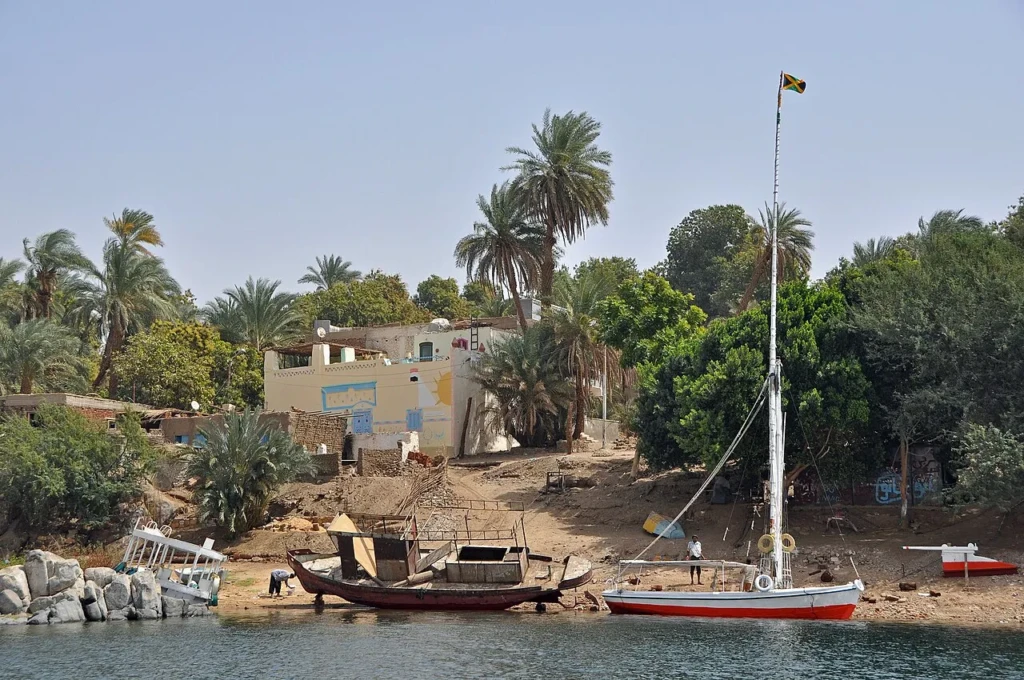
That made Elephantine a frontier town, a customs post and a garrison all at once. A fort stood here by around 3000 BC, in the First Dynasty, although people lived on the island even earlier. Ivory was one of the goods delivered here, and the island’s ancient name, Abu, means “elephant.” The name may describe the island’s shape, which from above resembles an elephant tusk, or the rounded gray boulders along its banks.
The island was also a source of stone. Aswan granite was quarried in the area and shipped north for temples and monuments across Egypt. The Ministry has identified an ancient loading quay on Elephantine, known today as El-Ahly Quay, as one of the main points where heavy stones were put onto boats.
The gods of the flood
Egyptians believed the Nile flood began near Elephantine. Khnum, a ram-headed creator god, was said to control the river’s water from caves beneath the island and to shape human bodies on a potter’s wheel. Satet guarded Egypt’s southern border and personified the yearly flood. Anuket, goddess of the First Cataract, completed the trio worshipped here.
A Jewish community on the frontier
One of the island’s surprises has nothing to do with pharaohs. Aramaic papyri found here record a community of Judean soldiers and their families, present from the 7th century BC, who helped guard the frontier with Nubia. They had their own temple to Yahweh, first mentioned in 525 BC. In 410 BC a Persian commander had it burned, and the community wrote letters asking for help to rebuild it.
These Elephantine papyri were found between 1893 and 1910. Most are now in museums abroad, with the largest group in Berlin.
What to See on Elephantine Island
The archaeological zone is at the southern end of the island. It is a site of foundations, column drums and rebuilt walls rather than a single standing temple, so a guide makes a real difference here. The order below follows a natural loop.
1. The museum
Start at the small museum at the southern end of the island. The Ministry highlights it as a must-see, with objects found by the German archaeological mission that works on the island. Seeing the finds first makes the ruins outside much easier to understand.
Animal cults were part of life here. A gilded ram mummy dedicated to Khnum on Elephantine is now in the Mummification Museum in Luxor, so if you visit both cities, look out for it there.
2. The Temple of Satet
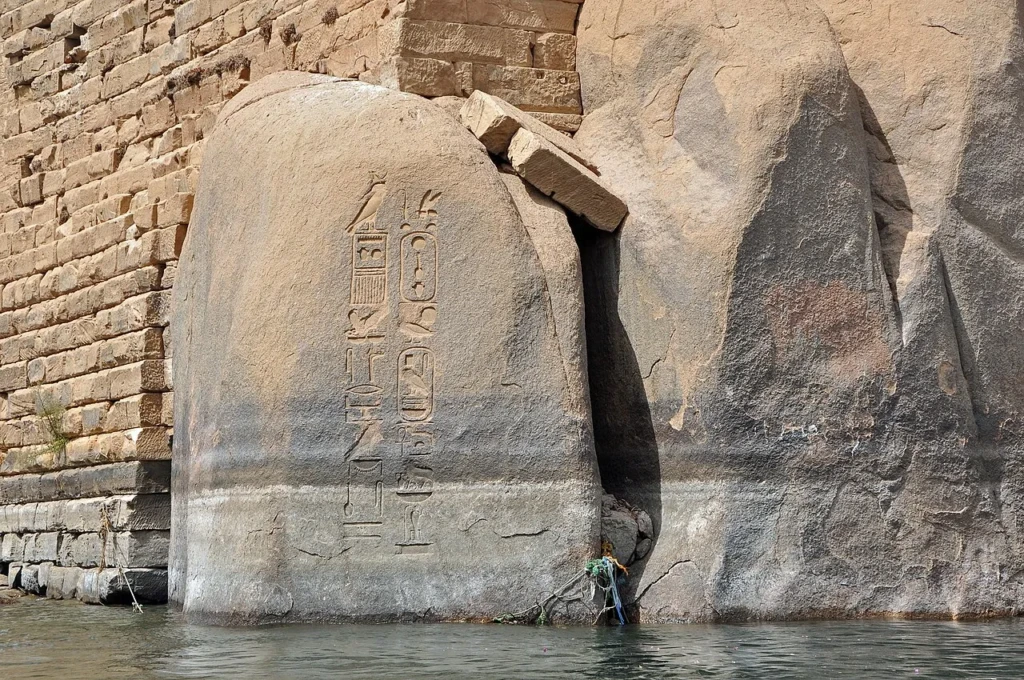
The Temple of Satet is the island’s most remarkable ruin for its long history. It began around 3200 BC as a tiny mud-brick shrine wedged between three natural granite boulders. Over the next 3,000 years it was enlarged and rebuilt many times, by kings including Pepi I, Mentuhotep II, Senusret I, Hatshepsut and Thutmose III, and finally Ptolemy VI and Ptolemy VIII.
For most of that time, each new sanctuary was built directly over the old one. That makes the site one of the best examples in Egypt of a temple whose construction can be traced across the whole pharaonic period. Look at the layers of building in the ground and the remains of the New Kingdom temple, a solid rectangular building that was once surrounded by a pillared walkway.
3. The Satet Nilometer
Close to the Temple of Satet is the island’s best-preserved Nilometer, a stone stairway leading down to the river. Priests used Nilometers to measure the height of the flood, which helped predict the harvest and set taxes for the year.
This one is among the oldest in Egypt. It was last rebuilt in Roman times and was still in use in the 19th century. Its 90 steps carry level markings in Arabic, Roman and hieroglyphic numerals, a neat summary of the island’s long history in one staircase.
4. The Temple of Khnum
At the southern tip of the island stand the ruins of the Temple of Khnum, the island’s oldest standing remains. A temple to Khnum is recorded here as early as the Third Dynasty, and it was completely rebuilt in the Thirtieth Dynasty, the last native Egyptian dynasty. Close by is a small granite step pyramid dating from the Third Dynasty.
Near the temple is a second, rectangular Nilometer basin, facing the Old Cataract Hotel across the water. It is probably older than the Satet Nilometer.
5. The shrine of Heqaib
Heqaib was a local governor of the Sixth Dynasty who was later worshipped as a saint. His shrine was a place where Middle Kingdom officials set up statues and small chapels in his honor. Several royal statues once in the Temple of Satet were also found in this sanctuary.
What is gone
Elephantine once had two New Kingdom temples built by Thutmose III and Amenhotep III. They were pulled down in 1822, during Muhammad Ali’s campaign in Sudan. It is a reminder that some of the losses at Egypt’s sites are recent.
The Nubian Villages on Elephantine
The middle of the island is not a museum. It is home to a sizable Nubian community living in three villages. A large hotel occupies the northern end of the island.
Walking through the villages is a pleasant contrast with the ruins. Remember that these are private homes and working neighborhoods. Dress modestly, ask before photographing people, and follow the lead of your guide on where to walk. If you would like a fuller visit to a Nubian home, our Nubian village guide explains the options on Aswan’s West Bank.
Opening Hours and Ticket Prices
As listed on the official Ministry of Tourism and Antiquities site in October 2026, the Elephantine archaeological site is open daily from 8:00 AM to 4:00 PM. Check before you go.
| Ticket type | Price (October 2026) |
|---|---|
| Foreign adult | EGP 200 |
| Foreign student (with valid student card) | EGP 100 |
You can confirm current details on the official Elephantine page of the Ministry of Tourism and Antiquities. The Nubian villages themselves are residential areas and are not part of the ticketed site.
How to Get to Elephantine Island
Elephantine lies in the Nile beside central Aswan, so every visit starts with a short boat crossing from the East Bank. Many travelers combine the crossing with a sail around the island’s granite rocks. Your guide will arrange the boat and confirm timing on the day, since crossings depend on where you are staying and how busy the river is.
Once on the island, the archaeological zone and the villages are covered on foot. Paths in the ruins are uneven, with steps down to the Nilometers, so wear shoes with good grip.
Best Time to Visit
Aswan gets very hot in summer. In those months, visit as soon as the site opens and finish before late morning. From around October to April, the weather is much milder and mornings or mid-afternoon both work well.
Late afternoon is the classic time for a sail around the island, after the site has closed. For month-by-month weather, see our best time to visit Egypt guide.
Practical Tips
- Bring sun protection and water. There is little shade among the ruins at the southern tip.
- Use a guide or read up first. The ruins are low and layered, and the history is hard to read without context.
- Be respectful in the villages. Keep voices low, cover shoulders and knees, and ask before taking photos of residents.
- Carry small cash. Boat crossings and small purchases on the island are usually easier with Egyptian pounds.
See what to pack and wear in Egypt for more advice.
How to Combine Elephantine with Nearby Sites
Elephantine fits easily into a half day in Aswan. Directly across the river, the cliffs of Qubbat al-Hawa hold the tombs of local governors and officials from the Old and Middle Kingdoms. The Ministry lists them as open 7:00 AM to 4:00 PM daily, with foreign adult tickets at EGP 200 and students at EGP 100, as of October 2026; check before you go.
- Philae Temple, the island temple of Isis south of the city.
- Abu Simbel Temples, the great day trip from Aswan.
- Kom Ombo Temple, usually seen on a Nile cruise between Aswan and Luxor.
- The Old Cataract Hotel, which faces the southern tip of Elephantine across the river.
Our Aswan travel guide brings these together with ideas on where to stay and eat. If you are arriving by river, the Nile cruise Luxor to Aswan guide shows where Aswan falls in a typical itinerary.
Visit with Delta Tours Egypt
We do not currently publish a set tour of Elephantine Island. We can arrange a private visit on request, with an Egyptologist guide, the boat crossing and time in the Nubian villages, built around your Aswan schedule. Start planning on our tailor-made Egypt tours page.
These published Aswan tours combine well with an Elephantine visit: the Aswan Day Tour to Philae Temple, from $85 per person; the Nubian Village Tour from Aswan by Boat, from $50 per person; the Philae Temple Sound and Light Show, from $60 per person; and Abu Simbel by Car, from $120 per person. You will find more on our private Aswan day tours page.
Frequently Asked Questions
Is Elephantine Island worth visiting?
Yes, if you want to understand why Aswan mattered in ancient times. The ruins are modest in height, but they cover more than 3,000 years of history, and the Nubian villages add a living side to the visit.
How much is the Elephantine Island ticket?
As listed on the official Ministry of Tourism and Antiquities site in October 2026, the archaeological site costs EGP 200 for foreign adults and EGP 100 for foreign students. Check the official page before you go.
Why is it called Elephantine Island?
Its ancient Egyptian name, Abu, means “elephant,” and the Greeks translated it as Elephantine. The name may come from the island’s tusk-like shape or from the rounded gray boulders along its shore.
What is the Nilometer on Elephantine Island?
It is a stone stairway leading down to the Nile, used to measure the height of the annual flood. The Satet Nilometer has 90 steps with markings in Arabic, Roman and hieroglyphic numerals and was used into the 19th century.
How long do you need on Elephantine Island?
Our planning suggestion is one and a half to two hours for the ruins and museum. Add another hour if you want to walk through the Nubian villages.
Can I visit Elephantine Island on a Nile cruise?
Many cruises start or end in Aswan, so a visit fits well into free time there. Check your cruise program, and if it is not included, a private visit can be added on request.
Elephantine is where Egypt once began, and an hour or two on the island makes the rest of Aswan easier to understand. Share your travel dates on our tailor-made tours page, and we will build the island into your Aswan days.
Featured image: Elephantine Island ruins seen across the Nile. Photo: Marc Ryckaert (MJJR) / Wikimedia Commons, CC BY 3.0