Abydos Temple: Seti I, the King List & Osireion Guide
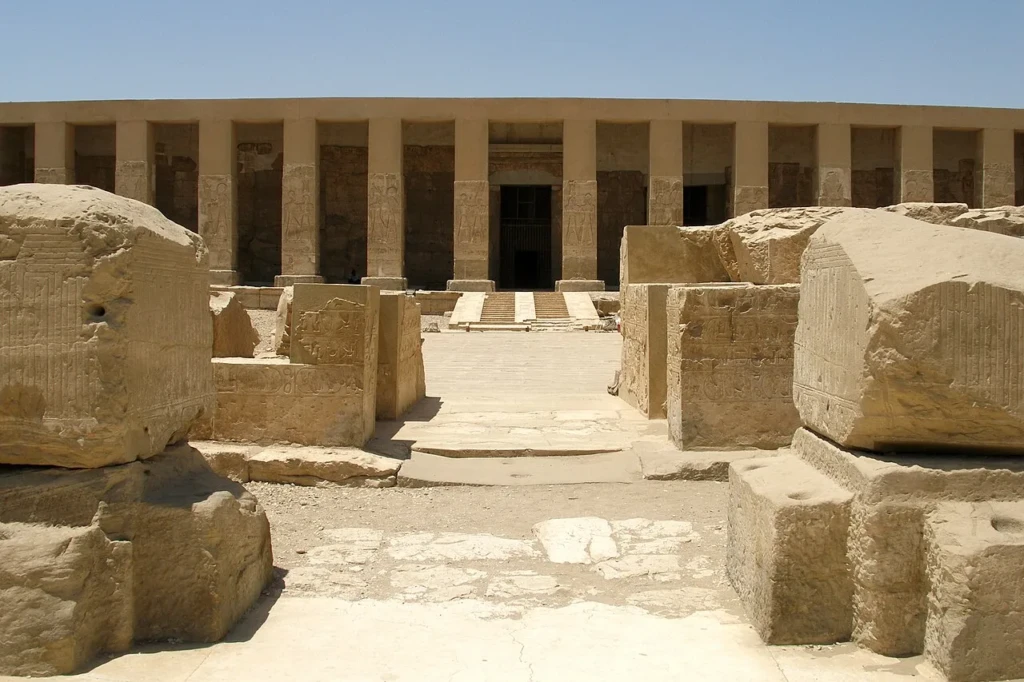
The Abydos temple is the Temple of Seti I at Abydos, in Sohag Governorate, Upper Egypt, built in the 13th century BC and finished by Ramesses II. It is famous for some of the finest painted reliefs in Egypt, the Abydos King List, and the Osireion, a sunken stone structure linked to the god Osiris. Most travelers visit on a long day trip from Luxor, usually combined with the Temple of Hathor at Dendera.
This guide explains why Abydos was sacred, what you will see inside the temple in the order you meet it, and the practical details: official hours and ticket price, travel time from Luxor, and how to plan the day.
Abydos Temple at a Glance
| Fact | Details |
|---|---|
| Location | Abydos, near El Balyana, Sohag Governorate, about 11 km west of the Nile |
| Period | New Kingdom, 19th Dynasty (13th century BC) |
| Built by | Seti I; completed and decorated in part by his son Ramesses II |
| Dedicated to | Osiris and the major gods of Egypt, the deified Seti I and the royal ancestors |
| Distance from Luxor | About 76 miles (roughly 120 km) by road; route planners estimate about 3 hours each way |
| Opening hours | Daily, 7:00 AM to 5:00 PM (official listing, October 2026) |
| Foreign adult ticket | EGP 260 (student EGP 130) |
| Time on site | Our planning suggestion: 1.5 to 2 hours |
What Is Abydos, and Why Does It Matter?
Abydos is one of the oldest sacred places in Egypt. Its ancient name was Abedju. Long before the pyramids, the early kings of Egypt were buried in the desert here, at a royal cemetery now called Umm el-Qa’ab. Rulers of the First Dynasty, including Narmer and Aha, were laid to rest at Abydos around 3000 BC.
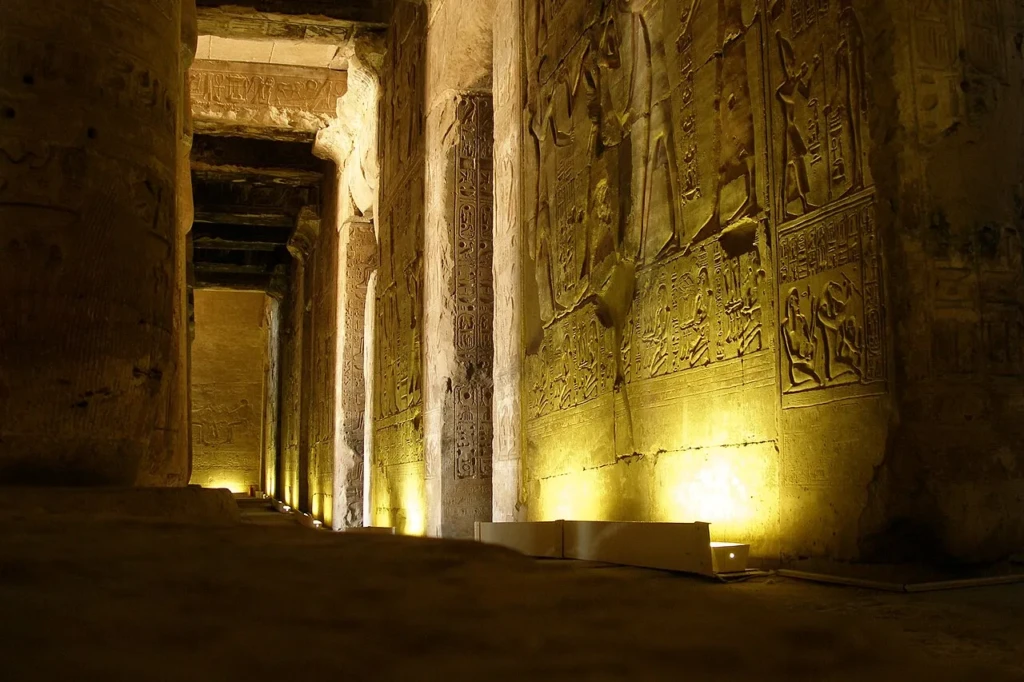
Over time, Abydos became the main cult center of Osiris, god of the dead and of rebirth. Egyptians came to believe that Osiris himself was buried here. One of the early royal tombs was even reinterpreted as the tomb of the god. Pilgrimage to Abydos became a lifelong wish for many Egyptians, and wealthy families recorded such journeys in their tomb paintings. Many people wanted to be buried here, or at least to leave a memorial near the god.
Into this ancient landscape, Seti I of the 19th Dynasty built a new temple on fresh ground south of the old town. Its purpose was partly religious and partly political. It honored Osiris and the major gods of Egypt. It also presented Seti as the rightful heir of every legitimate king before him. Seti died before it was finished, and his son Ramesses II completed much of the decoration.
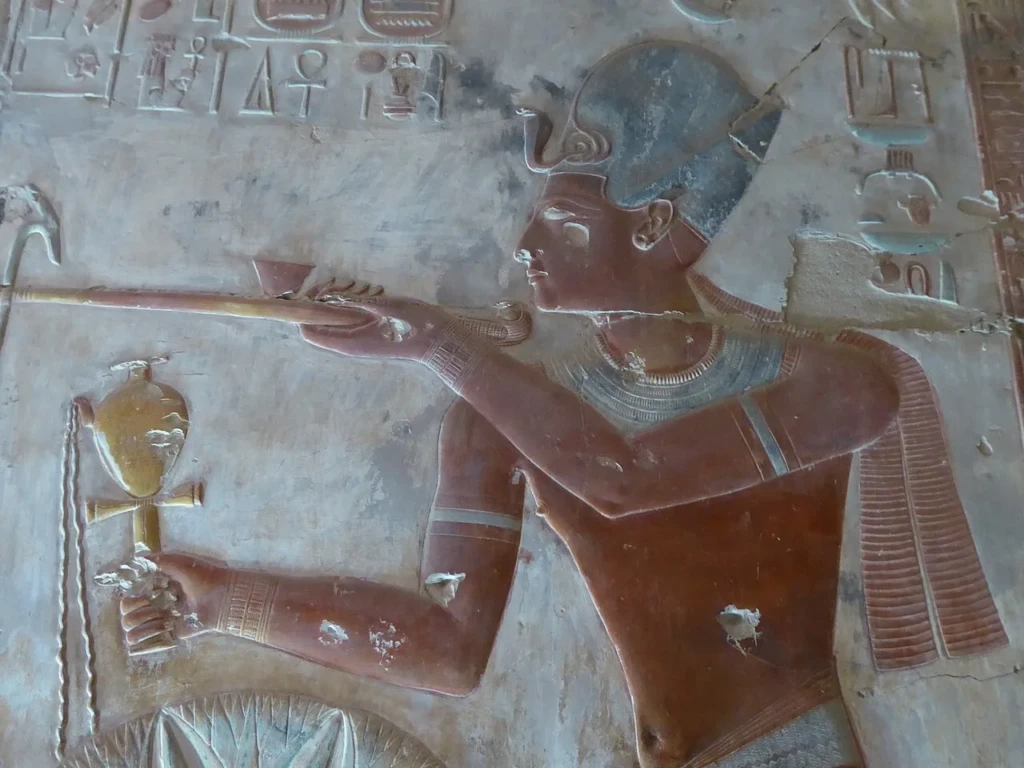
Why does it matter to visitors today? Because the quality of the carving is exceptional. The temple’s reliefs are celebrated for their delicacy and refinement, blending the restraint of much older Egyptian art with the liveliness of the late 18th Dynasty. The building is also nearly complete, so you experience it as a real temple rather than a field of ruins. Apart from the King List and a tribute to Ramesses II, its scenes are religious rather than historical, focused on the gods and the king’s transformation after death.
What to See at the Abydos Temple, in Visiting Order
The temple has an unusual L-shaped plan. The main axis leads from the courts to seven sanctuaries, while a side wing to the south holds the King List gallery and service rooms. The Osireion lies behind the main building. The order below follows a typical guided route.
1. The courts and pylon
You approach through the remains of the outer courts. These areas are more ruined than the inner temple. Ramesses II decorated them with scenes celebrating his own reign, including battle scenes. They prepare you for the contrast with the finer work inside.
2. The first hypostyle hall
The first columned hall was carved mainly under Ramesses II, who completed his father’s work. Somewhere in the temple your guide can also point out the famous “helicopter” hieroglyphs. These are not a mystery. Seti’s original inscription was filled with plaster and re-carved with a new title under Ramesses II. As the plaster fell away, the two sets of signs overlapped and created shapes that some people read as modern machines.
3. The second hypostyle hall
The two halls are separated by a wall and together hold 36 columns. As you move deeper into the temple, take your time with the figures of the king and the gods. The faces, hands and jewelry show the precision that makes Abydos famous.
4. The seven chapels
At the back of the second hall is a row of seven chapels. Each was dedicated to a different deity:
- Seti I, shown as a god
- Ptah, god of Memphis
- Ra-Horakhty, the sun god of Heliopolis
- Amun-Ra, the god of Thebes, in the central position
- Osiris, Isis and Horus, the divine family of Abydos
The wall scenes record the daily temple ritual, step by step, as priests performed it before the god’s statue. They are the earliest complete version of this ritual known from Egypt. The Ministry of Tourism and Antiquities has announced the completion of restoration work in the Amun-Ra chapel.
Behind the Osiris chapel is a further suite of rooms devoted to the Osiris cult, connected with the god’s death and rebirth.
5. The Gallery of the Kings (Abydos King List)
Turn into the southern wing to find the temple’s most famous wall. The Abydos King List shows Seti I and his son Ramesses making offerings before the names of their royal ancestors. It contains 76 kings, from the earliest rulers of the First Dynasty down to Seti’s father, Ramesses I. The names are written in cartouches arranged in rows of 38, with a third row repeating Seti’s own names.
The list is as interesting for who is missing as for who is present. It leaves out the Hyksos rulers, the female pharaohs Hatshepsut and Sobekneferu, and the kings of the Amarna period, including Akhenaten and Tutankhamun. In other words, it is an official history that records the kings Seti wished to recognize. Even so, it remains an important source for the order of early kings, and for some of them it is the only list that survives.
6. The southern service wing
Beyond the gallery, rooms and corridors lead toward storerooms and a slaughter court where offerings were prepared. Scenes here show animals being brought and butchered for the gods. It is a practical side of temple life that is easy to forget amid the sanctuaries.
7. The Osireion
Behind the temple lies the Osireion, a monumental structure built as a symbolic tomb, or cenotaph, connected with Osiris and with Seti as Osiris. It was built of red granite and sandstone and reached by a long descending passage. Its long entrance passage was decorated with texts from the Book of the Dead and the Book of Caves, completed under Seti’s grandson Merenptah.
The Osireion was excavated in the early 20th century by a team working with Flinders Petrie and Margaret Murray. Today, parts of it stand in water. It is treated as an integral part of Seti I’s temple complex, designed in the style of a New Kingdom royal tomb.
8. The Temple of Ramesses II nearby
A short distance away is a smaller temple built by Ramesses II. Only the lower parts of its walls survive, including outer scenes of the Battle of Kadesh. Ask your guide whether it is open on the day and whether there is time to include it.
Abydos Temple Opening Hours and Tickets
The official Ministry of Tourism and Antiquities ticket price list gives the following for Sohag Governorate, as consulted in October 2026; check before you go, as prices and hours change.
| Site | Opening hours | Foreign adult | Foreign student |
|---|---|---|---|
| Temple of Seti I (Temple of Abydos) | Daily, 7:00 AM to 5:00 PM | EGP 260 | EGP 130 |
| Shunet el-Zebib and Kom el-Sultan | 7:00 AM to 5:00 PM | EGP 100 | EGP 50 |
Shunet el-Zebib is the mud-brick funerary enclosure of the Second Dynasty king Khasekhemwy, the most complete of several such enclosures in the desert behind ancient Abydos. The ministry’s site does not publish a separate visitor page for the Seti temple, so we could not confirm details such as photography rules on site.
How to Get to Abydos from Luxor
Abydos lies north of Luxor, near the town of El Balyana. Route planners give the road distance from Luxor to the Temple of Seti I as about 76 miles (roughly 120 km), with a drive of about three hours each way. Actual timing depends on the route and conditions, and your driver will confirm it on the day.
Because of the distance, most travelers visit Abydos on a full-day private tour by car from Luxor, with Dendera on the same day. Dendera lies between Luxor and Abydos, near Qena. Route planners estimate roughly an hour and a half by road from the Qena area to Abydos.
A typical plan is to leave Luxor early, drive to Abydos first while it is cooler, then visit Dendera on the way back. Bring water, snacks and something to read for the road.
Best Time to Visit Abydos
October to April brings the most comfortable temperatures for a long day of driving and walking. In summer, Upper Egypt is very hot, so an early start matters even more. See our Luxor travel guide for more on seasons and planning a stay.
Within the day, arrive at Abydos as early as you can. Mornings are cooler, and an early start leaves time for Dendera before it closes at 5:00 PM.
Practical Tips for Visiting
- Carry cash: bring Egyptian pounds in small notes for tips, restrooms and small purchases.
- Dress for the sun: wear a hat, sunglasses and breathable clothing that covers shoulders and knees, as you will pass through rural towns.
- Wear good shoes: floors are uneven, and there are steps between halls.
- Read a little first: knowing the story of Osiris and the names on the King List makes the visit much richer. A guide helps you read the walls.
- Pace the day: Abydos and Dendera together are a long day. Plan a quiet evening in Luxor.
For general packing advice, see our guide on what to pack and wear in Egypt.
How to Combine Abydos with Nearby Sites
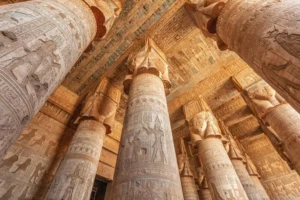
The natural partner for Abydos is the Temple of Hathor at Dendera, famous for its painted ceilings, rooftop chapels and zodiac. Seeing both in one day shows you more than a thousand years of temple building, from Seti’s New Kingdom carving to Dendera’s Ptolemaic and Roman-period temple.
Abydos also links naturally to what you see in Luxor. Seti I’s tomb (KV17) in the Valley of the Kings belongs to the same king, so seeing both lets you follow him from his temple to his burial place. His work also appears at Karnak Temple, where the Great Hypostyle Hall was decorated under Seti and Ramesses II. Visiting these sites in the same trip helps you recognize Seti’s style.
Visit with Delta Tours Egypt
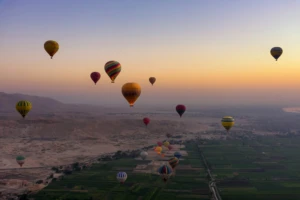
Our Dendera and Abydos day tour from Luxor, from $150 per person, covers both temples in one private day. To round out a Luxor stay, add the Luxor East and West Bank tour, from $128 per person, or a sunrise Luxor hot air balloon ride, from $120 per person. If you want more time in the Valley of the Kings, our West Bank private tour starts from $150 per person. Delta Tours Egypt is a family-run operator founded in 1974 and licensed by the Ministry of Tourism (licence No. 121).
Frequently Asked Questions
Is Abydos temple worth the trip from Luxor?
Yes, if you enjoy art and history. The reliefs from Seti I’s reign are among the finest in Egypt, and the King List and Osireion are unique. The trade-off is a long drive, so it suits travelers with at least three days in Luxor.
How long does it take to get from Luxor to Abydos?
Route planners estimate about three hours each way by road for roughly 76 miles. Your driver will confirm timing on the day. Most visitors combine Abydos with Dendera in a full-day trip.
How much is the ticket for Abydos temple?
The official Ministry ticket list gives EGP 260 for foreign adults and EGP 130 for foreign students, with hours of 7:00 AM to 5:00 PM. These figures were consulted in October 2026. Check before you go, as prices change.
What is the Abydos King List?
It is a carved list of 76 royal names in the Temple of Seti I, showing Seti and Ramesses honoring the kings who came before them. It skips rulers that Seti’s court did not recognize, such as Hatshepsut and the Amarna kings.
What are the “helicopter” hieroglyphs at Abydos?
They are overlapping carved inscriptions. Seti’s original text was plastered over and re-carved under Ramesses II. As the plaster wore away, both versions became visible and formed shapes that look modern.
Can you visit Abydos and Dendera in one day?
Yes, and it is the most common way to see them. Leave Luxor early, visit Abydos first, then stop at Dendera on the return journey. Expect a full day.
Abydos rewards the effort with some of the most beautiful temple art in Egypt. Explore our private Luxor day tours to plan your visit, or ask our team to fit Abydos and Dendera into your itinerary.
Featured image: Temple of Seti I, Abydos. Photo: Vyacheslav Argenberg / Wikimedia Commons, CC BY 4.0