Khan el-Khalili Bazaar: What to Buy, Where to Eat, How to Haggle
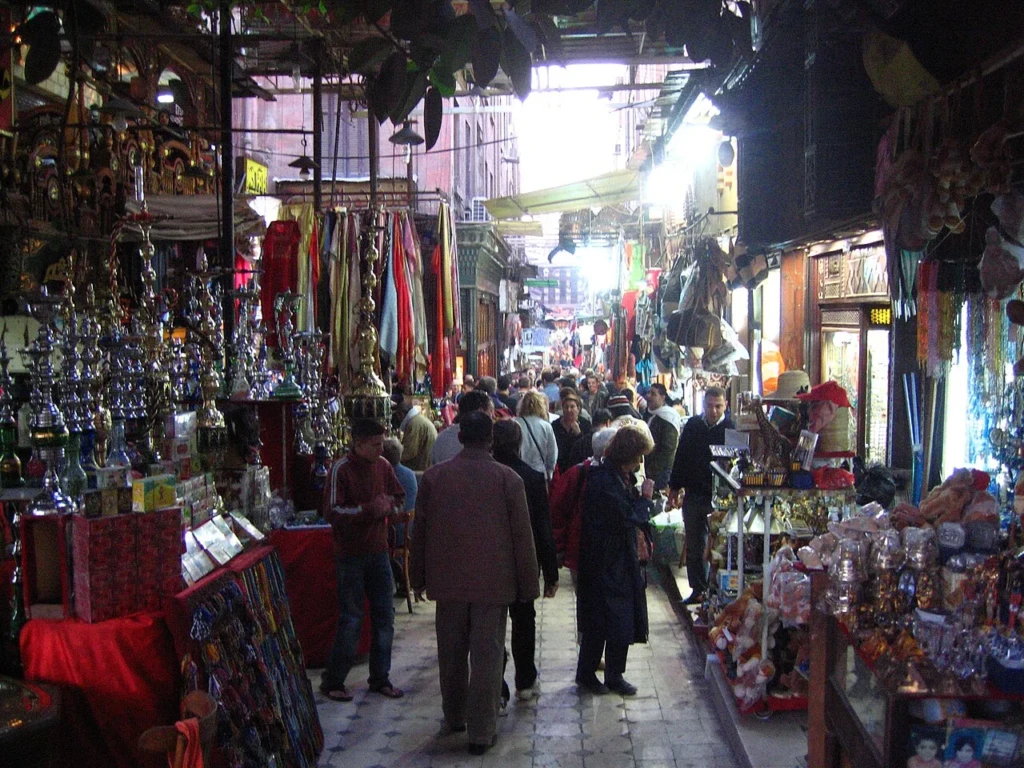
Khan el-Khalili is Cairo’s historic bazaar, a maze of lanes in the medieval city center between al-Muizz Street and the al-Hussein Mosque. It dates back to the Mamluk era of the 14th century and today sells lamps, brass, textiles, jewelry, spices and souvenirs, with traditional coffeehouses tucked between the shops. Go with cash, a rough idea of what you want, and a relaxed attitude to bargaining.
This guide covers what the bazaar is, what is worth buying, where to sit down for coffee or a meal, how haggling works, and how to fit Khan el-Khalili into a day in Islamic Cairo.
Khan el-Khalili at a Glance
| Fact | Details |
|---|---|
| Location | Historic (Islamic) Cairo, bounded roughly by al-Muizz Street to the west, al-Muski Street to the south and the al-Hussein Mosque to the east |
| Founded | Late 14th century, during the first reign of Sultan Barquq (1382–1389) |
| Named after | Jaharkas al-Khalili, Barquq’s Master of the Stables, who built the original khan (merchants’ inn) |
| Rebuilt | Sultan al-Ghuri rebuilt the original khan in 1511 and added a gated market street |
| Entry | Free to walk the lanes; individual monuments nearby charge separate tickets |
| Time needed | Our planning suggestion: 2 to 3 hours, or longer with a café stop and nearby monuments |
| Status | Part of Historic Cairo, a UNESCO World Heritage Site since 1979 |
What Is Khan el-Khalili, and Why Does It Matter?
“Khan” means an inn for traveling merchants: a building around a courtyard, with storerooms below and lodgings above. In the 1380s, a Mamluk official named Jaharkas al-Khalili built a large khan on this spot, on the site of a Fatimid royal mausoleum. The building took his name, and over time the name spread to the whole shopping district around it.
The location was no accident. Cairo’s main north-to-south avenue, today’s al-Muizz Street, had become crowded with shops, mosques and mausoleums. New commercial buildings spread east toward al-Azhar Mosque and the shrine of al-Hussein, where there was still room. By the end of the Mamluk period, the district held around twenty khans and wikalas (warehouse-inns), with market lanes running between them.
In 1511, Sultan al-Ghuri, the last major Mamluk ruler, pulled down the original khan and rebuilt it. He also laid out a market street with monumental stone gates. Two of those gates survive: Bab al-Badistan on the west and Bab al-Ghuri on the east. When you walk under them, you are walking through 16th-century Cairo’s luxury shopping arcade.
Under the Ottomans, the district became the base of Cairo’s Turkish merchant community. Later changes, including al-Muski Street in the 19th century and new blocks of shops built in the 1930s, shaped the eastern part of the bazaar that most visitors see today.
What makes Khan el-Khalili matter is continuity. It has been a working market for more than six centuries. Alongside souvenir shops, the goldsmiths’ market still serves Egyptian families, and craft workshops operate in courtyards and upper floors around the bazaar. Naguib Mahfouz, Egypt’s Nobel Prize-winning novelist, set his novel Midaq Alley in one of its lanes.
How the Bazaar Is Laid Out
The bazaar has no single entrance and no straight lines. It helps to know three anchors.
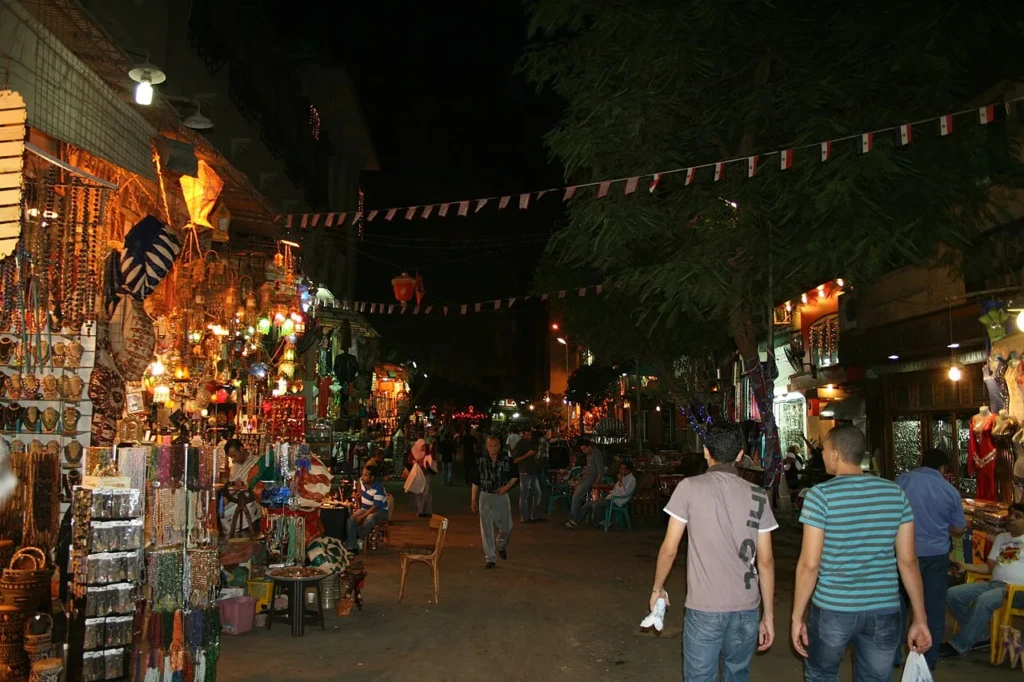
- Al-Hussein Square and Mosque (east): the usual drop-off point. Cafés and restaurants line the square, and the main tourist lanes start here.
- Al-Muizz Street (west): the historic main avenue, lined with Mamluk mosques, madrasas and mansions. The Ministry of Tourism and Antiquities calls it the largest open-air museum of Islamic monuments in the world.
- Al-Muski Street (south): a long, busy local market street running west toward downtown. It feels less touristic and more like everyday Cairo shopping.
Between these edges, lanes are grouped loosely by trade. You will find runs of lamp shops, jewelers, textile sellers and spice merchants. Expect to get a little lost. That is part of the experience, and most lanes lead back to al-Hussein Square or al-Muizz Street within minutes.
What to Buy in Khan el-Khalili
The bazaar sells everything from mass-produced souvenirs to fine handwork. The skill is telling them apart. These are the categories most worth your time.
Lamps and lanterns
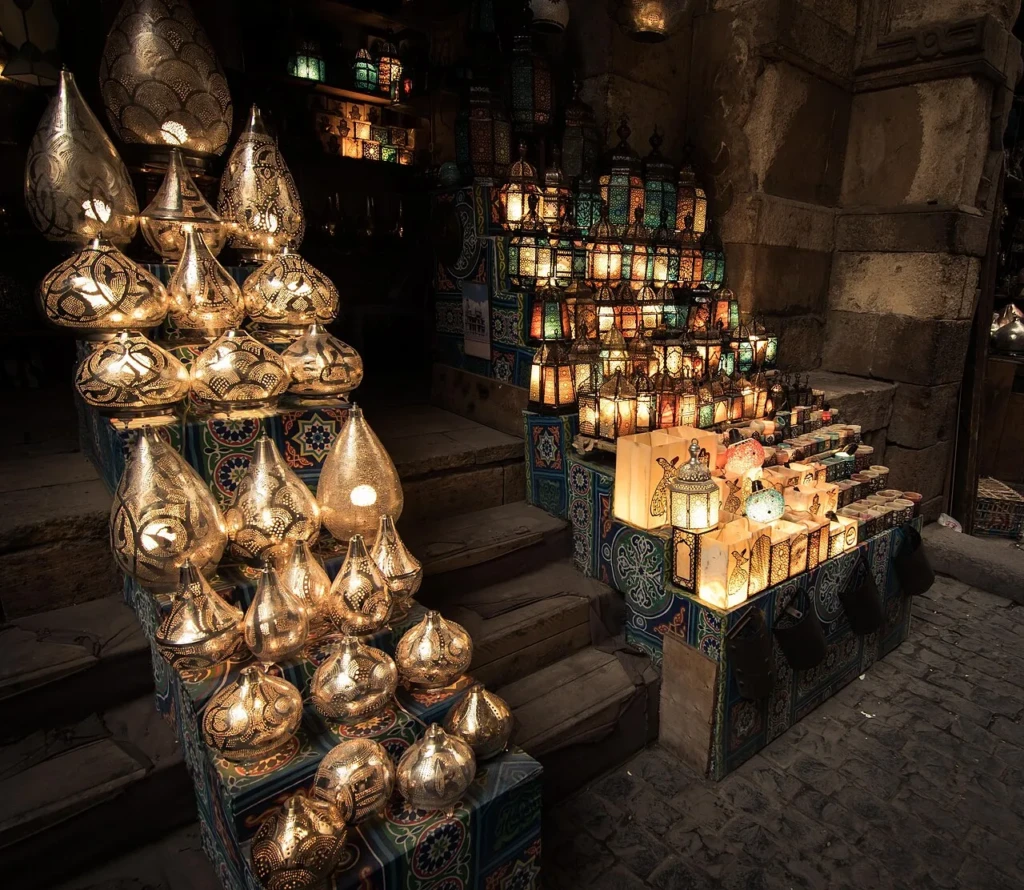
Pierced metal lanterns and colored-glass lamps hang in clusters above many shop fronts. Look at the weight of the metal, the neatness of the cut patterns and how well the glass panels are fitted. Ask the seller to pack fragile pieces properly, or to ship them if the shop offers that.
Brass and copper
Engraved trays, plates, coffee pots and vases are a Cairo tradition. Hand engraving has slightly irregular lines and depth; machine-stamped pieces look uniform and shallow. Watching a craftsman at work, if one is in the shop, tells you a lot.
Textiles and cotton
Scarves, tablecloths, embroidered cushion covers and galabeyas (long robes) are easy to carry home. Egyptian cotton has a strong reputation, but labels in a bazaar are not a guarantee. Feel the fabric and judge it on quality, not on the claim.
Jewelry, gold and silver
Silver pieces, cartouche pendants with your name in hieroglyphs, and gold from the nearby goldsmiths’ market are popular. For gold and silver, ask about the purity mark and the weight, and get the details written on your receipt.
Inlaid boxes and woodwork
Boxes, backgammon boards and frames inlaid with mother-of-pearl or contrasting woods continue a decorative tradition you can also see in Cairo’s historic mosques. Check that the inlay is flush and the hinges are solid.
Spices, tea and perfume oils
Spice stalls sell hibiscus (karkadeh) for tea, cumin, mixed spice blends and dried herbs. Perfume shops offer essential oils and decorated glass bottles. Check your home country’s customs rules before packing food items.
A word on “antiques”
Some shops describe items as antique or ancient. Unless you are buying from a specialist dealer with proper documentation, treat these as reproductions and pay accordingly. A well-made replica can still be a lovely souvenir when you buy it for what it is.
Where to Eat and Drink
Traditional coffeehouses
Coffeehouses are as much a part of the bazaar as the shops. Most are small, with low tables spilling into the lane, serving Arabic coffee, mint tea, fresh juice and shisha. The best known is El-Fishawy Café, a coffeehouse dating to the 18th century and run by the same family for generations. Writers and intellectuals, including Naguib Mahfouz, were regulars. It is busy, but a short stop here is a classic Cairo moment.
Local food around al-Hussein
The squares and lanes around al-Hussein Mosque have many casual restaurants and street-food stands. This is a good place to try Egyptian staples such as koshary, ful medames, ta’ameya (Egyptian falafel) and feteer, a flaky layered pastry with sweet or savory fillings. For a fuller list of dishes and what they are, see our guide to traditional Egyptian food to try.
Eating tips
- Choose places that are busy with Egyptian families. High turnover usually means fresh food.
- Ask for a menu with prices before you order, especially at cafés on the main square.
- Drink bottled water, and carry hand sanitizer.
- Your guide can recommend places that suit your taste and any dietary needs.
How to Haggle in Khan el-Khalili
Bargaining is normal in most bazaar shops, and sellers expect it. Approached with good humor, it is part of the fun rather than a contest. These principles work well.
- Look first, buy later. Walk a few lanes before you buy anything. Similar items appear in many shops, and you will quickly sense the range of quality and asking prices.
- Decide your number in advance. Think about what the item is worth to you before you ask the price. Then the seller’s opening figure has less pull on you.
- Let the seller name the first price. Respond calmly with a lower counteroffer. Avoid showing strong enthusiasm for one piece.
- Move in small steps. Each side usually gives a little at a time. If the gap stays wide, it is fine to thank the seller and walk on. Sometimes the price follows you out of the door; sometimes it does not, and that is fine too.
- Bundle items. Buying several pieces from one shop gives you room to ask for a better overall price.
- Only make offers you will honor. If the seller accepts your figure, buy the item. Haggling with no intention to buy is considered poor manners.
- Stay friendly. A smile, a few words of Arabic such as “shukran” (thank you), and accepting a glass of tea if offered all help. You are never obliged to buy because you drank the tea.
- Check before you pay. Confirm the price, the currency and exactly what is included, then inspect the item once more before it is wrapped.
Some shops use fixed prices, and some sellers will tell you so. Respect that, and focus on whether the price works for you.
Touts and commissions
Friendly strangers sometimes offer to show you a “family shop” or a special workshop. A polite “la, shukran” (no, thank you) and walking on is enough. If you are with a guide, it is reasonable to ask whether a shop visit is part of the plan, and to say clearly if you would rather browse on your own.
Practical Tips for Visiting
- Cash: carry Egyptian pounds in small notes. Smaller shops and cafés often prefer cash.
- Timing: the bazaar is pleasant in the morning and livelier in the evening, when the lanes fill with Egyptian families. Avoid the hottest hours in summer.
- Dress: modest clothing is respectful, as you will pass mosques and walk through a traditional neighborhood. Cover shoulders and knees. You need a headscarf and covered arms and legs to enter mosques. Our Egypt what-to-wear guide has more detail.
- Belongings: lanes get crowded. Keep your phone and wallet in a front pocket or a cross-body bag.
- Shoes: wear comfortable, closed shoes. The ground is uneven in places.
- Safety: the bazaar is one of Cairo’s busiest public places for both visitors and Egyptians. For the latest official advice, read our guide to whether it is safe to travel to Egypt right now.
Monuments Next to the Bazaar: Hours and Tickets
Khan el-Khalili itself is free to enter. Several historic sites at its edges charge entry. The figures below are as listed on the official Ministry of Tourism and Antiquities site in October 2026; check before you go.
| Site | Opening hours | Foreign adult | Foreign student |
|---|---|---|---|
| Al-Muizz Street area ticket (covers several monuments, including the Qalawun complex and Sultan Barquq’s mosque) | Daily, 9:00 AM to 5:00 PM | EGP 220 | EGP 110 |
| Bab Zuwayla (southern city gate) | Daily, 9:00 AM to 5:00 PM | EGP 100 | EGP 50 |
| Bayt al-Suhaymi (Ottoman-era house) | 9:00 AM to 5:00 PM | EGP 220 | EGP 110 |
| Al-Ghuri complex (dome, sabil and house) | 9:00 AM to 5:00 PM | EGP 150 | EGP 75 |
The official al-Muizz Street page lists the monuments the area ticket covers and notes that Bayt al-Suhaymi needs its own ticket. Bab Zuwayla, built in 1092, is worth a stop on your way south. The Ministry’s Bab Zuwayla page explains its Fatimid origins and the twin minarets of the adjoining Mosque of al-Mu’ayyad.
How to Get There and How to Combine It
Most visitors arrive by car or taxi and are dropped near al-Hussein Square. Travel time from downtown, Zamalek or Giza depends heavily on Cairo traffic, so your driver or guide will confirm timing on the day.
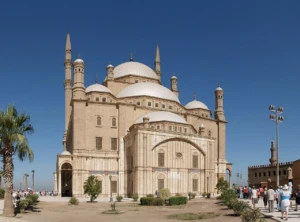
Khan el-Khalili fits naturally at the end of a day in historic Cairo. A popular route starts at the Citadel and the Mohamed Ali Mosque, continues to Coptic Cairo in Old Cairo, and finishes at the bazaar for late-afternoon shopping and an evening coffee. Another option is a morning at the Egyptian Museum in Tahrir Square, then the bazaar for lunch and browsing.
For a full picture of the city, including where to stay and how to divide your days, see our Cairo travel guide.
Visit with Delta Tours Egypt
Our Old Cairo private tour, from $100 per person, links the Citadel, Coptic Cairo and the bazaar in one guided day with your own car. If you are passing through Cairo on a long connection, the Cairo airport layover tour, from $180 per person, pairs the Pyramids with the bazaar. For a longer stay, the Taste of Egypt 4-day Cairo tour, from $535 per person, combines the Pyramids, the Grand Egyptian Museum and Old Cairo. Delta Tours Egypt is a family-run operator founded in 1974 and licensed by the Ministry of Tourism (licence No. 121). Your guide can show you around the lanes, explain the history and step back when you want to shop on your own.
Frequently Asked Questions
Is Khan el-Khalili worth visiting?
Yes. Even if you buy nothing, the lanes, the Mamluk gates and the coffeehouse culture make it one of Cairo’s most atmospheric places. It also sits next to some of the finest Islamic monuments in the city.
Is there an entry fee for Khan el-Khalili?
No. Walking the bazaar is free. Nearby monuments such as the al-Muizz Street group and Bab Zuwayla have their own tickets, listed on the official Ministry site.
How much should I offer when haggling?
There is no fixed rule, and asking prices vary widely by shop and item. Decide what the piece is worth to you, compare a few shops, and counter calmly from there. Walk away politely if the price does not work.
What is the best thing to buy in Khan el-Khalili?
Metal lanterns, engraved brass, inlaid boxes, textiles and silver jewelry are the most popular buys. Choose items where you can see the quality of the handwork, and treat anything sold as ancient as a reproduction.
Can I pay by card in Khan el-Khalili?
Some larger shops may take cards, but many small shops and cafés work in cash. Carry Egyptian pounds in small notes, and confirm the payment method before you agree a price.
What should I wear to Khan el-Khalili?
Light, modest clothing that covers shoulders and knees is the best choice, since you are in a traditional neighborhood next to major mosques. Bring a scarf if you plan to enter a mosque, and wear comfortable closed shoes.
Khan el-Khalili is at its best with a little local knowledge and no rush. Browse our private Cairo day tours to add the bazaar to your trip, or ask our team to plan an evening there around your other sightseeing.
Featured image: The Khan el-Khalili market in Cairo. Photo: V Manninen from Funland / Wikimedia Commons, CC BY 2.0