Siwa Oasis Travel Guide: Shali, the Oracle Temple and Salt Lakes
Three things bring most travelers to Siwa Oasis: the crumbling salt-and-mud town of Shali, the hilltop Temple of the Oracle that Alexander the Great consulted, and the salt lakes around the palm groves. Siwa lies in Egypt’s Western Desert, about 50 km (31 miles) from the Libyan border and around 560 km (350 miles) from Cairo, and it is reached by road via Marsa Matruh on the Mediterranean coast. Plan on at least two nights, because the journey alone takes up most of a day each way.
Siwa feels different from the rest of Egypt. Its people are Siwi Berbers with their own language, the town is surrounded by date and olive groves, and the pace is slow. This guide covers the history, the main sights in a practical order, official ticket prices, how to get there, when to go and how to behave in a conservative community.
Siwa Oasis at a Glance
| Fact | Details |
|---|---|
| Location | Western Desert, Matrouh Governorate, between the Qattara Depression and the Great Sand Sea |
| Distance | About 560 km (350 miles) from Cairo; about 300 km (185 miles) south-west of Marsa Matruh by road |
| Elevation | A depression reaching about 19 m (62 ft) below sea level |
| Main sights | Shali, Temple of the Oracle at Aghurmi, Gebel al-Mawta tombs, springs and salt lakes |
| Protected area | Siwa Protected Area, a national park declared in 2002 (7,731 km²) |
| Language | Siwi (a Berber language) and Egyptian Arabic |
| Time needed | Our planning suggestion: 2 to 3 nights in Siwa, plus travel days |
A Short History of Siwa
People have lived in the Siwa depression for many thousands of years. The oasis is fed by around 200 natural springs, which made it a vital stop on desert caravan routes. Its first clear links with the Egyptian state date to the 26th Dynasty, in the 7th and 6th centuries BC.
The Oracle of Amun
Siwa’s fame in the ancient world came from its oracle of Amun, the god the Greeks identified with Zeus. Greek settlers at Cyrene, in what is now Libya, knew the shrine by the 7th century BC, and its reputation spread across the Mediterranean.
The most famous visitor was Alexander the Great, who crossed the desert to consult the oracle in 331 BC, after founding Alexandria. His court historians claimed the oracle confirmed him as divine and as Egypt’s rightful pharaoh. Under Roman rule, the oracle lost its standing.
Shali and Modern Siwa
In the Middle Ages, Siwans built a fortified hill town called Shali, a Siwi word meaning “city.” Egypt’s Ministry of Tourism and Antiquities dates it to the 6th century AH, the 12th century AD. Muhammad Ali brought the oasis under Cairo’s control in 1820, and fighting reached Siwa in both world wars.
For most of its history, Siwa was linked to the outside world only by camel tracks. A paved road to the Mediterranean coast arrived in the 1980s, and with it television, tourism and closer ties to the rest of Egypt. Dates remain the backbone of the local economy, followed by olives.
What to See in Siwa, in Visiting Order
The sights are spread around the oasis but close together by road. A sensible plan is to see the town and Shali on the first afternoon, the ancient sites the next morning and the springs and lakes later in the day. Your guide will adjust the order around heat and light.
1. Shali
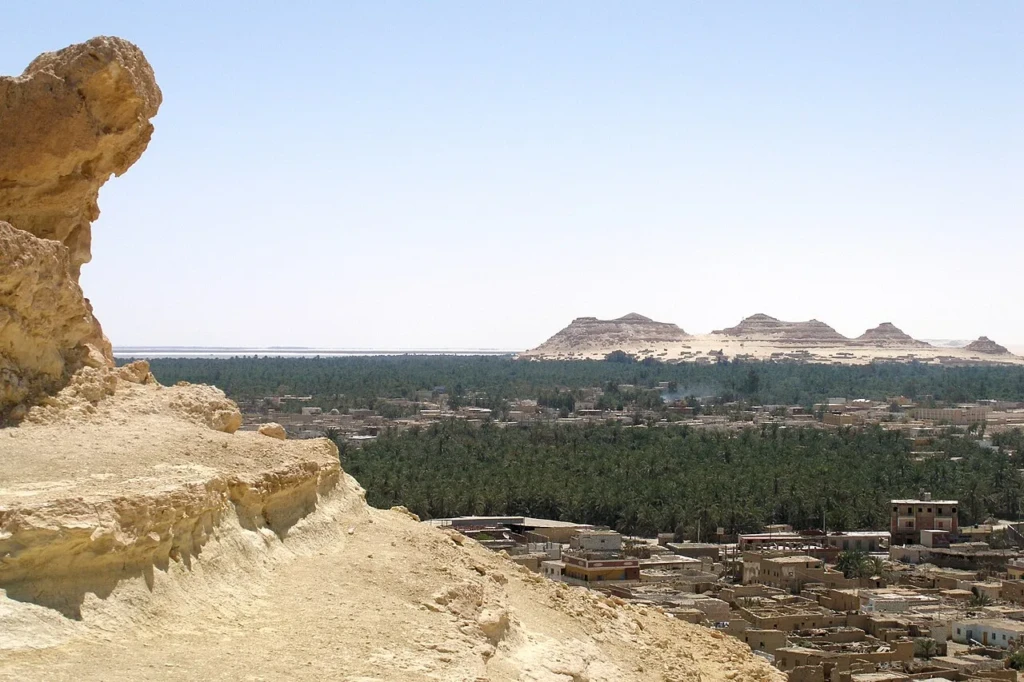
Shali rises in the middle of modern Siwa town. It was built of kershef, a clay heavily saturated with salt that dries almost as hard as cement, along with palm logs. According to the Ministry of Tourism and Antiquities, the walled town originally had a single gate, Bab Anshal. A second gate, Bab Athrat, was added later on the south side, and a third gate, used only by women, was opened after that.
Inside the walls stand the old Al-Ateeq Mosque and the Tandi Mosque, also called the Sheikha Hasina Mosque. The ministry describes the old mosque as the oldest mud-built mosque in Africa. The town also had six deep wells for drinking water.
Shali was largely abandoned after three days of heavy rain damaged it badly in 1926. Residents moved to new houses on the plain below. The ministry has since completed restoration work so that the ruins can be visited. At night the walls are floodlit, and the higher lanes give a good view over the palm groves.
2. Gebel al-Mawta (Mountain of the Dead)
This limestone hill, about 1 km (0.6 miles) north of the town center, is honeycombed with rock-cut tombs, mostly from the Ptolemaic and Roman periods. The highlight is a group of tombs on the north-east slope, including the Tomb of Si-Amun with its colored reliefs. Your guide will confirm which tombs are open on the day.
3. Temple of the Oracle at Aghurmi
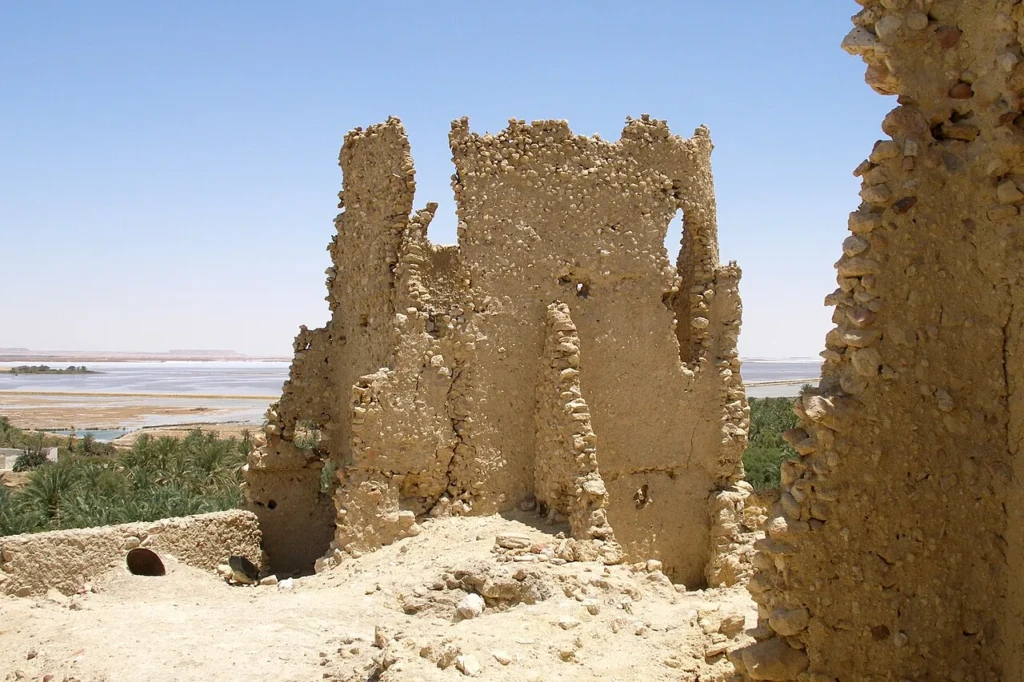
The Temple of the Oracle stands on a rocky hill at Aghurmi, about 4 km (2.5 miles) east of Siwa town, among the ruins of the old village of Aghurmi. It is usually dated to the 6th century BC. The temple itself is plain, but it is the site where Alexander received his answer, and some inscriptions date to the 4th century BC. Climb to the top for a wide view across palm groves, lakes and desert.
4. Temple of Umm Ubeida
About 400 m south of the oracle stand the remains of a second temple to Amun, usually attributed to one of the Nectanebo kings of the 4th century BC. Early European explorers sketched it in detail, which is fortunate. In 1897 a local official had most of it blown up to reuse the stone for a police station, and only one wall still stands.
5. Cleopatra’s Bath
Less than 1 km south of Umm Ubeida is a round stone pool fed by a natural spring, known locally as Cleopatra’s Bath. The link with Cleopatra is a modern story with no historical basis. The water is about 29°C (84°F), and there is a café beside it. Swim in modest clothing out of respect for local customs.
6. The Salt Lakes
Large salt lakes surround the cultivated land, fed partly by drainage water from the farms. Around them are smaller pools created by salt extraction. When salt is dug from a dried lake bed, the hollows refill with spring water, and evaporation makes the water extremely salty. The result is turquoise water in which it is very hard to sink.
Floating here is popular, but keep the water out of your eyes and avoid shaving just before you swim, as the salt stings. Bring fresh water to rinse off afterward.
7. Fatnas Island and Sunset
Fatnas, about 6 km (4 miles) west of town, was once an island in Lake Siwa and is now joined to the shore. It has palm trees, a spring and a café, and it is the classic place to watch the sun set over the lake.
8. The Great Sand Sea
South and west of the oasis begin the dunes of the Great Sand Sea. Local operators run 4×4 trips into the dunes, often combined with a warm spring at Bir Wahed, about 15 km (9 miles) south-west of town. Go only with a licensed local driver, and stay well away from the Libyan border area.
Opening Hours and Ticket Prices
As listed on the official Ministry of Tourism and Antiquities ticket price list in October 2026 (the latest version we could find is dated November 2024); check before you go:
| Site | Foreign adult | Foreign student | Hours |
|---|---|---|---|
| Temple of Aghurmi (Temple of the Oracle) | EGP 120 | EGP 60 | 9:00 am – 5:00 pm |
| Tombs of Gabal al-Mawta | EGP 120 | EGP 60 | 9:00 am – 5:00 pm |
The official list does not include a ticket for Shali, the Temple of Umm Ubeida or the springs and lakes. Private salt pools and cafés may charge their own fees, which your guide can confirm on the day.
How to Get to Siwa Oasis
There are no flights to Siwa, so you arrive by road. The standard route is the coast road west from Alexandria to Marsa Matruh, then about 300 km (185 miles) south-west across the desert on a paved road. Services along this desert road are very limited, so a reliable vehicle and driver matter.
Your driver or guide will confirm timing, but expect the journey from Cairo or Alexandria to fill most of a day. You can break it with a night in Alexandria or on the coast. A second road links Siwa with Bahariya Oasis, but the UK Foreign Office advises against all but essential travel on it, so we do not recommend that route.
Is Siwa Safe to Visit?
The UK Foreign, Commonwealth and Development Office (FCDO) advises against all but essential travel to most of the Western Desert. Its current Egypt travel advice (updated 4 August 2026 and still current in October 2026) makes exceptions for the oasis town of Siwa, the Marsa Matruh–Siwa road and the coast between the Nile Delta and Marsa Matruh.
The FCDO advises against all travel within 20 km of the Egypt–Libya border and against all but essential travel on the Bahariya–Siwa road. Stick to Siwa town, the main sights and the Marsa Matruh road, and check the latest advice before you book. Our guide on whether it is safe to travel to Egypt right now gives the wider picture.
Best Time to Visit Siwa
Siwa has a hot desert climate with almost no rain. Summer temperatures approach 40°C (104°F), and the hot khamsin wind can push the thermometer past 40°C as early as March. Winter days are mild, but nights can drop to around 5°C (41°F).
The most comfortable months are roughly October to April. Siwa’s own three-day festival, the Siyaha, is a gathering of reconciliation held at Gebel Dakrour near town. Its date varies from year to year, so check before planning around it. For the rest of Egypt, see our guide to the best time to visit Egypt.
Respecting Local Customs
Siwa is a small, traditional community, and visitors are expected to follow local norms. A few practical points:
- Dress conservatively. Cover shoulders and legs, and women may want a scarf.
- Avoid public displays of affection.
- Do not drink alcohol in public.
- Ask before photographing people, especially women, and accept a no.
- Swim in modest clothing at springs and pools used by locals.
- During Ramadan, many shops close or keep short hours, so plan around it.
Our page on what to pack and wear in Egypt has more on clothing.
Combining Siwa With Alexandria and the Coast
Because the road to Siwa starts on the Mediterranean, Alexandria is the natural partner. Spend a day or two in Alexandria before or after the oasis, and break the long drive on the coast. Our Alexandria travel guide covers the city’s museums, catacombs and seafront.
Siwa works best as a stand-alone extension to a classic Cairo and Nile trip rather than squeezed between other stops. To see how extra days change the shape of a trip, compare our 7, 10 and 14-day Egypt itineraries.
Visit With Delta Tours Egypt
We do not currently sell a set Siwa tour. We can arrange a private trip to the oasis on request, with a car, driver and local guide, as part of a tailor-made Egypt tour. Tell us how many nights you would like and whether you want a desert excursion, and we will plan the route via Alexandria.
For the Alexandria part of your trip, our private Alexandria Over Day trip from Cairo starts from $130 per person. Packages that already include Alexandria are the 4 Days Egypt Budget Tour – Cairo & Alexandria from $390 per person, the Cleopatra 10-day Cairo, Nile cruise and Alexandria tour from $1,190 per person and the Ptolemy 10-day luxury tour from $3,210 per person. See them all on our Egypt packages with Alexandria page.
Frequently Asked Questions
Where is Siwa Oasis?
Siwa is in Egypt’s Western Desert, in Matrouh Governorate, about 50 km (31 miles) east of the Libyan border. It is around 560 km (350 miles) from Cairo and about 300 km (185 miles) south-west of Marsa Matruh.
How many days do you need in Siwa?
Our planning suggestion is two to three nights in the oasis, plus the travel days. That gives you time for Shali, the ancient sites, the springs and a sunset at Fatnas without rushing.
Can you fly to Siwa?
No. There are no flights to Siwa, so visitors travel by road, usually from Alexandria via Marsa Matruh.
Is Siwa safe for tourists?
The UK FCDO does not advise against travel to Siwa town or the Marsa Matruh–Siwa road, as of its advice updated in August 2026. It does advise against the Bahariya–Siwa road and the Libyan border zone, so stay on the main route and check the latest advice.
Can you really float in the Siwa salt lakes?
Yes. The pools formed by salt extraction are so salty that most people float easily. Keep the water away from your eyes and rinse with fresh water afterward.
Did Alexander the Great visit Siwa?
Yes. He traveled to the oracle of Amun in 331 BC. The ruins of the Temple of the Oracle still stand on the hill at Aghurmi, east of town.
Siwa asks for time and patience, and it gives back something no other part of Egypt quite offers. If you would like us to plan it as a private extension to your trip, start with our tailor-made Egypt tours.
Featured image: Temple of the Oracle of Amun at Siwa Oasis. Photo: Vyacheslav Argenberg / Wikimedia Commons, CC BY 4.0