Tombs of the Nobles Aswan: Qubbet el-Hawa Visitor Guide
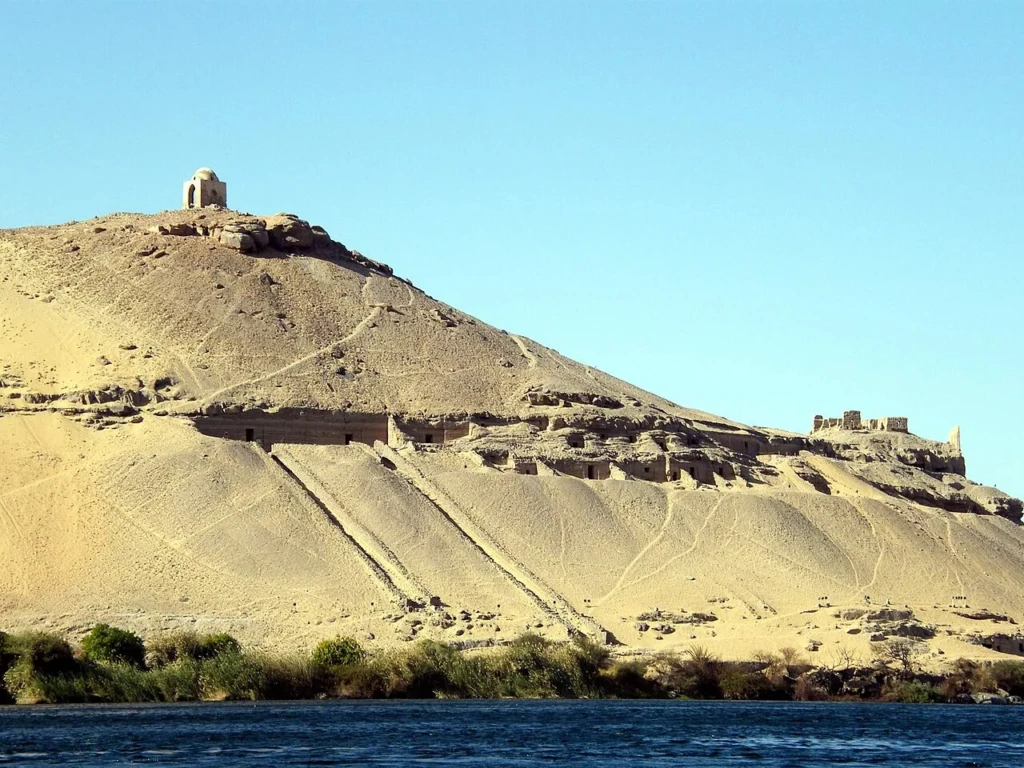
Across the Nile from Aswan’s Corniche, the Tombs of the Nobles at Qubbet el-Hawa are rock-cut tombs of the local governors and officials who guarded Egypt’s southern frontier around 4,000 years ago. The site opens daily from 7:00 am to 4:00 pm, and the foreign adult ticket is EGP 200, as listed on the official Ministry of Tourism and Antiquities site in October 2026; check before you go. Allow about two hours, including the boat crossing and the walk up the hill.
Below you will find who these nobles were, which tombs to see in order, how to reach the west bank, and how to pair the visit with Aswan’s other sights.
| Quick facts | Details |
|---|---|
| Official name | Qubbat al-Hawa Cemetery (Qubbet el-Hawa) |
| Location | West bank of the Nile at Aswan, opposite the northern tip of Elephantine Island |
| Period | Mainly Old and Middle Kingdom tombs; the cemetery stayed in use into the Roman Period |
| Built for | Governors of the first Upper Egyptian province, mayors of Elephantine and senior officials |
| Hours | 7:00 am to 4:00 pm daily (official listing) |
| Foreign ticket | Adult EGP 200, student EGP 100 (official listing) |
| World Heritage | Inscribed in 1979 within the Nubian Monuments from Abu Simbel to Philae |
| Time needed | About 2 hours including the crossing (our planning suggestion) |
What are the Tombs of the Nobles in Aswan?
The Tombs of the Nobles are a cemetery of rock-cut tombs cut into terraces on the hillside of Aswan’s west bank. The Ministry of Tourism and Antiquities describes them as the tombs of local governors and high dignitaries from the Old to the Middle Kingdom. The site remained in use for burials until Roman times.
The hill takes its Arabic name, Qubbet el-Hawa, “the Dome of the Wind,” from the small domed tomb of a Muslim holy man, Sheikh Ali Abu al-Hawa, on its summit.
Do not confuse these tombs with the Tombs of the Nobles in Luxor. The Luxor tombs belong to New Kingdom officials of Thebes. The Aswan tombs are mostly older and tell a different story, one of frontier life and long journeys into Africa.
Why the tombs matter
In ancient times, Aswan and Elephantine Island marked Egypt’s southern border, at the First Cataract of the Nile. The men buried here ran that frontier. They governed the first province of Upper Egypt, served as priests of the local gods and led trading and military expeditions south into Nubia.
Their tomb inscriptions are some of the most valuable written sources for Egypt’s dealings with its southern neighbors. Harkhuf’s autobiography, carved on the face of his tomb, is the best example. It records journeys to a distant land called Yam and a famous letter from a boy king.
The site is still being studied. Wikipedia notes that about 100 tombs had been found by July 2022, and teams including the University of Jaén, which resumed excavation in 2008, continue to work on the hill. New Old Kingdom tombs were announced as recently as June 2025.
What to see, in visiting order
Not every tomb is open on every day, and openings can change with conservation work. The tombs below are the ones most often visited. Your guide will confirm which are accessible when you arrive.
1. The tombs of Mekhu and Sabni (QH 25 and QH 26)
This joint tomb of a father and son from the 6th Dynasty carries one of the most human stories on the hill. Mekhu led a royal expedition south and was killed in Nubia. His son Sabni is said to have struck back and recovered his father’s body so it could be buried at home.
The two tombs carry consecutive numbers, QH 25 and QH 26, and are usually visited together. Ask your guide to tell the story in front of them; it sets the scene for the whole hill.
2. The tomb of Harkhuf (QH 34n)
Harkhuf was a governor of Upper Egypt and overseer of caravans who served Kings Merenre I and Pepi II of the 6th Dynasty. He led four expeditions into Nubia, including journeys to the land of Yam, whose exact location scholars still debate.
The main attraction is outside, not inside. Harkhuf’s autobiography is carved in 58 lines on the soft stone around his entrance. It includes prayers, his titles and a list of his virtues. Most famously, it records a letter from the young Pepi II. On Harkhuf’s last expedition he brought back a dwarf, apparently a pygmy, and the king wrote eagerly that he wanted to see him. Ask your guide to point out the passage, since the soft stone has flaked over time.
3. The tomb of Sarenput I (QH 36)
Sarenput I was governor of the first province and mayor of Elephantine under Senusret I, early in the 12th Dynasty. His large tomb has three rooms linked by passages, with pillared halls in the first two.
The facade and doorway carry sunk reliefs showing Sarenput with members of his family and his dogs. His autobiography appears twice, once outside and once inside. The tomb has suffered damage over the centuries, but a painting of Sarenput with the ram-headed god Khnum survives inside.
4. The tomb of Sarenput II (QH 31)
Save this one for last. Sarenput II, a later governor and high priest of Khnum and Satet in the 12th Dynasty, has what Wikipedia calls the finest and largest tomb at Qubbet el-Hawa.
You enter a hall whose ceiling rests on six pillars. A corridor follows, lined on both sides by niches holding figures of Sarenput in the form of Osiris. It leads to a small inner room with four pillars and a shrine niche at the back. Only the niche and a few of the inner pillars are decorated, but the paintings, mainly showing Sarenput himself, are vivid and detailed. Remains of a granodiorite statue that once stood in the niche are now in the British Museum.
5. The view from the top
Once you have seen the tombs, the panorama is the final reward. From the terraces you look across to the northern tip of Elephantine Island, the sailboats on the river and the city of Aswan on the east bank. It is one of the best places to understand how the river, the islands and the old frontier fit together.
How to get to the Tombs of the Nobles
The tombs are on the west bank, so you cross the Nile by boat from the city side. If you travel with a guide, the boat is usually arranged for you. The tombs are cut into the slope above the river, so expect an uphill walk from the landing to the terraces.
We could not verify a current official crossing fare or timing, so your guide or driver will confirm the crossing time and cost. Travelers with limited mobility should ask about the route up the hill before booking.
Opening hours and ticket prices
The site is open daily from 7:00 am to 4:00 pm. Foreign adults pay EGP 200 and foreign students pay EGP 100, as listed on the official Ministry of Tourism and Antiquities site in October 2026; check before you go. Egyptian visitors pay EGP 20 for adults and EGP 10 for students.
The boat crossing is paid separately. Keep small notes of Egyptian pounds with you for the boat and for tipping the custodians who unlock tombs.
Best time to visit
Time of day
Go early. The site opens at 7:00 am, and the hillside has little shade. A morning visit means cooler air for the climb and softer light on the river. Late afternoon also works for the view, but leave enough time before the 4:00 pm closing.
Season
Aswan is one of the hottest places in Egypt in summer. The cooler months are much more comfortable for climbing and walking. Our guide to the best time to visit Egypt gives month-by-month weather, and our Aswan travel guide covers the city in more depth.
Practical tips
- Footwear: wear shoes with good grip for the uphill path.
- Water and sun: carry water, a hat and sunscreen, especially in warmer months.
- Light: tomb interiors can be dim, so a small flashlight or phone light helps with details.
- Photography: rules can change, so ask your guide or the ticket office before taking photos inside the tombs.
- Do not touch: keep hands off painted surfaces and carved inscriptions, which are fragile.
- Cash: bring Egyptian pounds for the boat and small tips.
Dress comfortably and modestly; light layers that cover shoulders and knees work well in Aswan.
How to combine the tombs with nearby sights
The west bank holds several sights that fit well with the tombs in a half-day by boat.
- Monastery of Saint Simeon: a well-preserved medieval monastery on Aswan’s west bank, with evidence of religious activity from the 6th to the early 14th century. The Ministry lists it as open daily from 7:00 am to 5:00 pm, with a foreign adult ticket of EGP 150, as listed in October 2026; check before you go.
- Elephantine Island and the Botanical Garden: both lie in the river nearby and can be added to the same boat outing; your guide will confirm timing.
- A Nubian village visit: our Nubian Village Tour from Aswan by Boat (1 day, from $50 per person) is a natural partner for a day on the river. Read more in our Nubian village Aswan guide.
Most travelers also want to see Philae. Our Aswan Day Tour (1 day, from $85 per person) focuses on the temple, and our Philae Temple guide explains what you will see. In the evening, the Philae Temple Sound and Light Show (from $60 per person) is a gentle way to end the day.
If Abu Simbel is on your list, plan it for a separate day. Compare Abu Simbel by Car (1 day, from $120 per person) with the flight option, and plan an early start. Many Nile cruises start or end in Aswan, so you can also fit the tombs around a sailing; ask us how the timing works with your sailing dates.
Visit with Delta Tours Egypt
Delta Tours Egypt does not currently sell a set tour that includes the Tombs of the Nobles. We can arrange a private visit on request, with a boat crossing and an Egyptologist guide, and fit it around your other Aswan plans. Tell us your dates through our tailor-made Egypt tours page, or browse our private Aswan day tours for ready-made options.
Frequently Asked Questions
How much is the ticket for the Tombs of the Nobles in Aswan?
The foreign adult ticket is EGP 200 and the foreign student ticket is EGP 100, as listed on the official Ministry site in October 2026. The boat crossing is paid separately.
What are the opening hours?
The official listing shows 7:00 am to 4:00 pm every day. Go early to avoid the midday heat on the exposed hillside.
Is the climb to the tombs difficult?
The tombs are cut into the hillside above the river, so you walk uphill from the boat landing. Take it slowly in the heat, and ask in advance if you have mobility concerns.
Which tomb is the best?
Sarenput II’s tomb (QH 31) is usually described as the finest and largest, with its pillared hall, Osiris figures and vivid paintings. Harkhuf’s tomb is the most important for its inscription.
What does Qubbet el-Hawa mean?
It means “the Dome of the Wind” in Arabic. The name comes from the domed tomb of Sheikh Ali Abu al-Hawa on the top of the hill.
Are these the same as the Tombs of the Nobles in Luxor?
No. The Luxor tombs belong to New Kingdom officials of Thebes. The Aswan tombs are mainly older, from the Old and Middle Kingdoms, and belong to the governors of Egypt’s southern frontier.
The Tombs of the Nobles reward anyone curious about the people behind the pharaohs, and the view alone is worth the climb. If you would like them included in your Aswan days, we will plan it with you through our tailor-made Egypt tours.
Featured image: Tombs of the Nobles at Qubbet el-Hawa above the Nile, Aswan. Photo: youssef_alam / Wikimedia Commons, CC BY 3.0