The Nubian Museum in Aswan: Highlights, Tickets and Tips
If you visit only one museum in Aswan, make it the Nubian Museum. Opened in 1997 on a hillside in the city, it traces Nubia’s story from prehistory to the modern day and explains how the region’s temples were rescued from Lake Nasser. Plan on about two hours, including the garden, which works as an open-air museum of its own.
Below you will find the museum’s background, its highlights in visiting order, official hours and foreigner tickets, and ideas for pairing it with the rest of Aswan.
| Quick facts | Details |
|---|---|
| Official name | International Museum of Nubia, usually called the Nubian Museum or Nubia Museum |
| Location | Central Aswan, on Sharia al-Fanadeq opposite the Basma Hotel |
| Opened | November 23, 1997 |
| Created in response to | UNESCO’s international campaign to save the monuments of Nubia, launched in 1960 |
| Architecture | Building by Egyptian architect Mahmoud El-Hakim; exhibition design by Mexican architect Pedro Ramírez Vázquez |
| Award | Aga Khan Award for Architecture, 2001 |
| Opening hours | 9:00 AM to 5:00 PM daily, ticket window closes 4:00 PM; evening hours Thursday and Friday 6:00 PM to 9:00 PM, ticket window closes 8:00 PM (official listing, October 2026) |
| Foreigner ticket | EGP 400 adult, EGP 200 student (official listing, October 2026) |
| Time needed | Our planning suggestion: 1.5 to 2 hours |
What is the Nubian Museum?
Nubia is the stretch of the Nile valley that runs from Aswan into northern Sudan. For thousands of years it was home to its own peoples, languages and kingdoms, in close and often tense contact with Egypt to the north.
The Aswan High Dam, built in the 1960s, flooded much of Lower Nubia under Lake Nasser. Whole villages were moved, and UNESCO led an international campaign to save the region’s monuments. The Ministry of Tourism and Antiquities explains that the Nubian Museum grew directly out of that campaign. A committee of specialists from Egypt’s antiquities authority, Egyptian universities and UNESCO began work on it in the early 1980s.
The result is a museum devoted to one region and one people, rather than to ancient Egypt in general. That focus is its strength. You leave with a clear picture of Nubia as a civilization in its own right.
Why the building matters
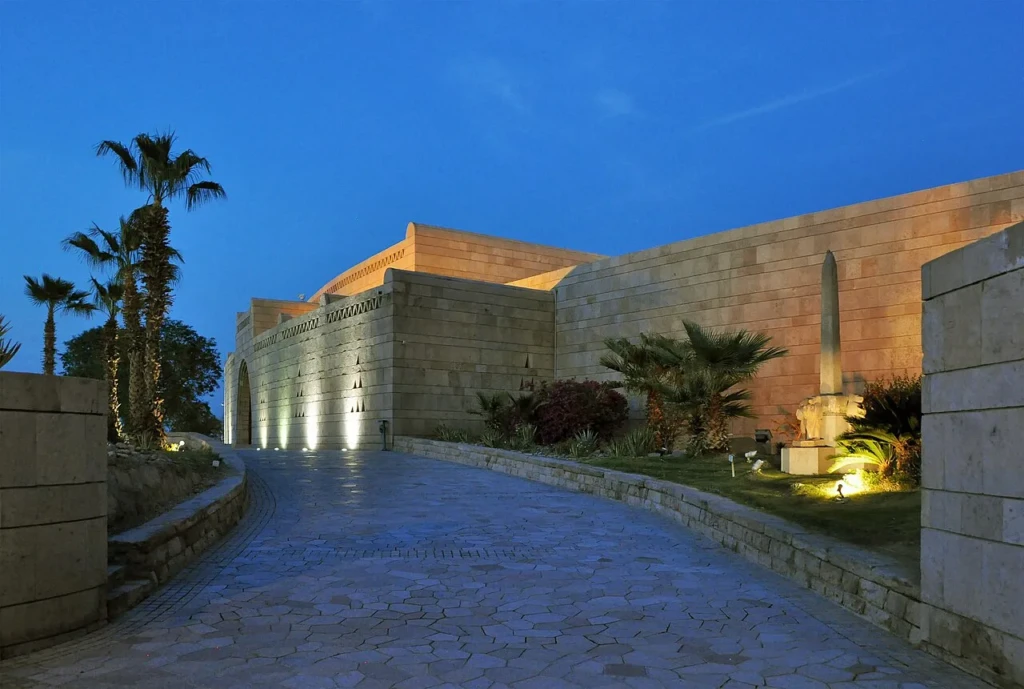
The museum’s architecture is part of the visit. The official museum page describes a building clad in local sandstone and pink granite, designed to echo traditional Nubian architecture. In 2001 it received the Aga Khan Award for Architecture.
According to Wikipedia, the grounds cover about 50,000 square meters. The building takes up about 7,000 of those, and the rest is given over to gardens and public spaces. The museum sits on a steep slope, and the landscaping uses that height to trace the course of the Nile.
What to see, in visiting order
Inside, the museum is spread across three floors. Lonely Planet describes the galleries as running roughly in date order, from about 4500 BC to the present day. That makes it easy to follow without a guide, although an Egyptologist will add a great deal of context.
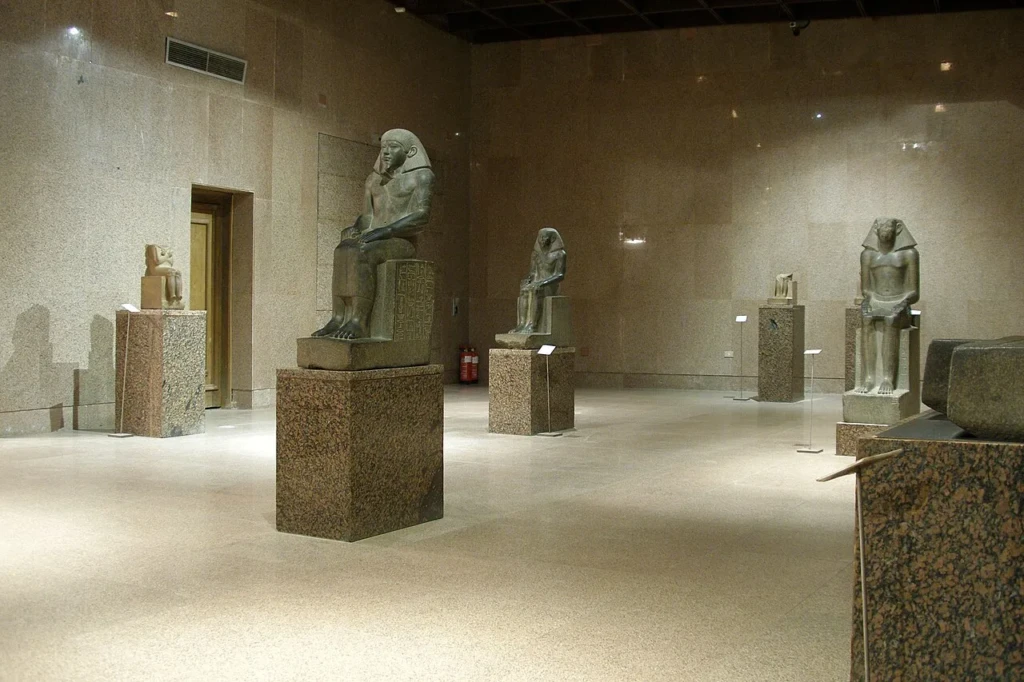
The main hall and its large monuments
You enter into a large hall where the biggest pieces stand. Wikipedia notes that monumental objects take up the largest part of the museum, showing the stages of Nubian culture. Take a slow first lap here before heading into the side galleries.
Prehistoric Nubia
The early galleries show how people lived along this part of the river long before the pharaohs. Look for the painted pottery bowls, which Lonely Planet dates to about 6,000 years ago. Their designs are a reminder that Nubia had its own artistic traditions from very early on.
The kingdoms of Kush and Meroe
The next section covers the kingdoms that rose to the south of Egypt. For about a century, Kushite kings even ruled Egypt as its 25th Dynasty. A quartzite statue of a priest of Amun from that period stands out, carved with distinctly Kushite features. It captures a moment when Nubia and Egypt were joined under southern rulers.
Coptic and Islamic Nubia
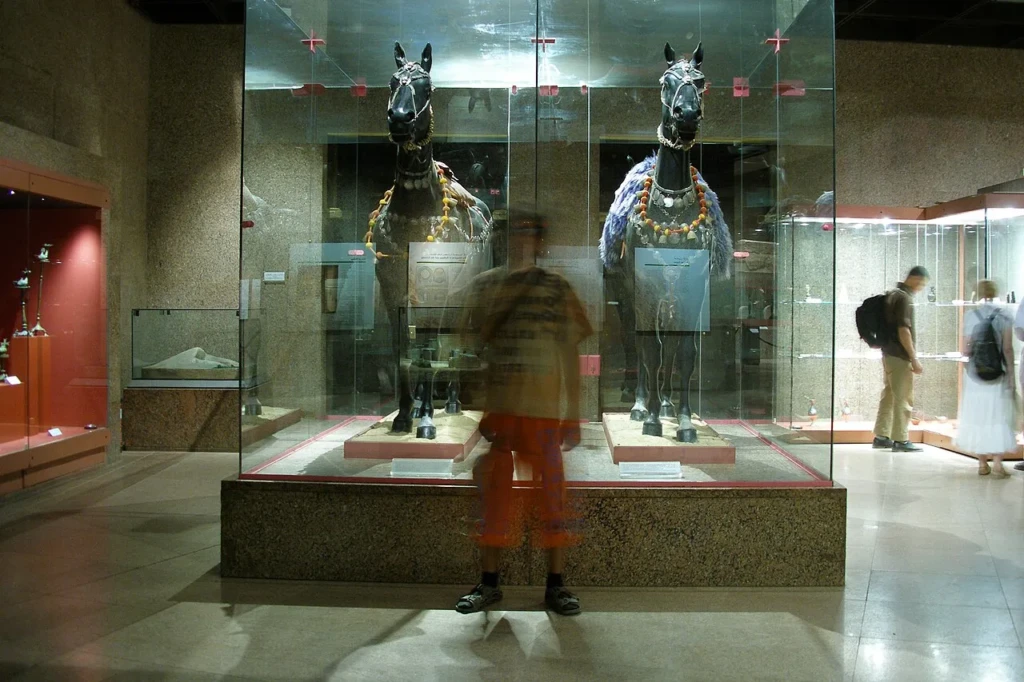
Christianity reached Nubia in late antiquity, and Islam followed later. The galleries for these periods show how the region’s faith and art changed over many centuries. Look out for finds from the Ballana culture, including horse armor from tombs of that period.
Daily life and the Nubian house
The ethnographic displays are among the most memorable. The official page describes a main hall and diorama devoted to local traditions and handicrafts. Lonely Planet highlights a model Nubian house with traditional furniture and figures wearing silver jewelry.
There is also a display on irrigation along the Nile up to the old Aswan Dam. It helps explain how the river shaped every part of Nubian life.
The rescue of the monuments
The visit ends with the story of the UNESCO campaign itself. This is the part that connects the museum to the temples you will see. Philae, Kalabsha and Abu Simbel all stand where they do today because of this work.
The garden: an open-air museum
Do not leave without walking the grounds. The Ministry’s page lists several features worth finding:
- Part of a Fatimid-era cemetery
- A cave with prehistoric rock inscriptions
- A watercourse that represents the Nile, with channels showing how a Nubian village related to the river
- Plants that would have grown in the area in ancient times
- A reconstructed Nubian house that gives a sense of daily life
The museum also has an open-air amphitheater used for Nubian folklore performances, as well as a library, lecture hall and theater.
Opening hours and tickets
The official Ministry of Tourism and Antiquities page for the Nubia Museum lists daily hours of 9:00 AM to 5:00 PM, with the ticket window closing at 4:00 PM. It also lists evening hours on Thursday and Friday from 6:00 PM to 9:00 PM, with the ticket window closing at 8:00 PM.
The foreigner ticket is EGP 400 for adults and EGP 200 for students. These figures are as listed on the official Ministry of Tourism and Antiquities site in October 2026; check before you go. The official free-entry list includes children under 6.
Rules to know before you go
- Personal photography is permitted once you have paid for entry. Flash is not allowed.
- A camera stand may only be used after you buy a separate ticket for it.
- Bags, backpacks or parcels larger than 40 x 40 cm must go to the cloakroom, along with umbrellas.
- Food and drink are not allowed in the galleries, apart from small water bottles.
- Visitors are asked to dress appropriately.
How to get there
The museum is in the city of Aswan itself, on Sharia al-Fanadeq facing the Basma Hotel. Your driver or guide will confirm timing from your hotel or ship.
Because it is so central, the museum fits easily into a half-day with other sights, or into a free afternoon at the end of a cruise.
Best time to visit
The galleries are indoors, so the museum works well in the middle of the day when outdoor sites are hottest. The garden is more pleasant in the morning or late afternoon.
The listed Thursday and Friday evening session is handy if your days are full of temples and boat trips.
Visit before or after Abu Simbel?
We suggest going before. Seeing the rescue story first makes the scale of the work at Abu Simbel and Philae Temple much easier to grasp. If your schedule only allows a visit afterward, it still ties the trip together well.
How to combine the Nubian Museum with nearby sites
A full Aswan day might look like this:
- Morning boat trip to Philae Temple.
- Late morning at the Nubian Museum, out of the midday sun.
- Afternoon boat ride to a Nubian village on the west bank.
- Evening at the Philae sound and light show.
Delta’s Aswan excursions match that plan closely. The private Philae Temple Aswan day tour runs from $85 per person. The Nubian village tour by boat runs from $50 per person, and the Philae sound and light show from $60 per person. Our Nubian village guide explains what to expect there.
For the big day trip south, Delta offers Abu Simbel by private car from $120 per person and Abu Simbel by flight from $360 per person. All of these are listed on our Aswan tours and excursions page, and our Aswan travel guide covers the city in more depth.
Visit with Delta Tours Egypt
Delta does not list a dedicated Nubian Museum tour, but we can arrange a private visit on request within a tailor-made Egypt tour. Your Egyptologist guide can lead you through the galleries and link them to the temples on your route. We are a family-run, Ministry-licensed operator (licence No. 121), based in Cairo since 1974. Share your dates and the time you have in Aswan, and we will fit the museum in where it works best.
Frequently Asked Questions
How much is the Nubian Museum ticket for foreigners?
The official Ministry listing shows EGP 400 for foreign adults and EGP 200 for foreign students, as of October 2026. Check the official page before you travel, as prices change.
How long do you need at the Nubian Museum?
Our planning suggestion is 1.5 to 2 hours. Add extra time if you want to explore the garden properly.
Is the Nubian Museum open in the evening?
The official page lists evening hours on Thursday and Friday from 6:00 PM to 9:00 PM. The ticket window closes at 8:00 PM.
Can I take photos in the Nubian Museum?
Yes, personal photography is allowed once you have a ticket, but flash is not. A camera stand needs its own ticket.
Is the Nubian Museum worth it if I have seen the Grand Egyptian Museum?
Yes. The Grand Egyptian Museum centers on pharaonic Egypt, while the Nubian Museum tells the story of a neighboring civilization. The two complement each other rather than overlap.
Who designed the Nubian Museum?
The building was designed by Egyptian architect Mahmoud El-Hakim. The interior exhibition was designed by Mexican architect Pedro Ramírez Vázquez.
Want Aswan’s history explained by someone who knows it well? Explore our tailor-made Egypt tours, and we will build a private day around the Nubian Museum and the temples it helps explain.
Featured image: Nubian Museum, Aswan, at dusk. Photo: Marc Ryckaert / Wikimedia Commons, CC BY 3.0