Ibn Tulun Mosque & Gayer-Anderson Museum: Cairo Visitor Guide
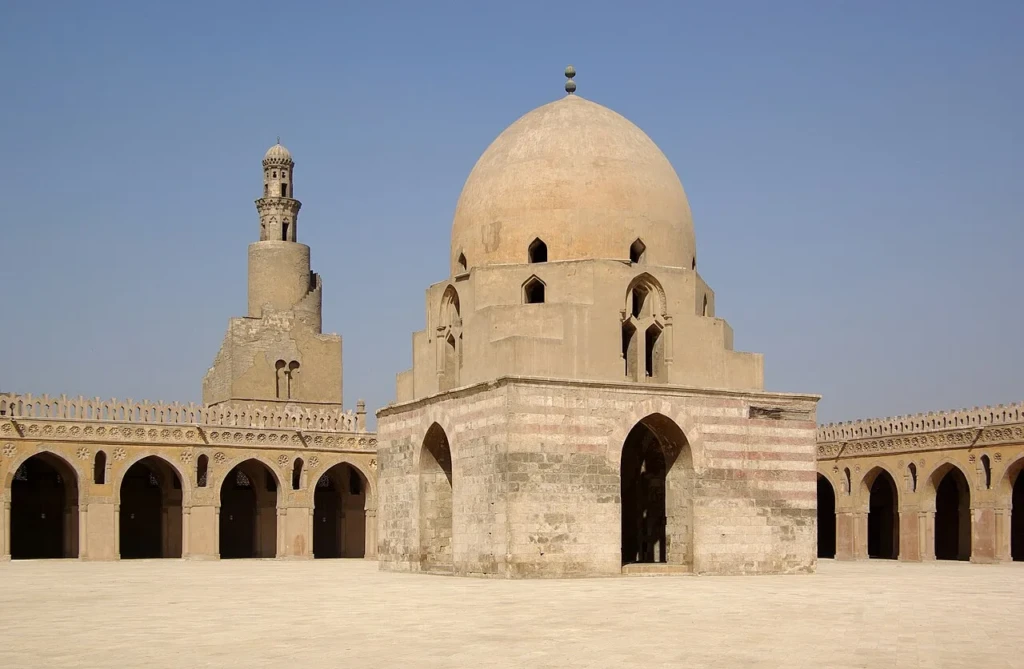
The Ibn Tulun Mosque in Cairo, built between 876 and 879 CE by the governor Ahmad ibn Tulun, is the oldest mosque in Egypt that still largely keeps its original form. It is known for its vast open courtyard, carved stucco arches and a minaret with an outside spiral staircase. The Gayer-Anderson Museum, a pair of Ottoman-era houses filled with a collector’s treasures, stands against its outer wall.
This guide covers both sites together, since almost every visitor sees them in one stop. It explains the history, what to look for, official opening hours and tickets, and how to visit respectfully.
Ibn Tulun Mosque and Gayer-Anderson Museum at a Glance
| Fact | Details |
|---|---|
| Location | Ahmad Ibn Tulun Square, Sayyida Zaynab district, Cairo, on the low hill of Gebel Yashkur |
| Built | 876–879 CE (263–265 AH) |
| Commissioned by | Ahmad ibn Tulun, Abbasid governor who ruled Egypt as an independent state |
| Size | About 26,318 square meters including the outer enclosure, one of the largest mosques in Egypt by area |
| World Heritage | Part of Historic Cairo, inscribed by UNESCO in 1979 |
| Mosque hours | 9:00 am to 5:00 pm daily; no entrance fee is listed |
| Gayer-Anderson Museum | Foreign adult EGP 100, foreign student EGP 50 (see hours below) |
| Time on site | Our planning suggestion: about 1 hour for the mosque and 45 minutes to 1 hour for the museum |
| Getting there | By car or taxi; your driver or guide will confirm timing from your hotel |
Who Was Ibn Tulun and Why the Mosque Matters
Ahmad ibn Tulun was sent to Egypt by the Abbasid caliphs of Baghdad and governed it from 868 to 884. According to the Ministry of Tourism and Antiquities, by 872 he ruled Egypt as an independent state. He built a new administrative capital called al-Qata’i, northeast of the older city of Fustat, and this mosque was its main congregational mosque.
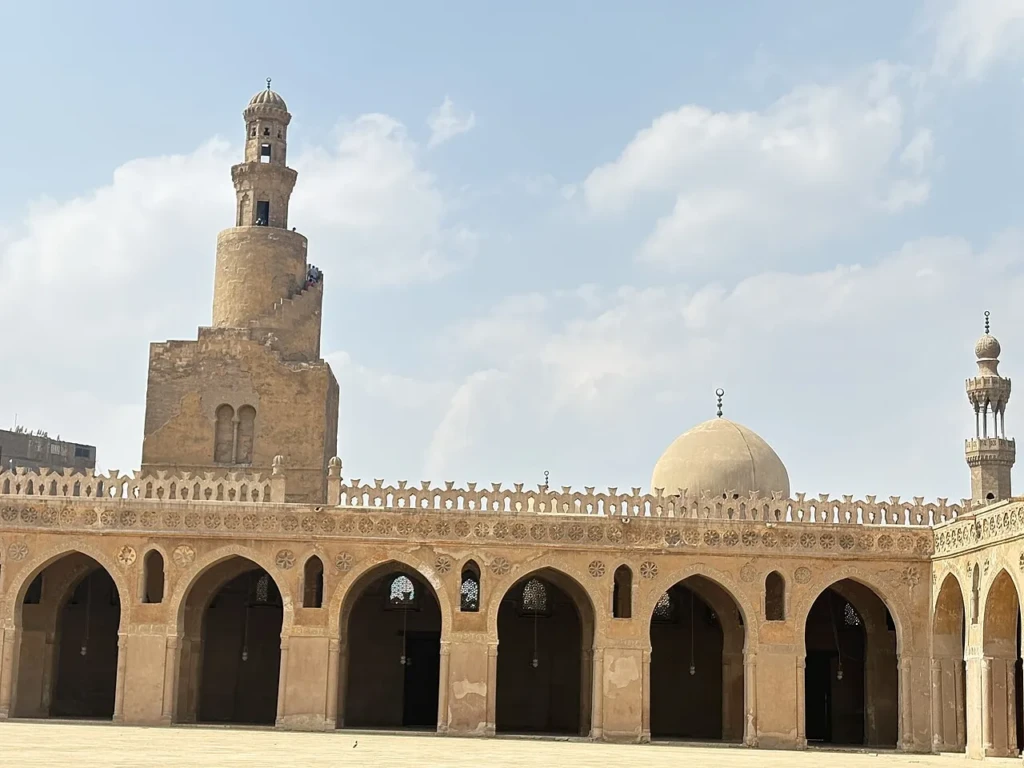
Building a grand mosque was also a political statement. It showed that Egypt now had its own ruler, even while he still recognized the caliph in name. In 905 an Abbasid army retook Egypt and razed al-Qata’i. The mosque was spared because of its religious function, and today it is the only surviving monument of that city.
A piece of Iraq in Cairo
Ibn Tulun had spent his early career in Samarra, then the Abbasid capital in Iraq. His mosque follows the Samarra style closely: brick piers, pointed arches, stucco in Samarran patterns and a spiral minaret that recalls the famous one at Samarra. That makes it one of the best surviving examples of 9th-century Abbasid architecture anywhere. A 10th-century writer named the architect as al-Nasrani, a non-Muslim who had also designed Ibn Tulun’s aqueduct.
Decline and rescue
The mosque had hard centuries. By the 1290s it had fallen into ruin. The Mamluk officer Lajin hid there after taking part in a sultan’s assassination, and according to Mamluk writers he vowed to restore it if he survived. When he became sultan, he kept that promise with a major restoration in 1296. Many of his additions are still in place.
In the 19th century the building was used as a military hospital, a salt store, an asylum and a poorhouse. Conservation work began in the 1880s and 1890s, and a full restoration took place from 2002 to 2004.
What to See at the Mosque, in Visiting Order
1. The outer enclosure (ziyada)
You first pass through the ziyada, a wide walled space that wraps around three sides of the mosque. It once held ablution facilities and a clinic, and it kept the noise of the city away from the prayer space. Look up at the brick crenellations on the walls, cut in a pattern that some describe as linked human figures. The building once had 22 doorways, but visitors today use only one.
2. The courtyard and fountain
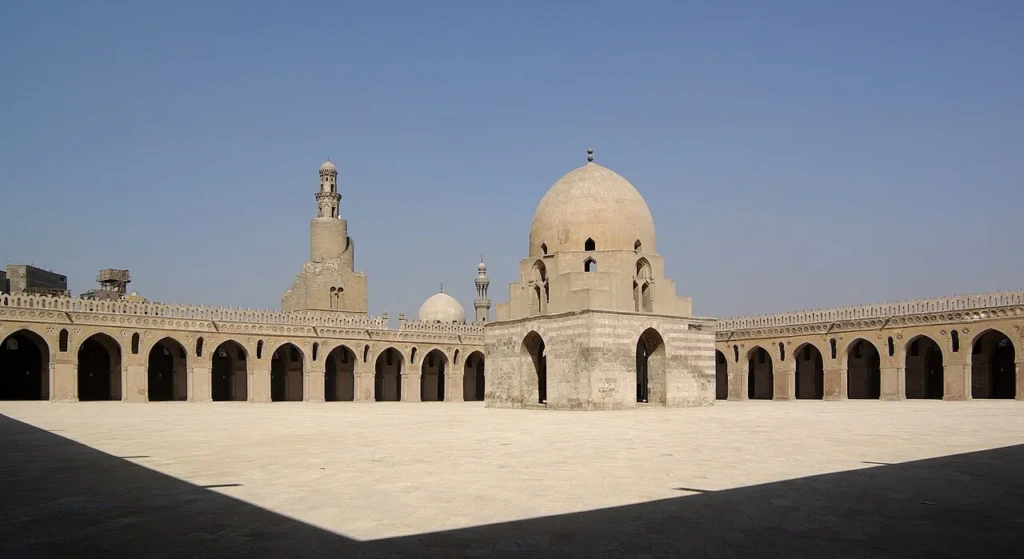
The courtyard is the heart of the visit: a huge, open square framed by arcades of pointed arches. In the center stands a domed fountain kiosk for ablutions. It dates from Sultan Lajin’s restoration of 1296 and replaced an earlier Tulunid fountain that burned down. Stand near the kiosk and turn slowly; the repeating arches show the scale of the original plan better than any photo.
3. The stucco arches and windows
The edges of the arches and the window frames are carved with geometric and floral stucco. These designs were once brightly painted. The mosque has 128 windows covered with stucco grilles of different patterns, and only three or four of them are original from Ibn Tulun’s time; the rest come from later restorations. The southwest arcade preserves the most of the original decoration under its arches.
4. The prayer hall and the Quran frieze
The prayer hall on the qibla side is five aisles deep. Just below the ceiling runs a carved wooden frieze with Quranic verses in Kufic script. In total it was nearly 2 km long and held about one fifteenth of the Quran, though much of it is now fragmentary. It is the oldest surviving Islamic monument with religious inscriptions on this scale.
5. The six mihrabs and Lajin’s minbar
The mosque has six mihrabs, the niches that mark the direction of Mecca. The main one is concave and dates from the Tulunid period, with later Mamluk marble and glass mosaic. Five more are flat stucco panels from different eras, including one added in 1094 under the Fatimid vizier al-Afdal. Beside the main mihrab stands a wooden minbar (pulpit) given by Sultan Lajin in 1296, a fine early example of Mamluk woodwork.
6. The spiral minaret
The minaret stands in the outer enclosure, joined to the mosque by a bridge with horseshoe arches. A square base turns into a round shaft, and an external staircase spirals around both. A popular legend says Ibn Tulun designed it by absent-mindedly winding a strip of parchment around his finger. Historians still debate how much of the present tower is original and how much dates from later rebuilding, including Lajin’s work.
The Gayer-Anderson Museum Next Door
At the southeast corner of the mosque, two houses joined by a bridge form one of the best-preserved examples of domestic architecture in old Cairo. The ministry dates the first house to 1545 (built by the scholar Abd al-Qadir al-Haddad) and the second to 1631. A woman from Crete later owned one of them, which is why the complex is called Bayt al-Kritliyya, the House of the Cretan Woman.
Who was Gayer-Anderson?
Robert Gayer-Anderson was a British army doctor who served in Egypt from 1907. In 1935 he received permission to live in the restored houses, furnish them in traditional style and fill them with Pharaonic, Islamic and Asian antiquities. The agreement said the collection would pass to the Egyptian people when he left. He left in 1942 because of poor health, and the houses became the Gayer-Anderson Museum.
What to look for inside
- The courtyard and the Bats’ Well: A marble-floored court with a deep well tied to local legends, including the story that Noah’s Ark came to rest on this hill.
- The reception hall (qa’a): The main family room, with marble tables and a fragment of the green silk Kiswa textile.
- Mashrabiya screens: Carved wooden lattices that let women of the household look out without being seen.
- Themed rooms: A Persian room, a richly painted wooden Damascus room, and the Muhammad Ali Room, an Ottoman apartment with green and gold walls and rococo furniture.
- The roof terrace: Enclosed by mashrabiya and used, with the reception hall, as a filming location for the James Bond film The Spy Who Loved Me.
Opening Hours and Tickets
The following details are as listed on the official Ministry of Tourism and Antiquities sites in October 2026; check before you go.
| Site | Hours | Foreign adult | Foreign student |
|---|---|---|---|
| Ibn Tulun Mosque | 9:00 am – 5:00 pm daily | No fee listed | No fee listed |
| Gayer-Anderson Museum | 9:00 am – 5:00 pm daily; ticket window closes 4:00 pm | EGP 100 | EGP 50 |
| Gayer-Anderson Museum in Ramadan | 9:00 am – 3:00 pm; ticket window closes 2:00 pm | EGP 100 | EGP 50 |
One caution: the ministry’s separate ticket price list (the latest version we could find, dated November 2024) shows the museum closing at 3:00 pm rather than 5:00 pm. Plan to arrive at the museum well before 3:00 pm to be safe.
Museum rules worth knowing
- Private photography is allowed inside after you pay for your ticket, but flash is not.
- Bags larger than 40 x 40 cm, umbrellas and sharp items go to the cloakroom.
- Food and drinks are not allowed in the galleries, apart from small water bottles.
- Children must stay with an adult at all times.
Respectful Visiting at the Mosque
Ibn Tulun is a working mosque, so dress and behavior matter. The UK government’s Egypt travel advice asks visitors to dress modestly, especially in mosques. Cover shoulders and knees, and women should carry a scarf to cover their hair. Remove your shoes where indicated before entering prayer areas.
Prayer times move through the year, so avoid arriving at prayer time and on Friday at midday. Keep your voice low, do not walk in front of people praying, and do not photograph worshippers. Our Egypt packing and dress guide has more on clothing that works across religious sites.
Best Time to Visit
Come in the morning, soon after the 9:00 am opening. You visit the museum before any early closing, and the courtyard is cooler before midday. The open courtyard has little shade, so a hat and water help from spring to autumn. Our guide to the best time to visit Egypt explains how temperatures change through the year.
How to Combine It With Nearby Sights
The mosque stands in the Sayyida Zaynab district, close to the historic Saliba Street that the ministry describes as running from the Citadel square. That makes it easy to pair with the Citadel and the mosques around it in one day. Our Old Cairo and Citadel private tour, from $100 per person, visits the Citadel, the Mosque of Muhammad Ali, Khan el-Khalili and Coptic Cairo. Ibn Tulun is not part of its listed itinerary, so ask us if you want it added in a custom version.
For a longer stay in the capital, the Taste of Egypt 4-day Cairo tour starts from $535 per person and covers Giza, the Grand Egyptian Museum and Old Cairo. With only a few days, a simple plan is one day in Islamic Cairo and another on the Grand Egyptian Museum and Giza Pyramids private tour, from $95 per person. You can browse more options among our private Cairo day tours, and our Cairo travel guide helps you group sights by area.
Visit With Delta Tours Egypt
We do not run a fixed tour dedicated to Ibn Tulun and the Gayer-Anderson Museum. We can arrange a private visit on request, with an Egyptologist who knows Islamic Cairo and a driver who handles the traffic. Share your interests on our tailor-made Egypt tours page, and we will build the day around the mosque, the museum and any nearby monuments you want to add.
Frequently Asked Questions
Is the Ibn Tulun Mosque free to visit?
The ministry’s official price list shows no entrance fee for the mosque. The Gayer-Anderson Museum next door has its own ticket. As of October 2026, foreign adults pay EGP 100 there.
What are the opening hours of the Ibn Tulun Mosque?
The ministry lists 9:00 am to 5:00 pm every day. As an active mosque, it may be busy or less accessible during prayer times. Avoid Friday midday prayers.
How old is the Ibn Tulun Mosque?
It was built between 876 and 879 CE. It is the oldest mosque in Egypt that largely keeps its original form. The fountain kiosk and minbar were added during Sultan Lajin’s 1296 restoration.
Can I climb the minaret of Ibn Tulun?
We could not confirm current access rules for the minaret from an official source. Ask your guide on the day, as access to monuments can change for safety or restoration reasons. The view of the minaret from the courtyard is worth the visit on its own.
Is the Gayer-Anderson Museum worth visiting?
Yes, if you want to see how wealthy Cairo families lived in the Ottoman period. The rooms, mashrabiya screens and roof terrace give a sense of daily life that mosques and palaces do not. It sits right beside the mosque, so it adds little travel time.
What should I wear to the Ibn Tulun Mosque?
Wear loose clothes that cover shoulders and knees. Women should bring a scarf for their hair. Easy slip-on shoes help, since you remove them before entering prayer areas.
Ibn Tulun and the Gayer-Anderson Museum show two sides of Cairo’s past in one visit: a 9th-century imperial mosque and the private homes that grew up against its walls. To plan your own day in Islamic Cairo, start with our tailor-made tours team.
Featured image: Courtyard and ablution fountain of the Mosque of Ibn Tulun, Cairo. Photo: Berthold Werner / Wikimedia Commons, CC BY 3.0