Al Muizz Street: Islamic Cairo Walking Guide & Tickets
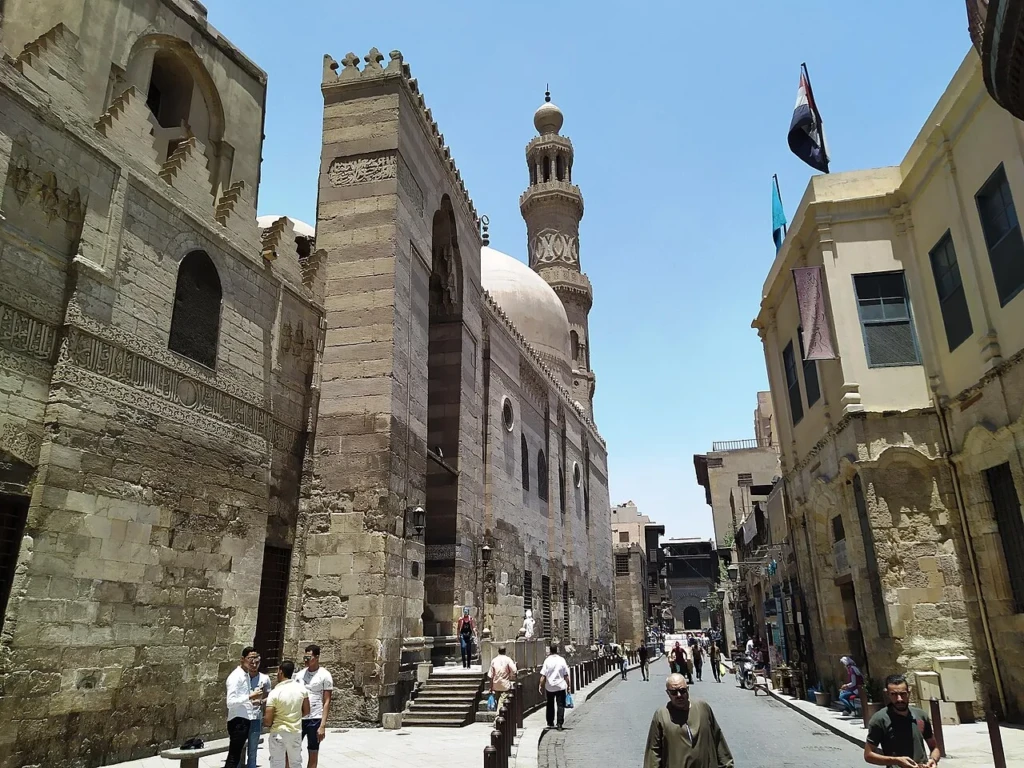
Al Muizz Street is the main historic street of Islamic Cairo. It runs about 1 kilometer (0.6 miles) from the Fatimid gate of Bab al-Futuh in the north to Bab Zuwayla in the south. The Ministry of Tourism and Antiquities counts 29 monuments along it, built between the 10th and 19th centuries. Walking it from end to end, with stops inside the best buildings, takes most of a morning.
This walking guide explains the street’s history, the monuments to see in north-to-south order, the official area ticket, and practical tips for a first visit.
Al Muizz Street: Quick Facts
| Fact | Details |
|---|---|
| Location | Historic walled city of Cairo (Islamic Cairo), between Bab al-Futuh and Bab Zuwayla |
| Length | About 1 km (0.6 miles) inside the old walls |
| Founded | With the city of Cairo by the Fatimids, from 969 to 970 AD |
| Named after | Fatimid Caliph al-Muizz li-Din Allah, who ruled Egypt 969 to 975 AD; the street took his name in 1937 |
| Monuments | 29, from the Fatimid period to the Muhammad Ali dynasty, according to the Ministry |
| World Heritage status | Part of Historic Cairo, UNESCO World Heritage List, 1979 |
| Foreigner area ticket | EGP 220 adult / EGP 110 student (details below) |
| Time needed | Our planning suggestion: 2.5 to 4 hours on foot |
What Is Al Muizz Street, and Why Does It Matter?
When the Fatimid dynasty conquered Egypt in 969, their general Jawhar al-Siqilli laid out a new royal city northeast of Fustat, the existing capital. It was called al-Qahira, “the Victorious,” which gave us the name Cairo. A main avenue ran north to south through it, linking the city gates.
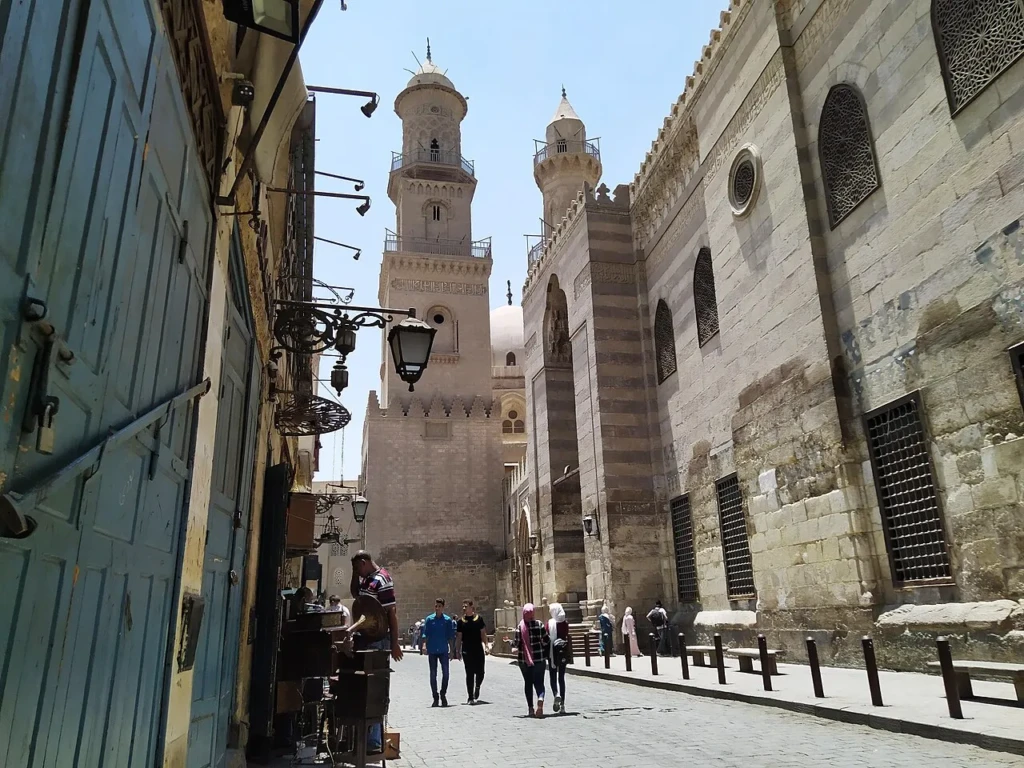
Two great Fatimid palaces stood near the middle of that avenue. The open space between them was called Bayn al-Qasrayn, “Between the Two Palaces.” In those years, Cairo was a closed royal city. Ordinary people lived in Fustat.
That changed after Saladin ended Fatimid rule in 1171. The royal city opened up, and the seat of power moved to the new Citadel. The avenue, known as the Qasaba, became Cairo’s main market street. Sultans and emirs still wanted to build along it, and the Mamluk period in particular filled it with mosques, schools, tombs and fountains.
An open-air museum of Islamic architecture
The Ministry of Tourism and Antiquities describes al-Muizz as the largest open-air museum of Islamic monuments in the world. It sits within Historic Cairo, which joined the UNESCO World Heritage List in 1979. The buildings range from religious and domestic to commercial and defensive.
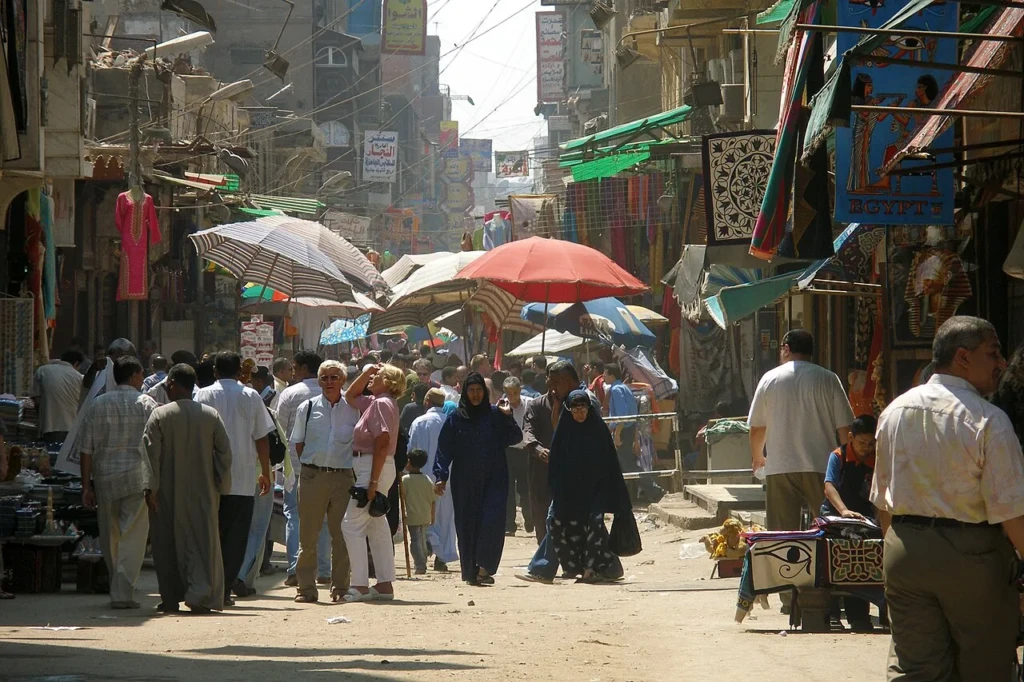
Since 1997, the government has restored monuments, repaved the street in a traditional style and added exterior lighting. Shops, vendors and local crafts still line the way, so it remains a working street as well as a historic one.
How Al-Azhar Street splits the route
In the 20th century, the busy Al-Azhar Street was cut across the old city. It divides al-Muizz into a northern section, with most of the major monuments and Khan el-Khalili, and a shorter southern section that leads to Bab Zuwayla. You cross it on foot midway through the walk.
Walking Al Muizz Street: What to See, North to South
Starting at the northern gate and walking south is the classic route. It follows the order most monuments are listed by the Ministry and by historians. Here are the key stops.
1. Bab al-Futuh and the northern walls
Bab al-Futuh, the “Gate of Conquests,” was built in 1087 by the vizier Badr al-Jamali. It replaced an older gate, and Cairenes kept the old name. Look up at the platform between its rounded towers. Shafts in its floor allowed defenders to pour boiling oil on attackers. The Ministry lists entry as free.
2. Mosque of al-Hakim bi-Amr Allah
Just inside the gate is this large Fatimid mosque, completed in 1013. The Ministry describes it as the fourth oldest mosque in Egypt. It is one of the few Fatimid buildings on the route, alongside the gates and al-Aqmar.
3. Mosque and Sabil of Sulayman Agha al-Silahdar
Built in 1839 by Sulayman Agha, an official in the service of Muhammad Ali Pasha, this is one of the youngest monuments on the walk. Its main facade faces the street, and it includes a public water fountain (sabil).
4. Bayt al-Suhaymi in Darb al-Asfar
Turn into the lane of Darb al-Asfar for one of the finest old houses in Cairo. The first part was built in 1648 and a second section in 1796. The two were later joined and named after the last owner, Sheikh Muhammad Amin al-Suhaymi.
The house is built around a courtyard garden. Look for the carved wooden mashrabiya window screens, the raised sitting loggia (maq’ad), a reception hall, a bath and the wooden gear of a waterwheel. Bayt al-Suhaymi needs its own ticket (see below).
5. Al-Aqmar Mosque
Back on the main street, this small Fatimid mosque dates to 1125. Its front is one of the oldest surviving stone facades in Egypt, carved with Kufic inscriptions. The builder angled the facade to the street while keeping the prayer hall facing Mecca. The facade of Cairo’s Coptic Museum was later modeled on it. The Ministry lists entry as free.
6. Qasr Bashtak and Hammam Inal
The palace of the Mamluk emir Bashtak dates to 1339. Nearby is the bathhouse of Sultan Inal, from 1456. Both are on the area ticket.
7. Bayn al-Qasrayn: Barquq, al-Nasir Muhammad and Qalawun
This is the heart of the walk. Three Mamluk complexes stand side by side where the Fatimid palaces once were.
- Madrasa and Khanqah of Sultan Barquq (1384 to 1386). A school for the four main schools of Islamic law, a mosque and a Sufi lodge. The prayer hall has a marble mihrab, a wooden pulpit and colored marble panels.
- Madrasa of al-Nasir Muhammad (1296 to 1303). Its marble entrance once served as the gate of a church in Acre. Look for the square minaret with fine stucco decoration and the rare plaster mihrab inside.
- Complex of Sultan Qalawun (1283 to 1284). A mosque, a school, the sultan’s mausoleum and a hospital, or bimaristan. The Ministry notes that the hospital treated people with nervous and psychological illnesses. Look at the entrances, decorated with gold and silver gilding and geometric and floral designs.
Close by is the Madrasa of al-Salih Ayyub, from 1250, built under the Ayyubid dynasty that came before the Mamluks.
8. Khan el-Khalili
South of Bayn al-Qasrayn, the bazaar district of Khan el-Khalili opens off the street to the east. It grew in the Mamluk period and spread toward the shrine of al-Hussein and al-Azhar Mosque. This is the natural place to pause for tea or shopping.
9. The Sultan al-Ghuri complex
Cross Al-Azhar Street to reach the complex of Sultan al-Ghuri, built in 1503 to 1504. It stands on both sides of the street. A mosque and school are on one side. A mausoleum, Sufi lodge, water fountain and Quran school are on the other. A wooden roof spans the street between the two halves and shelters a textile market.
Al-Ghuri was never buried in his domed mausoleum. He died in the Levant in 1516. The complex has its own ticket.
10. Mosque of al-Muayyad Shaykh
Near the southern end is the mosque of Sultan al-Muayyad Shaykh, built from 1415 to 1421. The story goes that he was once held prisoner on this spot and promised to build a mosque here if he became sultan. He kept his word.
11. Bab Zuwayla
The walk ends at Bab Zuwayla, the southern gate, built in 1092. Al-Muayyad Shaykh set the two minarets of his mosque on top of its towers. The gate has its own ticket. The gate saw the end of Mamluk rule in 1517, when the Ottoman sultan Selim I had the last Mamluk sultan, Tumanbay, hanged here.
Opening Hours and Tickets
The hours and foreigner prices below are as listed on the official Ministry of Tourism and Antiquities site in October 2026; check before you go.
| Ticket or site | Foreign adult / student | Listed hours |
|---|---|---|
| Al-Muizz area ticket | EGP 220 / EGP 110 | Daily, 9:00 am to 5:00 pm |
| Bayt al-Suhaymi (separate) | EGP 220 / EGP 110 | 9:00 am to 5:00 pm; Friday to 4:00 pm |
| Sultan al-Ghuri complex (separate) | EGP 150 / EGP 75 | Daily, 9:00 am to 5:00 pm |
| Bab Zuwayla (separate) | EGP 100 / EGP 50 | Daily, 9:00 am to 5:00 pm |
| Al-Aqmar Mosque | Free | Daily, 9:00 am to 4:00 pm |
| Bab al-Futuh | Free | Not listed |
According to the Ministry’s Al-Muizz Street page, the area ticket covers the site plus the Qalawun complex, the Mosque and Sabil of Sulayman Agha al-Silahdar, the Madrasa of al-Kamil, the Madrasa of al-Nasir Muhammad, the Madrasa of Barquq, the Musa bin Maimun synagogue, Hammam Inal and Bashtak Palace. It does not cover Bayt al-Suhaymi or Wekalet Bazaraa.
Note that the Ministry lists the Qalawun, Barquq and al-Nasir Muhammad buildings as open 9:00 am to 4:00 pm. Plan to reach Bayn al-Qasrayn well before 4:00 pm.
How to Get to Al Muizz Street
Most visitors arrive by car or taxi and start at one end. For the north-to-south walk, ask to be dropped at Bab al-Futuh. If you prefer to start near the bazaar, the Khan el-Khalili and al-Hussein area is in the middle of the route.
Traffic in central Cairo is unpredictable, so we have not printed drive times. Your driver or guide will confirm timing. Arranging a pickup at Bab Zuwayla saves you from walking back the same way.
Best Time to Visit and Practical Tips
Start in the morning. Most interiors close at 4:00 or 5:00 pm, and the cooler hours make the walk easier. The cooler months are the most comfortable for a long walk on foot.
After the monuments close, you can still see the restored facades lit up from the street. Your guide can tell you whether an evening stroll fits your plans.
Tips for the walk
- Wear comfortable shoes. You will be on your feet for several hours, and you may remove your shoes inside mosques.
- Dress modestly. Covered shoulders and knees are the respectful norm in mosques, and women may be asked to cover their hair. Follow any instructions from site staff. Our guide on what to pack and wear in Egypt has more advice.
- Avoid Friday midday prayers if you want to step inside the mosques that are still in use.
- Carry small Egyptian pounds. They are useful for tea, snacks and tipping site attendants.
- Take a break in Khan el-Khalili. It sits halfway, which makes it a natural rest stop. Our list of traditional Egyptian dishes to try will help you order.
- Consider a guide. A good guide can read the inscriptions with you and explain who built what, and why.
How to Combine Al Muizz Street With Nearby Sites
Al-Muizz is the backbone of Islamic Cairo, and several other sites are close by. Al-Azhar Mosque and the shrine of al-Hussein are close to Khan el-Khalili. Beyond Bab Zuwayla, the old road continues south through al-Khayamiya, the street of the tentmakers.
A full day might pair this walk with the Citadel, or with a museum visit in the morning and the street in the afternoon. For the city’s other neighborhoods, museums and hotels, start with our Cairo travel guide. If you want ancient Egypt on the same trip, our Egyptian Museum in Tahrir guide covers the downtown collection.
Visit With Delta Tours Egypt
We do not have a fixed al-Muizz walking tour, but we can arrange a private walk with an English-speaking guide on request through our tailor-made Egypt tours. Tell us how much time you have, and we will plan it around the monuments you want to enter.
If you prefer a ready-made day, our private Old Cairo and Citadel tour includes the lanes of Khan el-Khalili and is from $100 per person. The Taste of Egypt 4 Day Cairo tour, from $535 per person, includes an evening in Khan el-Khalili. On a long connection, the Cairo airport layover tour visits the pyramids and the bazaar and is from $180 per person.
Frequently Asked Questions
How long is Al Muizz Street?
The historic section runs about 1 kilometer (0.6 miles) from Bab al-Futuh to Bab Zuwayla. The road continues south beyond the old walls under other names.
Is there an entrance fee for Al Muizz Street?
The Ministry of Tourism and Antiquities lists an area ticket of EGP 220 for foreign adults and EGP 110 for foreign students, as of October 2026. It covers several monuments. Bayt al-Suhaymi, the al-Ghuri complex and Bab Zuwayla have separate tickets.
What are the opening hours of Al Muizz Street?
The Ministry lists the area as open daily from 9:00 am to 5:00 pm. Several major buildings, including the Qalawun complex, close at 4:00 pm, so start early.
How much time do I need for Al Muizz Street?
Our planning suggestion is 2.5 to 4 hours. That allows time inside the main complexes, a visit to Bayt al-Suhaymi and a break in Khan el-Khalili.
Which monuments should I not miss on Al Muizz Street?
If time is short, focus on Bayn al-Qasrayn, with the Qalawun, al-Nasir Muhammad and Barquq complexes. Add Bayt al-Suhaymi for domestic life and end at Bab Zuwayla, the southern gate.
Is Al Muizz Street the same as Khan el-Khalili?
No. Al-Muizz is the long historic street. Khan el-Khalili is the bazaar district that opens off its eastern side, roughly halfway along the walk.
Want Islamic Cairo in a private, well-paced day? Share your interests through our tailor-made tours page, or browse our private Cairo day tours for ready-made options.
Featured image: Madrasa of al-Nasir Muhammad, Muizz Street Cairo. Photo: Radosław Botev / Wikimedia Commons, CC BY 3.0 pl