Unfinished Obelisk, Aswan: History, Tickets & Visiting Tips
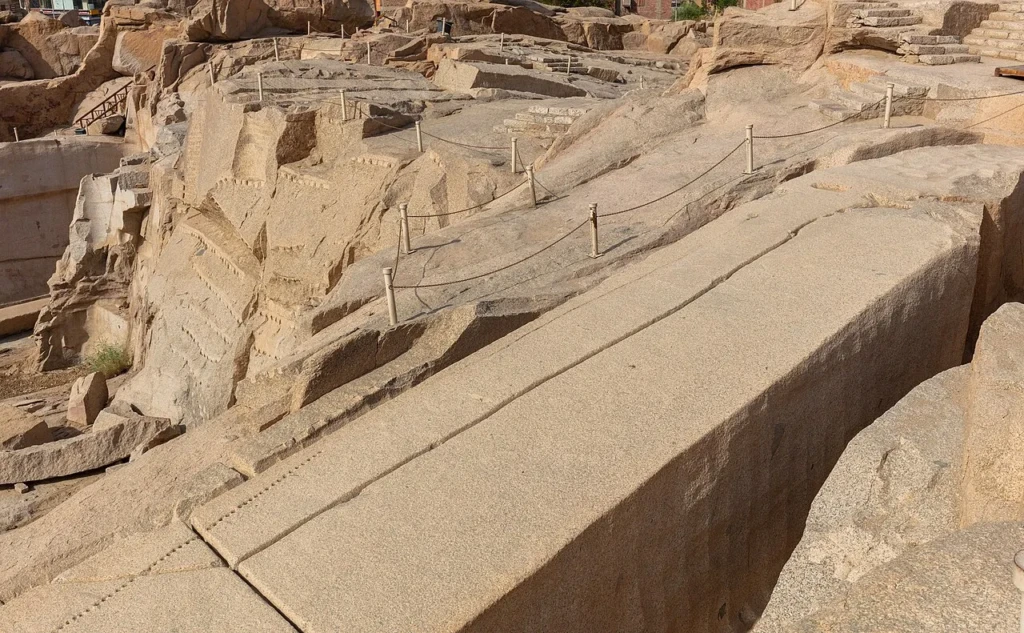
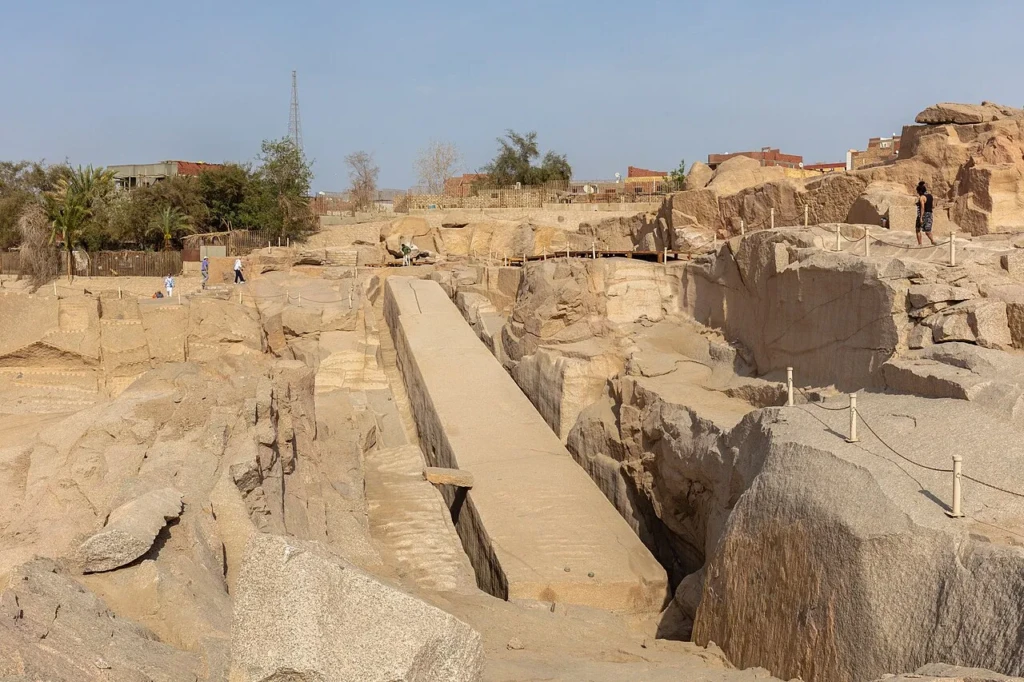
The Unfinished Obelisk is a giant granite obelisk that still lies in an ancient quarry in Aswan, abandoned after cracks appeared in the stone. Had it been completed, it would have stood around 42 meters tall and weighed about 1,168 tonnes, taller than any obelisk ancient Egypt ever raised. A visit takes under an hour and shows you, better than any temple, how the Egyptians cut their biggest monuments out of solid rock.
This guide covers what the obelisk is, why it was left behind, what to look for on site, the official opening hours and ticket price, and how to fit it into a day in Aswan.
The Unfinished Obelisk at a Glance
| Fact | Details |
|---|---|
| Location | The northern ancient granite quarries, Aswan, southern Egypt |
| Period | New Kingdom, 18th Dynasty; believed to date to the reign of Hatshepsut (c. 1473–1458 BC) |
| Commissioned by | Believed to be Queen Hatshepsut, for the Temple of Amun at Karnak |
| Planned size | About 42 m (138 ft) tall and 1,168 tonnes, per the Ministry of Tourism and Antiquities |
| Why unfinished | Flaws and multiple fissures in the granite |
| World Heritage | Part of the UNESCO site “Nubian Monuments from Abu Simbel to Philae” (inscribed 1979) |
| Opening hours | Daily, 7:00 AM to 4:00 PM (official listing, October 2026) |
| Foreign adult ticket | EGP 220 (student EGP 110) |
| Time on site | Our planning suggestion: 45 minutes to 1 hour |
What Is the Unfinished Obelisk?
An obelisk is a tall, four-sided stone shaft cut from a single block and topped with a small pyramid. The ancient Egyptians called it tekhen. Kings usually set them up in pairs at temple gateways. The pyramid-shaped tip, the pyramidion, was often covered in gold so it caught the first and last light of the day.
Obelisks were solar symbols. The Ministry of Tourism and Antiquities links them to the benben, the mound of earth that, in Egyptian myth, rose from the waters at the start of creation and on which the sun god first stood. Carving a king’s names and dedications on the four faces tied that ruler to the sun and to the gods of the temple.
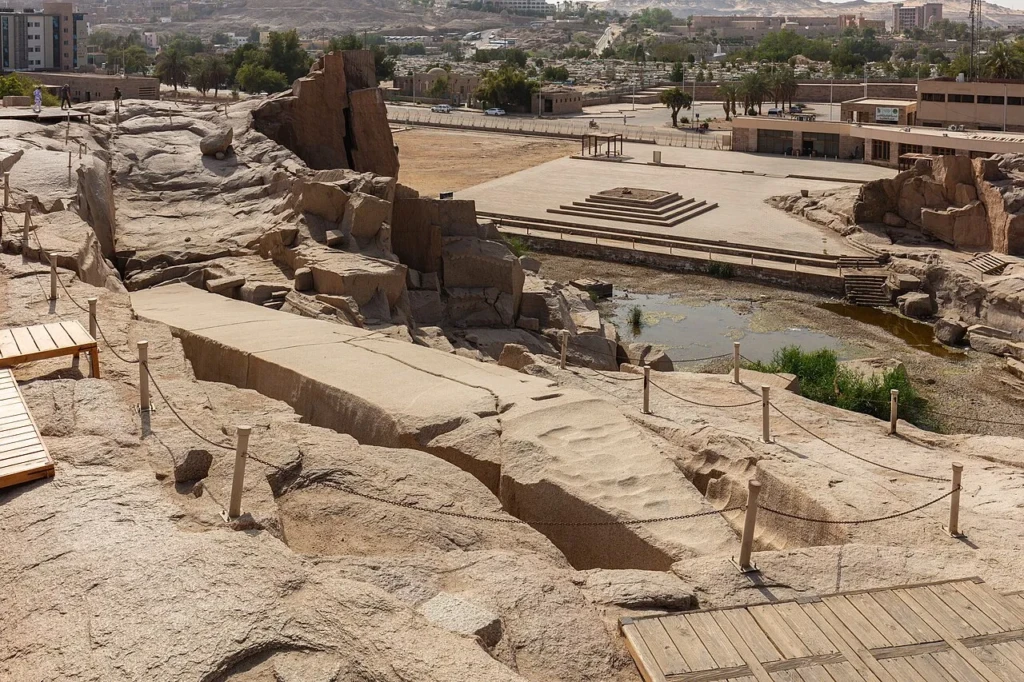
The Unfinished Obelisk is one of these shafts, caught partway through production. Its upper face and sides were cut free, but its underside is still fused to the bedrock. It lies on its side in the quarry where it was begun, roughly where workers left it some 3,500 years ago.
Why Was It Never Finished?
The short answer is the stone itself. As the workers deepened the trenches around the shaft, cracks appeared in the granite. The official site describes “flaws in the stone and the presence of multiple fissures.” An obelisk had to come out in one perfect piece. A crack running through the shaft meant it would snap during lifting or transport, so the project was abandoned.
Scholars believe Queen Hatshepsut ordered it for the Temple of Amun at Karnak in Thebes, modern Luxor. Wikipedia notes one theory that it was meant to pair with the obelisk now known as the Lateran Obelisk, which once stood at Karnak and was later taken to Rome. Neither link is proven, which is why every serious source says “believed” or “possibly.”
The sheer ambition is the point. At around 42 meters, it would have been roughly a third larger than any obelisk the Egyptians actually erected. Estimates of its weight vary a little by source. The Ministry gives 1,168 tonnes, while Wikipedia gives nearly 1,090 tonnes. Either way, it is far heavier than anything raised at Karnak.
When Was It Rediscovered?
Sand covered the quarry for thousands of years. The obelisk was uncovered in the early twentieth century, and the engineer Reginald Engelbach studied it in detail in 1922. Since then it has become the best-known feature of the Aswan quarries. Wikipedia also reports that an unfinished, partly worked obelisk base was found in the same quarries in 2005, a reminder that this area was a working industrial zone for centuries.
Why the Quarry Matters More Than the Obelisk
Most monuments in Egypt show you the finished result. The quarry shows you the process. That is why Egyptologists value it, and why it is worth a stop even if you have seen a dozen temples.
Aswan was famous for hard, high-quality granite. Stone from these quarries traveled north by river to temples and tombs across Egypt. Standing in the cutting, you can see how workers marked out a shape on the rock, sank trenches around it, and planned to free it from below. Tool marks are still visible on the stone, and Wikipedia notes ochre-colored lines that workers painted to guide their cutting.
This turns a cracked block of granite into a lesson in engineering. It answers a question many travelers ask at Karnak or Luxor Temple: how did they get these huge shafts out of the ground in the first place?
What to See at the Unfinished Obelisk, in Visiting Order
The site is compact, and a walking route takes you around the quarry so you can study the obelisk from more than one angle. Your guide will point out details as you go.
1. The Approach and the Quarry Walls
Before you reach the obelisk, look at the rock faces around you. This is the same hard granite that supplied temples far to the north. Ask your guide to show you the worked surfaces that are easiest to read from the path, so you know what to look for when you reach the shaft itself.
2. The Obelisk from Above
Find a spot where you can look along the full length of the shaft. From here the scale becomes clear. Follow the outline from the wide base to the narrowing upper end and imagine it standing upright at a temple gate. This is where most visitors take their photos.
3. The Cracks
Look for the fissures that ended the project. Seeing where the stone failed makes the story real. It also shows how much labor was lost: workers had already cut the shaft’s top and sides before the flaws made it unusable.
4. The Trenches and Tool Marks
The channels around the obelisk are where workers stood and cut. Their tool marks are still on the stone. Your guide can explain the main theories about how the granite was worked, and how the finished obelisk would have been freed and moved to the river.
5. The Wider Quarry
Take a few minutes to look beyond the obelisk. The surrounding rock shows other areas of ancient cutting. The whole quarry zone is protected as an archaeological site, so stay on marked paths.
Opening Hours and Ticket Prices
The Unfinished Obelisk is open every day of the week, from 7:00 AM to 4:00 PM. The foreign adult ticket costs EGP 220, and a foreign student ticket costs EGP 110. These figures are as listed on the official Ministry of Tourism and Antiquities site in October 2026; check before you go, as Egyptian site prices change from time to time.
| Ticket | Price |
|---|---|
| Foreign adult | EGP 220 |
| Foreign student | EGP 110 |
| Egyptian adult | EGP 20 |
| Egyptian student | EGP 10 |
You can check the current listing on the Ministry of Tourism and Antiquities page for the Unfinished Obelisk. Student prices normally require a valid student card. The official page does not list a separate camera fee, so we have not included one.
How to Get There and How Long It Takes
The obelisk sits in the northern ancient quarries within Aswan itself. Most visitors arrive by car with a driver or as part of a guided city tour, often combined with Philae Temple and the High Dam. The Ministry’s Aswan overview lists the granite quarries and the Unfinished Obelisk among the city’s main sites, alongside Elephantine Island, the Monastery of St Simeon and the Nubian Museum.
Drive times depend on where your hotel or cruise ship is moored and on traffic. Your driver or guide will confirm timing on the day. On a Nile cruise, the obelisk is usually seen during the Aswan sightseeing program rather than as a separate trip.
Is the Unfinished Obelisk Worth Visiting?
For most travelers, yes, as long as you know what you are coming to see. This is not a decorated temple. There are no painted walls or carved scenes. What you get is a clear, physical answer to how ancient Egyptians produced their largest monoliths, and an impressive sense of scale.
It suits you well if:
- You enjoy engineering, construction history or “how did they do it” questions.
- You plan to see obelisks at Karnak or Luxor Temple and want context.
- You want a short stop that fits easily into a half-day Aswan tour.
It may matter less if you have very limited time in Aswan and must choose between it and a major temple such as Philae. In that case, Philae comes first, and the obelisk is a good addition if your schedule allows both.
Best Time to Visit
The quarry is open rock with little shade, and Aswan is one of the hottest places in Egypt. Go early, close to the 7:00 AM opening, or in mid-afternoon in the cooler months, keeping in mind the 4:00 PM closing time. Softer light also helps the trenches and tool marks show up better in photos.
For the season, the cooler months are more comfortable for any outdoor site in southern Egypt. Plan the hottest months around early starts.
Practical Tips for Your Visit
- Wear shoes with grip. You are walking in a working quarry, not on a paved plaza.
- Bring water, a hat and sunscreen. There is little shade in the quarry.
- Stay on marked paths. The quarry is a protected archaeological site.
- Ask your guide about tool marks. They are easy to miss without someone pointing them out.
How to Combine the Unfinished Obelisk with Nearby Sites
The obelisk works best as one stop in a wider Aswan day. Common pairings include:
- Philae Temple. The island temple of Isis, reached by boat. Read our Philae Temple guide for history and highlights. In the evening you can return for the Philae Temple Sound and Light Show in Aswan, from $60 per person.
- A Nubian village. A relaxed afternoon by boat. See our Nubian village guide, or book the Nubian Village Tour from Aswan by Boat, from $50 per person.
- Abu Simbel. The great temples of Ramesses II lie around 300 km south of Aswan, according to the Ministry. Most travelers give them a separate day. See our Abu Simbel temples guide and the Abu Simbel by Car day trip, from $120 per person.
For a full picture of the city, our Aswan travel guide covers where to stay, what to do and how many days to plan. If you are sailing, the Luxor to Aswan Nile cruise guide shows how Aswan fits into a typical itinerary.
Visit with Delta Tours Egypt
Our Aswan Day Tour is from $85 per person and is built around Aswan’s key sights. Tell us you want the Unfinished Obelisk on your route and we will confirm it when you book. If you want more time in the south, browse our Aswan tours and excursions or a multi-day trip such as the 5 Days Cairo, Luxor & Abu Simbel Tour, from $1,030 per person.
Frequently Asked Questions
Where is the Unfinished Obelisk?
It lies in the northern ancient granite quarries in Aswan, southern Egypt. The quarry is within the city, so it is easy to add to a day of Aswan sightseeing. It is part of the UNESCO World Heritage site “Nubian Monuments from Abu Simbel to Philae.”
Who ordered the Unfinished Obelisk?
It is believed to have been commissioned by Queen Hatshepsut (c. 1473–1458 BC) for the Temple of Amun at Karnak. No inscription confirms this, so sources describe it as a likely attribution rather than a certainty.
How big would the Unfinished Obelisk have been?
The Ministry of Tourism and Antiquities says it would have stood around 42 meters tall and weighed 1,168 tonnes. Wikipedia gives a slightly lower weight of nearly 1,090 tonnes. Both put it well beyond any obelisk ancient Egypt actually raised.
How much is the ticket for the Unfinished Obelisk?
Foreign adults pay EGP 220 and foreign students EGP 110, as listed on the official Ministry site in October 2026. The site is open daily from 7:00 AM to 4:00 PM. Check the official page before you go, since prices can change.
How long do you need at the Unfinished Obelisk?
Our planning suggestion is 45 minutes to an hour. That gives time to walk the viewing paths, see the cracks and tool marks, and take photos without rushing.
Is the Unfinished Obelisk included in Aswan day tours?
It is a natural stop on an Aswan city day. Delta’s Aswan Day Tour is from $85 per person. Contact us to confirm the obelisk is on your route for your dates.
The Unfinished Obelisk is a short visit with a long story behind it, and it makes the rest of Egypt’s monuments easier to understand. To plan your days in the south, explore our Aswan tours and excursions and we will help you build the right route.
Featured image: The Unfinished Obelisk lying in its granite quarry in Aswan. Photo: Diego Delso / Wikimedia Commons, CC BY-SA 4.0