St Catherine Monastery: Visiting Hours, History and Tips
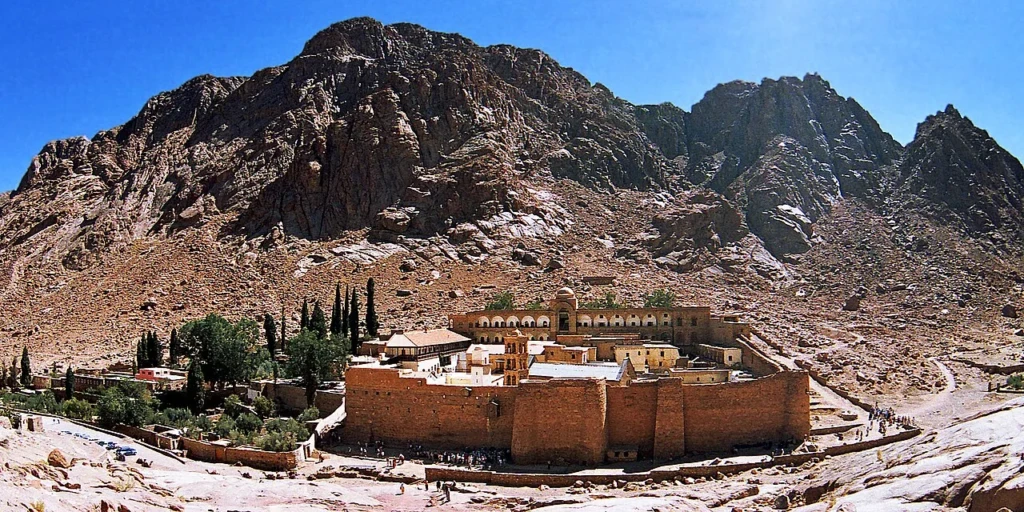
Most days, the gates of St Catherine’s Monastery open to visitors from 8:45 am to 12:45 pm. On Fridays the window shrinks to 10:30–11:30 am, and on Sundays the monastery is closed. Built on the orders of Emperor Justinian I between 548 and 565 AD at the foot of Mount Sinai, it is one of the oldest working Christian monasteries in the world.
This guide covers the monastery’s history, what you can see inside its walls, how to reach it, the official visiting hours, and how to fit it into a trip that also includes the Red Sea or Cairo.
| Quick facts | Details |
|---|---|
| Location | Town of Saint Catherine, South Sinai Governorate, at the foot of Mount Sinai (Jabal Musa) |
| Built | 548–565 AD, by order of the Byzantine Emperor Justinian I |
| Official name | The Sacred Monastery of the God-Trodden Mount Sinai |
| Named after | Saint Catherine of Alexandria, martyred in the early 4th century |
| Church | Greek Orthodox; run by the autonomous Church of Sinai |
| UNESCO status | Part of the Saint Catherine Area World Heritage Site, inscribed 2002 |
| Altitude of the town | About 1,586 m (5,203 ft) above sea level |
| Visiting hours | 8:45 am–12:45 pm; Friday 10:30–11:30 am; closed Sunday (official listing, October 2026) |
| Time needed | Our planning suggestion: 1.5 to 2 hours inside, plus the drive from your hotel |
What is St Catherine’s Monastery?
St Catherine’s is a walled Greek Orthodox monastery in the high mountains of southern Sinai. The Ministry of Tourism and Antiquities gives its formal name as the Sacred Monastery of the God-Trodden Mount Sinai. Everyone else calls it after the saint whose relics it keeps.
Monks were living in Sinai long before the walls went up. A pilgrim named Egeria described monastic life at the mountain in a Latin travel journal in the 380s AD. In the mid-6th century, Justinian I ordered a fortified monastery to house and protect these monks. The work ran from 548 to 565 AD.
The site was chosen for a reason. Christian tradition places the Burning Bush, where God spoke to Moses, inside the monastery grounds. Empress Helena, mother of Constantine the Great, had already built a small church over the spot in the 4th century. Justinian rebuilt it and enclosed it within his larger church.
Why is it named after Saint Catherine?
Catherine of Alexandria was martyred in the early 4th century. According to the monastery’s tradition, monks found her body on the nearby peak now called Mount Saint Catherine in the 9th century. Her relics were brought down to the monastery, which turned it into a major pilgrimage stop and, over time, gave it her name.
A place sacred to three faiths
Jews, Christians and Muslims all honor Moses, and all three traditions link him to this landscape. UNESCO cited that shared importance when it listed the Saint Catherine Area in 2002. A small mosque inside the walls shows how long that overlap has lasted. The Ministry dates it to 1106 AD, under the Fatimid Caliph al-Amir bi-Ahkam Allah, and notes that Muslim pilgrims heading to Mecca stopped here and left writings on its mihrab.
The monastery also holds a copy of the Ashtiname, a document that tradition says the Prophet Muhammad issued to grant his protection to the monks.
Survival through the centuries
The thick outer walls explain much of the monastery’s survival. Until the 20th century, visitors entered through a door set high in the wall rather than at ground level. The monastery was never caught up in the Byzantine destruction of religious images in the 8th and 9th centuries, which is why so many very early icons survive here.
Its history was not always calm. Wikipedia records a sharp decline in the late Mamluk period, when the community fell from several hundred monks in the mid-14th century to a few dozen a century later. Yet the monks never left, and the community has lived here without a break since the 6th century.
What to see inside the monastery
The complex is compact, and a visit follows a fairly natural loop. Which rooms are open can vary from day to day, so let your guide confirm what you can enter on the morning of your visit.
1. The fortified walls and the setting
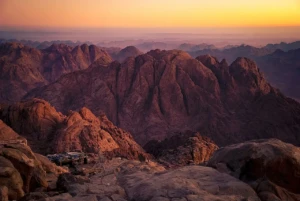
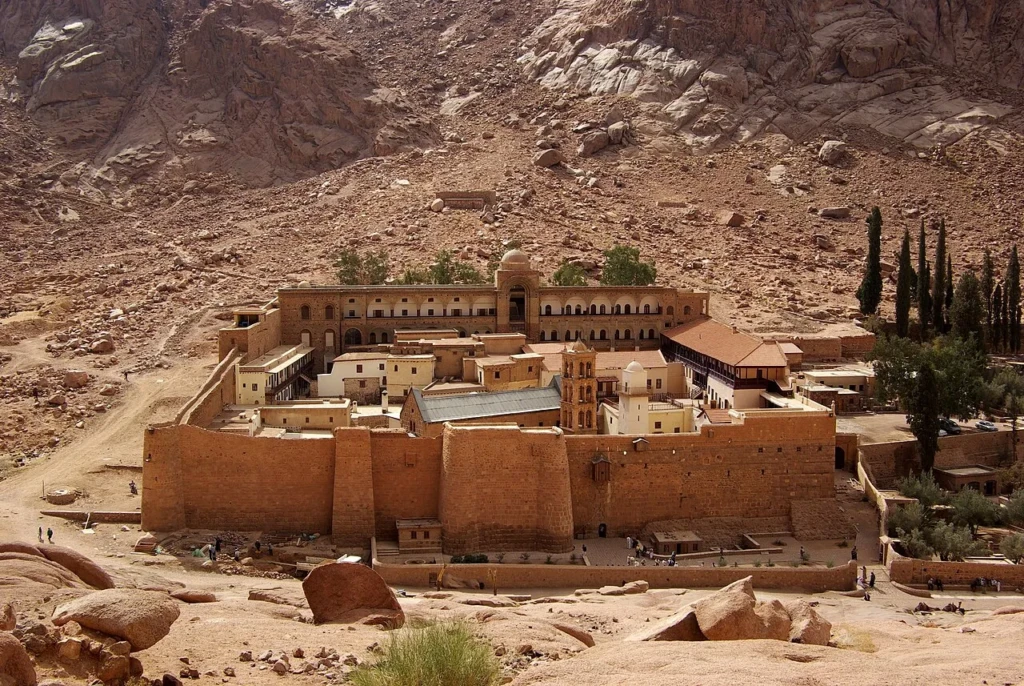
Start outside. The granite walls rise straight from the valley floor, with the mountains pressing in on every side. Willow Peak, which some identify with the biblical Mount Horeb, rises about 1 km to the west. Mount Sinai’s summit lies about 2 km to the south. Take a few minutes here before you go in, as the setting explains why monks chose this valley.
2. The Burning Bush
A large green bush grows against the outside wall of the main church. Tradition holds that it is the bush Moses saw burning but not consumed. The Ministry describes a small altar inside the church that marks the original spot of the bush, directly above its roots. The living plant now thrives just on the other side of the wall behind that altar.
3. The Well of Moses
Inside the walls is a well linked to the story of Moses meeting his future wife, Zipporah. It is still one of the monastery’s main sources of water, a practical reminder that this is a working community, not a museum.
4. The Church of the Transfiguration
This is the main church, built under Justinian. The Ministry notes that it contains nine smaller chapels, one of which is the Chapel of the Burning Bush. Wikipedia adds that the church’s king post roof truss is the oldest known surviving roof truss in the world.
The monastery is known for its early mosaics as well as its icons. The theme of the main church, the Transfiguration of Christ, also gives the monastery its main feast day.
5. The Fatimid mosque
Across from the main church, in the north-western part of the complex, stands the mosque from 1106 AD. Its minaret rises next to the church bell tower. The Ministry points out that its wooden minbar, or pulpit, is one of only three complete examples to survive from the Fatimid period.
6. The library and the icons
The monastery library is one of the most important in the Christian world. The Ministry counts around 6,000 manuscripts, the oldest from the 4th century AD. They include 2,319 in Greek, 600 in Arabic, 284 in Latin and 86 in Georgian. Guinness World Records lists it as the world’s oldest continuously operating library, according to Wikipedia.
Two of its most famous texts have unusual stories. The Codex Sinaiticus, a 4th-century Bible, was found here in the 19th century; the main part is now on display in the British Library in London. The Syriac Sinaiticus, a very early Gospel text written underneath a later one, was identified here in 1892 and remains at the monastery.
The icon collection is just as rare. It includes the earliest known image of Christ Pantocrator, painted in hot wax on a wooden panel. A conservation project on the library was completed in November 2017. Access to the library and the icons is not guaranteed on a standard visit, so ask your guide before you go.
7. The charnel house
The monks keep the bones of earlier generations in an ossuary, which the Ministry lists among the monastery’s buildings, along with an old olive press and a refectory. Whether it is open on your visit varies, and some visitors prefer to skip it.
Visiting hours and tickets
The official visiting window for St Catherine’s Monastery is listed on the official Ministry of Tourism and Antiquities site in October 2026 as follows. Check before you go, since a working monastery can change its hours for feast days and services.
| Day | Hours |
|---|---|
| Monday to Thursday, and Saturday | 8:45 am–12:45 pm |
| Friday | 10:30–11:30 am |
| Sunday | Closed |
The main Ministry listing for the monastery shows hours but no ticket price. A separate Ministry entry for the Church of the Burning Bush shows a foreigner ticket of EGP 140 for adults and EGP 70 for students, with different hours. The Ministry pages do not explain how the two listings relate, so confirm the current entry rules on arrival or with your tour operator.
One more thing to know. In late May 2025, an Egyptian appeals court ruled on the status of the land beneath and around the monastery. Orthodox Times reported that the monks then closed the gates to visitors in protest, with no reopening date given at the time. Wikipedia describes the case as still ongoing in early 2026. Because of this, check that the monastery is open to visitors in the week you plan to go.
How to get to St Catherine’s Monastery
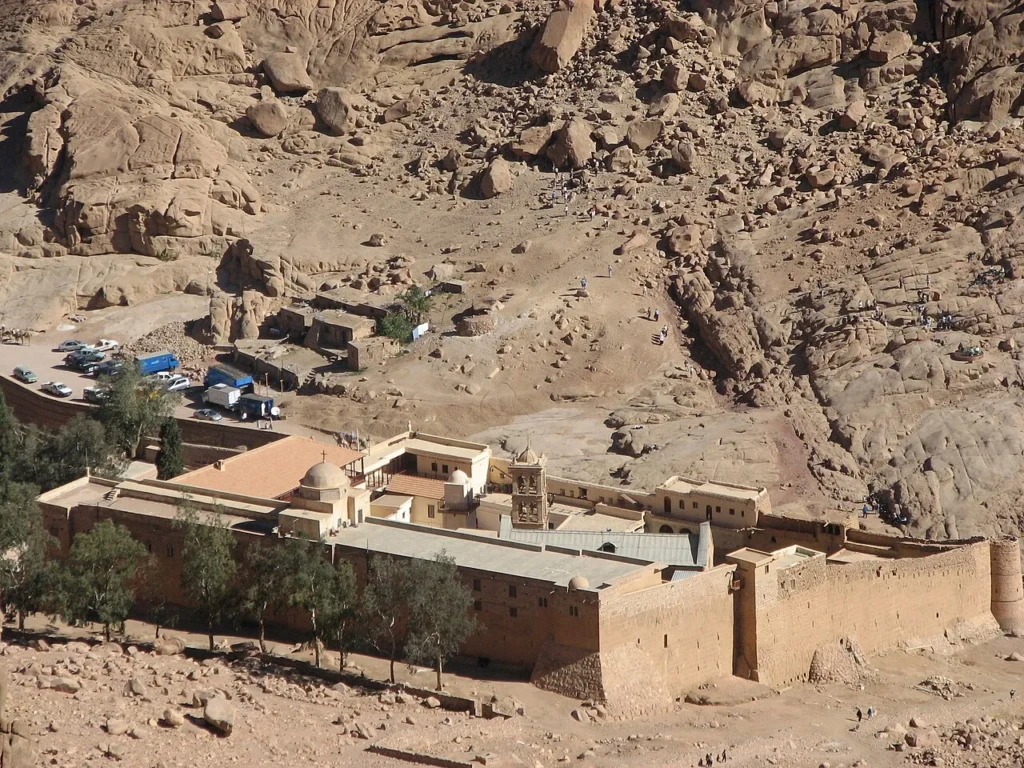
The monastery sits in the town of Saint Catherine, deep in the mountains of South Sinai. There is no rail link. Most visitors arrive by road, either on a day trip from the Red Sea coast or after staying overnight in the town.
From Sharm El Sheikh or Dahab
Sharm El Sheikh and Dahab are the usual bases. The road runs inland through desert valleys, with security checkpoints along the way. Drive times depend on the route and on stops at checkpoints, so your driver or guide will confirm timing when you book. Many visitors combine the monastery with a night climb of Mount Sinai, arriving in the town the evening before.
From Cairo
The town is a long drive from Cairo across the Suez Canal and down the peninsula. For most international travelers, flying to Sharm El Sheikh and driving from there is the more comfortable choice. Your operator can advise on the best routing for your dates.
A visa note for Sharm arrivals
The UK government’s travel advice explains a useful rule. If you fly into Sharm El Sheikh and stay under 15 days only in the resorts of Sharm, Dahab, Nuweiba or Taba, you get a free entry stamp instead of a visa. If you plan to travel outside those resorts, you need a full visa. A trip to St Catherine’s takes you outside them, so arrange a visa on arrival or an e-visa before you fly.
Is it safe to visit St Catherine’s Monastery?
Check official advice before you travel. As of its October 2026 review, the UK Foreign, Commonwealth & Development Office (FCDO) advises against all but essential travel to the northern part of South Sinai beyond the St Catherine–Nuweiba road, except for the coastal areas on the west and east of the peninsula. It describes travel to the Red Sea tourist areas of southern Sinai as generally low risk, with routine security checks protecting resorts such as Sharm El Sheikh.
The FCDO also says to book activities outside the resort areas through approved agents or tour operators. US citizens should read the current State Department advisory for Egypt as well. Our guide to whether it is safe to travel to Egypt right now explains how to read these notices calmly.
Best time to visit
The town sits at about 1,586 m (5,203 ft), so it feels very different from the beaches below. Wikipedia notes that Saint Catherine has the coldest nights of any town in Egypt. Snow falls occasionally between December and February. Spring and autumn usually give the most comfortable mix of cool mornings and sunny days. Our month-by-month guide to the best time to visit Egypt helps you match the mountains with the rest of your route.
Time of day matters even more. The monastery is open only in the morning, and Friday’s window is just one hour. Aim to be at the gate soon after it opens on a weekday. If you climb Mount Sinai for sunrise first, you will come down at about the right time to visit.
Practical tips for your visit
- Dress for a church. This is an active place of worship. We suggest covered shoulders and knees for everyone, and bringing a light scarf.
- Pack layers. Mornings at this altitude can be cold even when the coast is hot.
- Ask before you photograph. Rules for photography inside the churches are set by the monks and can differ by room. Your guide will tell you what is allowed on the day.
- Keep your voice low. Monks live and pray here. Services take priority over visits.
- Carry your passport. Expect security checks on the road and at the site.
- Bring some cash in Egyptian pounds. It is handy for small purchases in town.
Combining the monastery with other sights
Almost every visitor pairs the monastery with Mount Sinai. The mountain rises about 2 km south of the monastery, and the trails start just outside its walls. The classic plan is a night climb for sunrise, then breakfast and a monastery visit when the gates open.
The wider Saint Katherine Protectorate, declared in 1988, covers about 4,412 km² of high mountains and valleys around the town. Mount Catherine, at 2,629 m (8,625 ft), is the highest peak in Egypt. Local Jebeliya Bedouin families have long tended walled mountain gardens here.
Most travelers then return to the coast. Our Red Sea Egypt travel guide compares the beach resorts, and our Egypt travel guide shows how Sinai fits with Cairo, Luxor and a Nile cruise.
Visit with Delta Tours Egypt
Delta Tours Egypt does not currently sell a set St Catherine’s Monastery tour. We can arrange a private visit on request as part of a tailor-made Egypt tour, with timing built around the monastery’s short opening hours. Several of our packages already end with beach days in Sharm El Sheikh, including King Tut Dive, 10 days with Cairo, a Nile cruise and Sharm El Sheikh (from $1570 per person) and Hatshepsut Dive, 10 days with Cairo, a Nile cruise and Sharm El Sheikh (from $3160 per person). For a longer journey, see the Royal Egypt Tour, 14 days / 13 nights (from $7597 per person) or our 14 day Egypt family tour (from $7600 per person). Delta is a family-run operator licensed by the Ministry of Tourism (licence No. 121) and based in Cairo since 1974.
Frequently Asked Questions
What are the visiting hours of St Catherine’s Monastery?
The official Ministry listing gives 8:45 am to 12:45 pm, with Friday limited to 10:30–11:30 am. The monastery is closed on Sundays. Hours can change for religious feasts, so check before you go.
How much is the ticket to St Catherine’s Monastery?
The Ministry’s main monastery page does not list a ticket price. A separate entry for the Church of the Burning Bush lists EGP 140 for foreign adults and EGP 70 for students. Confirm the current rules on arrival.
Can you see the Burning Bush?
Yes, the bush that tradition links to Moses grows against the outside wall of the main church. An altar inside the church marks the spot above its roots. Your guide will show you where to view it.
How old is St Catherine’s Monastery?
It was built between 548 and 565 AD on the orders of Emperor Justinian I. Monks had lived in the area since at least the 4th century. It is one of the oldest continuously inhabited Christian monasteries in the world.
Do I need a visa to visit from Sharm El Sheikh?
Yes. According to UK government advice, the free Sinai entry stamp only covers stays in the resorts of Sharm, Dahab, Nuweiba and Taba. Travel to St Catherine’s takes you outside those resorts, so you need a full visa.
Can I visit the monastery and climb Mount Sinai on the same trip?
Yes, and most visitors do. The trails up Mount Sinai start beside the monastery. A night climb for sunrise brings you back down in time for the morning opening.
Thinking of adding Sinai to your Egypt trip? Tell us your dates through our tailor-made Egypt tours page, and we will plan a private route that fits the monastery’s morning hours.
Featured image: A full view of Saint Catherine's Monastery. Photo: Dr. Ondřej Havelka (cestovatel) / Wikimedia Commons, CC BY 4.0