The Hanging Church in Cairo: History and Visiting Tips
The Hanging Church is the Coptic Orthodox Church of the Virgin Mary in Old Cairo, raised on top of a gatehouse of the Roman Babylon Fortress so that its nave sits above an old passage. It is the best-known church in Cairo and one of the oldest in Egypt. The official Ministry site lists it as open daily from 9:00 AM to 4:00 PM, with no entry ticket listed.
Most visitors see it as part of a wider walk through Old Cairo, and our Cairo travel guide covers that district alongside the rest of the city. This page stays on the church itself: why it was built where it is, what to look for inside, and how to plan a calm, respectful visit.
The Hanging Church at a Glance
| Fact | Details |
|---|---|
| Official name | Saint Virgin Mary’s Coptic Orthodox Church; in Arabic, al-Kanisa al-Mu’allaqa (“the suspended church”) |
| Location | Old Cairo (the historic Fustat area), within the former enclosure of the Babylon Fortress, near the Coptic Museum |
| Period | Church history goes back to late antiquity; the first certain written mention is from the 9th century; rebuilt and restored many times since |
| Dedicated to | The Virgin Mary, with sanctuaries also dedicated to Saint John the Baptist and Saint George |
| Belongs to | The Coptic Orthodox Church of Alexandria |
| Hours | Daily, 9:00 AM to 4:00 PM (official Ministry listing) |
| Ticket | No ticket listed on the official Ministry page |
| Time needed | Our planning suggestion: 30 to 45 minutes for the church alone |
| Nearest metro | Mar Girgis station, Cairo Metro Line 1 |
Why Is It Called the Hanging Church?
The name is literal. The church was built over the southern gate of the Babylon Fortress, a Roman stronghold that guarded the mouth of an ancient canal beside the Nile. Its main hall rests on the old gate towers, and the passage below stays open. Seen from the right angle, the church seems to hang above the ground.
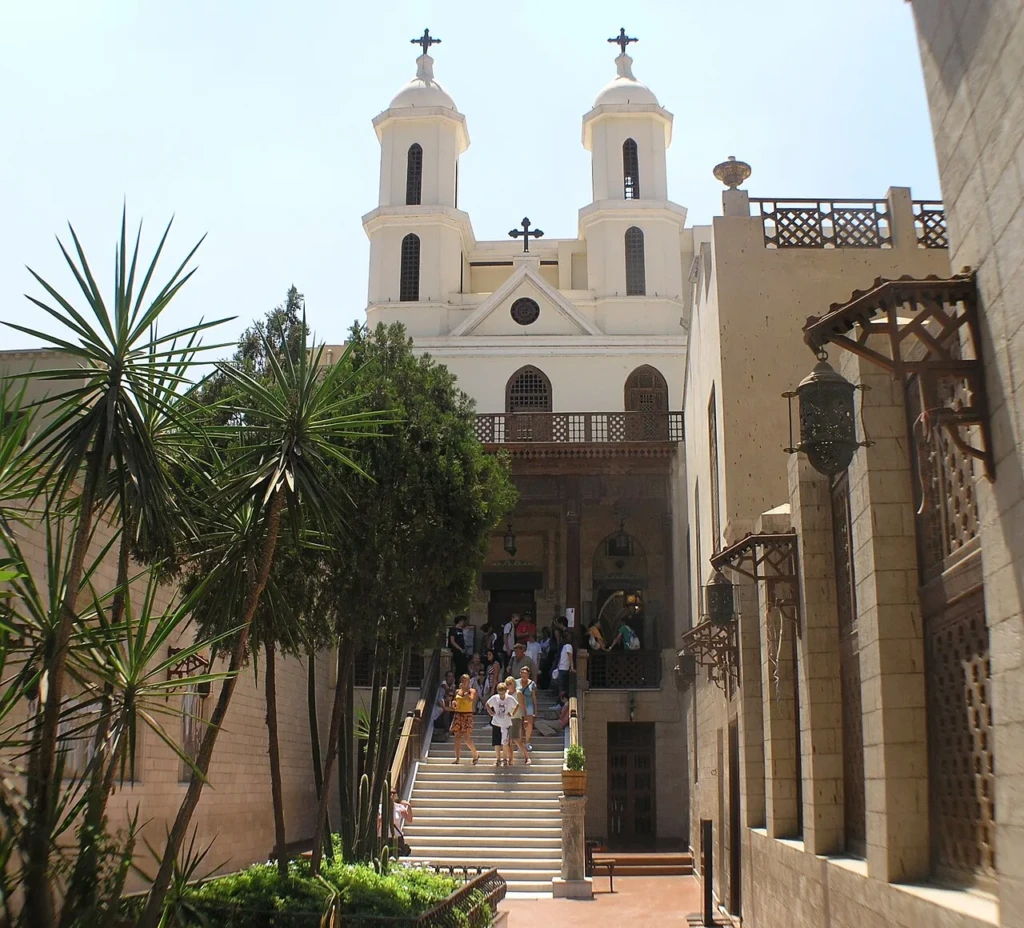
The fortress itself dates to around 300 AD and is now credited to Emperor Diocletian. It held out against the Arab army of ‘Amr ibn al-‘As for about seven months before falling in December 640. Soon after, ‘Amr founded Fustat beside it, Egypt’s first Islamic capital. That is why you will find Roman walls, old churches, a synagogue and an early mosque within a short walk of each other.
Street level has risen by roughly six meters since Roman times. As a result, much of the fortress lies buried, and you climb a flight of 29 steps to reach the church door. Early travelers sometimes called it the “Staircase Church” for that reason.
A Short History of the Church
The exact founding date is not known, and scholars disagree. A church may have stood here in the 3rd or 4th century. The first secure written reference comes from the biography of Patriarch Joseph I, who led the Coptic Church from 831 to 849. A carved beam over the entrance carries the date 284 AD, the first year of the Coptic era.
The building has had a rough history. It was partly destroyed in the 9th century during a dispute between the governor and the patriarch. Pope Abraham, who led the church in the 970s, commissioned a major rebuilding. Later rulers allowed further repairs.
A seat of the Coptic patriarchs
For most of its history the Coptic patriarch lived in Alexandria. In the 11th century, under Pope Christodolos, the patriarchal seat moved to Cairo, and the Hanging Church became an official residence in 1047. For the next few centuries, patriarchs were chosen here, some were buried here, and the church hosted major church business, including setting the annual date of Easter.
Damage and modern restoration
The 1992 Cairo earthquake damaged the walls. A long restoration began in 1998 and was completed in 2011. Objects no longer used in worship were moved over the years to the nearby Coptic Museum. Ten carved wooden panels from an old church door, dated around 1300, are now in the British Museum.
The Muqattam mountain tradition
The church is tied to one of the best-known Coptic traditions. It holds that, in the time of Pope Abraham, the faith of Simon the Tanner caused the Muqattam hill to move. Your guide can tell the full story as it is handed down in the Coptic Church.
What to See Inside, in Visiting Order
The church is an active place of worship, not a museum. The route below follows the natural path from the street to the sanctuary. Move quietly, and step aside if a service or prayer is under way.
1. The gateway and the steps
You enter from the street through iron gates under a pointed stone arch. A narrow courtyard decorated with modern biblical artwork leads to the 29 steps. Before you climb, look for the remains of the Roman gate structure below the church.
2. The facade and courtyards
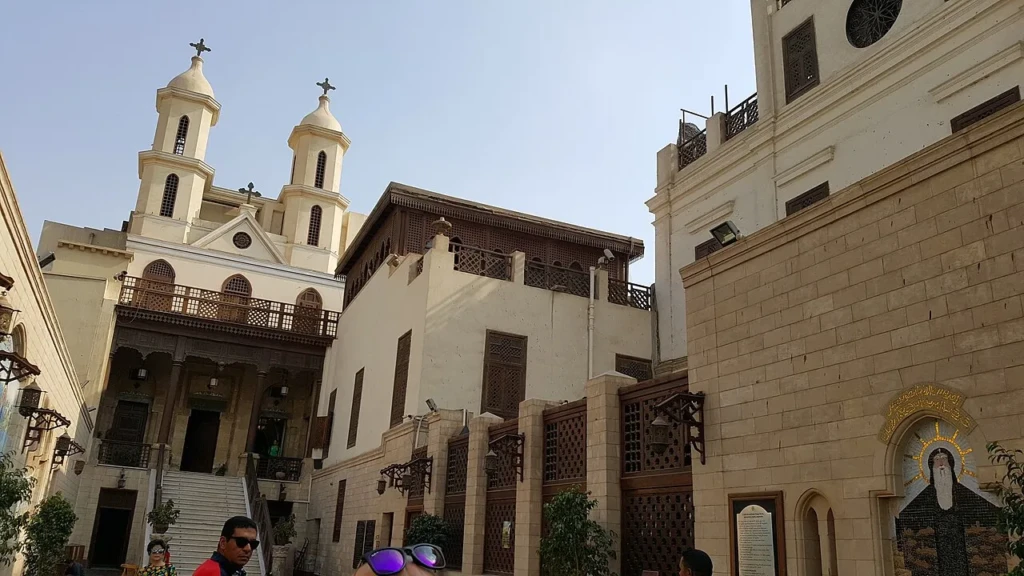
At the top stands a 19th-century facade with twin bell towers. It is younger than the building behind it. A second small courtyard and an 11th-century outer porch lead into the church.
3. The nave and the “Noah’s Ark” ceiling
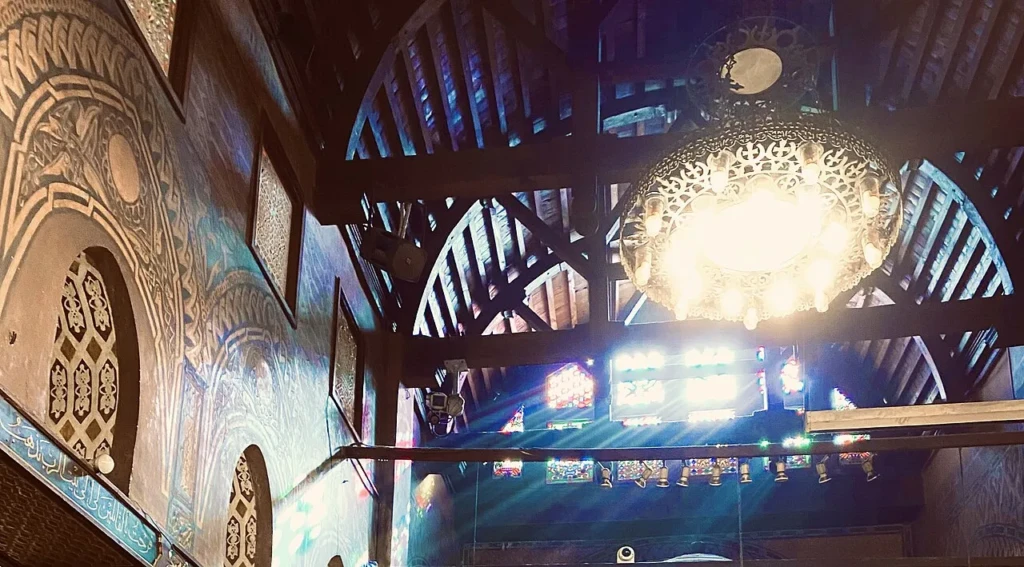
Inside, three rows of marble columns divide the hall into a central nave and side aisles. The wooden ceiling is vaulted and rounded. According to the Ministry, it was designed to resemble Noah’s Ark. Look up from the center of the nave for the best view.
4. The marble pulpit
The pulpit is one of the church’s prized features. The Ministry dates it to the 11th century and describes it as resting on slender columns decorated with mosaic. Many visitors try to count the columns; published sources give different numbers, so treat any figure you hear as tradition rather than fact.
5. The sanctuaries and altars
The Ministry describes five altars on the east side, each topped by a wooden dome. The main sanctuary honors the Virgin Mary. Side sanctuaries are dedicated to Saint George and Saint John the Baptist.
6. The icons
The walls hold a large collection of icons. The Ministry states that the oldest dates to the 15th century and that most of the others date to the late 18th century. Look for the faces and gold backgrounds typical of Coptic icon painting. Your guide can point out the icon of Saint Mercurius attributed to the painter Yuhanna al-Armani.
7. The baptismal font
The Ministry also notes an inscribed granite baptismal basin. It is easy to miss, so ask your guide where to find it.
Opening Hours and Tickets
As listed on the official Ministry of Tourism and Antiquities site in October 2026, the Hanging Church is open every day from 9:00 AM to 4:00 PM. The Ministry page lists no entry ticket. Check before you go, as hours can change around religious holidays and special services.
If you plan to visit the Coptic Museum next door, it does charge entry. The Ministry lists it as open daily from 9:00 AM to 5:00 PM, with the last ticket sold at 4:00 PM. Foreign adults pay EGP 280 and foreign students EGP 140, as listed on the official Ministry site in October 2026; check before you go. During Ramadan the museum closes earlier, at 3:00 PM.
| Site | Hours (official listing) | Foreign adult | Foreign student |
|---|---|---|---|
| Hanging Church | Daily, 9:00 AM – 4:00 PM | No ticket listed | No ticket listed |
| Coptic Museum (next door) | Daily, 9:00 AM – 5:00 PM; last ticket 4:00 PM | EGP 280 | EGP 140 |
How to Get to the Hanging Church
The church stands in Old Cairo, south of downtown and close to the east bank of the Nile.
- By metro: Mar Girgis station on Line 1 sits right beside the old fortress walls. Line 1 also stops at Sadat (Tahrir Square) and Al-Shohadaa, both interchange stations with Line 2.
- By private car: This is the simplest option from Giza or Zamalek hotels. Traffic in Cairo varies a great deal by hour, so your driver or guide will confirm timing on the day.
- On a guided day tour: Most travelers visit as part of a half-day or full-day Old Cairo tour, often paired with the Citadel.
Best Time to Visit and Practical Tips
Arrive soon after the 9:00 AM opening if you can. Tour groups tend to build up later in the morning, and the 29 steps and narrow courtyard feel crowded quickly. Cairo’s cooler months, from roughly October to April, make walking between Old Cairo’s sites more comfortable. Our month-by-month guide to the best time to visit Egypt explains the seasons in detail.
- Dress modestly. This is a working church, so cover shoulders and knees. A light scarf is useful to carry for religious sites in Egypt. Our guide to what to pack and wear in Egypt has practical advice.
- Respect services. Worshippers come and go all day. If a liturgy is in progress, keep to the back and keep your voice low.
- Photography. The Ministry page gives no photography rules for the church. Ask on site, avoid flash and never photograph people at prayer without permission.
- Mobility. Reaching the church means climbing steps, so it is not ideal for wheelchair users.
How to Combine the Hanging Church with Nearby Sites
The church is the natural starting point for a wider morning in Old Cairo. Within a short walk you can see the remains of the Babylon Fortress, the sunken lanes leading to the Church of Saints Sergius and Bacchus (Abu Serga), the Ben Ezra Synagogue and the Coptic Museum. The Ministry’s page on Al-Fustat also lists the Mosque of ‘Amr ibn al-‘As, the first building of Fustat, in the same district.
From Old Cairo, many visitors continue to the Citadel of Saladin and the Mosque of Mohamed Ali on the hill above the city, then end the day in Khan El Khalili. For a museum day, the Tahrir collection is covered in our Egyptian Museum in Cairo guide. To build the pyramids into the same trip, see our Giza Pyramids complex guide and plan them for a separate day.
Good Delta options for the rest of your Cairo time include:
- Pyramids Day Tour, from $55 per person (1 day)
- Grand Egyptian Museum and Pyramids, from $95 per person (1 day)
- Taste of Egypt – 4 Days (Cairo), from $535 per person (4 days / 3 nights)
Visit with Delta Tours Egypt
Our Old Cairo & Citadel private day tour is from $100 per person for one day. Its published itinerary includes the Hanging Church with the other churches and synagogue of Old Cairo, the Citadel of Saladin and the Mosque of Mohamed Ali, and time in Khan El Khalili. You travel by private car with your own English-speaking guide. For more Cairo options, browse our private Cairo day tours, or ask for an Egyptologist-led private tour if you want deeper commentary on Coptic history.
Frequently Asked Questions
Is there an entry fee for the Hanging Church?
The official Ministry of Tourism and Antiquities page lists no ticket for the Hanging Church. The Coptic Museum next door does charge entry.
How old is the Hanging Church?
Its exact age is debated. A church may have stood here from the 3rd or 4th century, and the first secure written mention dates to the 9th century. The present building reflects many later rebuilds, the last restoration finishing in 2011.
Why is it called the “Hanging” Church?
It was built over a gatehouse of the Roman Babylon Fortress, so its nave stands above an open passage. That gives the impression that the church hangs in the air. The Arabic name, al-Mu’allaqa, means “the suspended one.”
How long should I spend at the Hanging Church?
Our planning suggestion is 30 to 45 minutes for the church itself. Allow three to four hours if you also want to see Abu Serga, Ben Ezra Synagogue and the Coptic Museum.
Can I visit during a church service?
Yes, but visitors should stay quiet and keep to the back. Avoid walking through the nave during prayers. For a calmer visit, come early on a weekday morning.
Is the Hanging Church the same as Coptic Cairo?
No. The Hanging Church is one building within Old Cairo’s historic Christian quarter. The wider area also includes several other churches, the Ben Ezra Synagogue, the Babylon Fortress and the Coptic Museum.
The Hanging Church rewards a slow, unhurried visit with someone who can explain what you are seeing. If you would like it built into a wider trip, start with our private Cairo day tours and we will shape the day around you.
Featured image: Facade of the Hanging Church, Coptic Cairo. Photo: Ovedc / Wikimedia Commons, CC BY-SA 4.0