Bibliotheca Alexandrina: Visiting the New Library of Alexandria
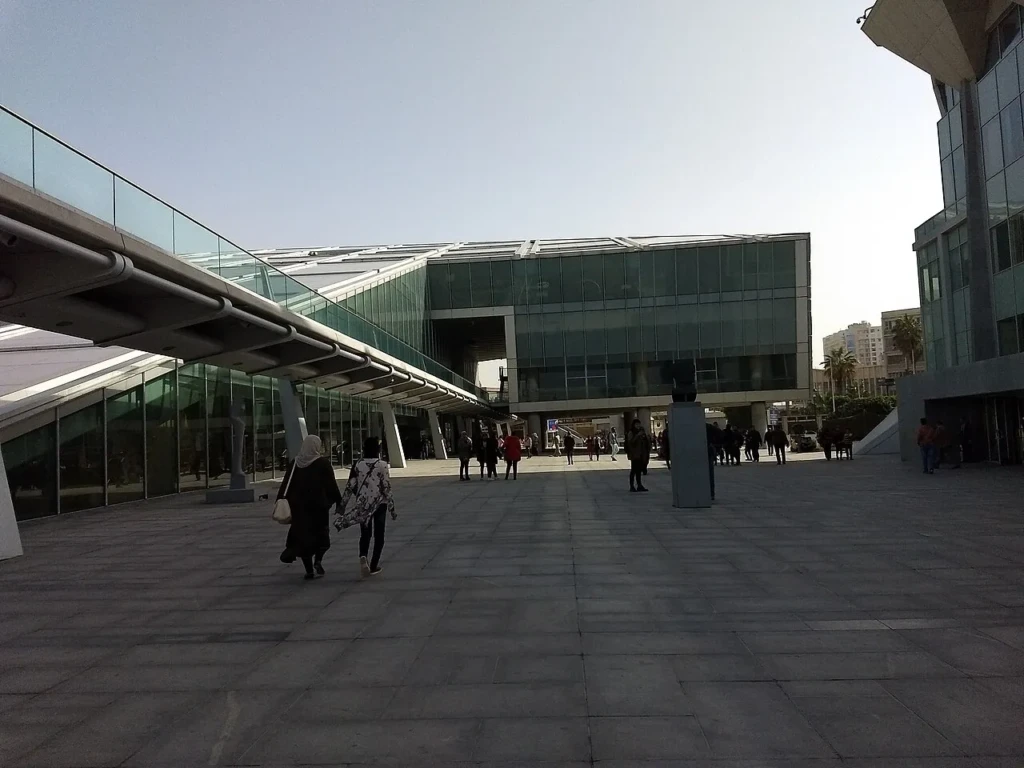
Opened in October 2002 on Alexandria’s Mediterranean shore, the Bibliotheca Alexandrina is Egypt’s modern library and cultural center, built near the presumed site of the ancient Library of Alexandria. Visitors come for its tilted, sundial-like roof, a vast reading room on eleven cascading levels, and museums of antiquities and manuscripts. Foreign adults pay EGP 150 for the main library or EGP 300 for a combined ticket, and the complex is closed on Fridays.
Our Alexandria travel guide covers the city as a whole. This article focuses on the library itself: the story behind it, what to see inside, current hours and tickets from the library’s official website, and how to fit a visit into a day in Alexandria.
Bibliotheca Alexandrina at a Glance
| Fact | Details |
|---|---|
| Location | Chatby (Shatby) district on the Alexandria seafront, near the presumed site of the ancient library |
| Opened | Inaugurated on 16 October 2002 |
| Designed by | Snøhetta, the Norwegian firm that won a UNESCO-backed international competition in 1988 |
| Dedicated to | Reviving the spirit of the ancient Library of Alexandria as a modern center of learning |
| Key features | Tilted glass roof about 160 m across, 20,000 m² reading room on eleven levels, granite wall carved with characters from 120 scripts |
| Hours for visitors | Tours, museums and planetarium Sunday to Thursday 9:30 AM – 5:00 PM; Saturday 10:00 AM – 2:00 PM; closed Friday |
| Foreign adult ticket | EGP 150 (main library) or EGP 300 (combined ticket with museums) |
| Time needed | Our planning suggestion: 1.5 to 2 hours, or 2.5 to 3 hours with the museums |
| From Cairo | A full-day trip by road; Delta’s Alexandria day trip allows around three hours’ drive each way, depending on traffic |
Why the Bibliotheca Alexandrina Matters
To understand the new library, start with the old one. The ancient Library of Alexandria was founded under the early Ptolemies, the Greek-speaking dynasty that ruled Egypt after Alexander the Great. It probably became a physical institution under Ptolemy II Philadelphus, who reigned from 285 to 246 BC. It formed part of the Mouseion, a research center in the royal quarter that supported scholars.
Some of the ancient world’s best-known thinkers worked there. Callimachus compiled the Pinakes, often called the first library catalogue. Eratosthenes estimated the circumference of the Earth. Nobody knows how many scrolls the library held; modern estimates range from about 40,000 to 700,000.
How the ancient library disappeared
The popular image of one great fire is misleading. Historians now describe a slow decline. Julius Caesar’s fire in 48 BC damaged the harbor area, but the library seems to have survived it in some form. Funding dwindled under Roman rule. Fighting in the 270s AD probably destroyed what remained, and the Serapeum, which housed a “daughter library,” was destroyed in 391 AD. The story that the library was burned after the Arab conquest first appears centuries later and is widely doubted.
The modern revival
The idea of a new library grew in the 1970s. In 1974 an Alexandria University committee chose a site between its campus and the sea, close to where the ancient library is thought to have stood. UNESCO backed an international design competition in 1988, which Snøhetta won from among more than 500 entries. Construction began in 1995, and the library was inaugurated on 16 October 2002.
Today the library describes itself as a public research library run as a joint project of the Egyptian government and UNESCO. It focuses on Alexandria’s heritage, Egypt, the Arab world, the Mediterranean and Africa. Its shelves can hold around eight million books, and it hosts a copy of collections donated by the Internet Archive.
During the 2011 revolution, the library closed and young people formed a human chain around the building to protect it from looting.
What to See, in Visiting Order
Guided tours are included with the main library ticket, according to the official admission page. A guide helps, because the complex is large. The order below follows a natural route from the plaza to the museums.
1. The plaza and the granite wall
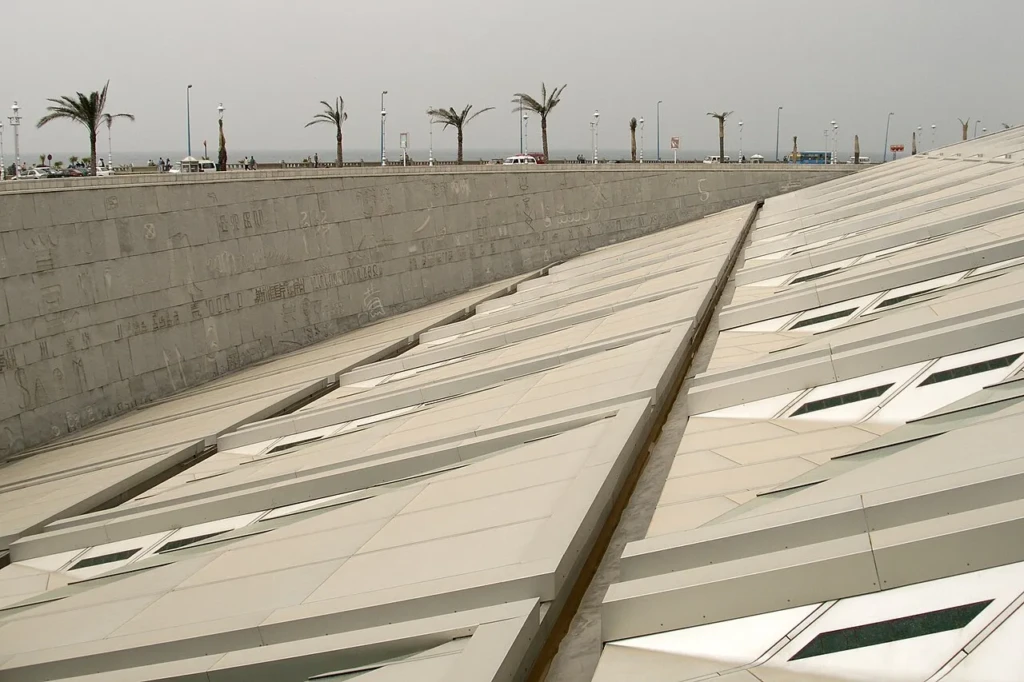
Start outside. The library’s curved outer wall is clad in gray granite carved with letters and characters from 120 scripts. Walk along it before going in. From the plaza you also see the roof’s angle clearly.
2. The sundial roof
The building is a huge tilted disc about 160 meters in diameter, sloping toward the sea like a sundial. Its glass-panelled surface forms the roof over the reading room below.
3. The main reading room
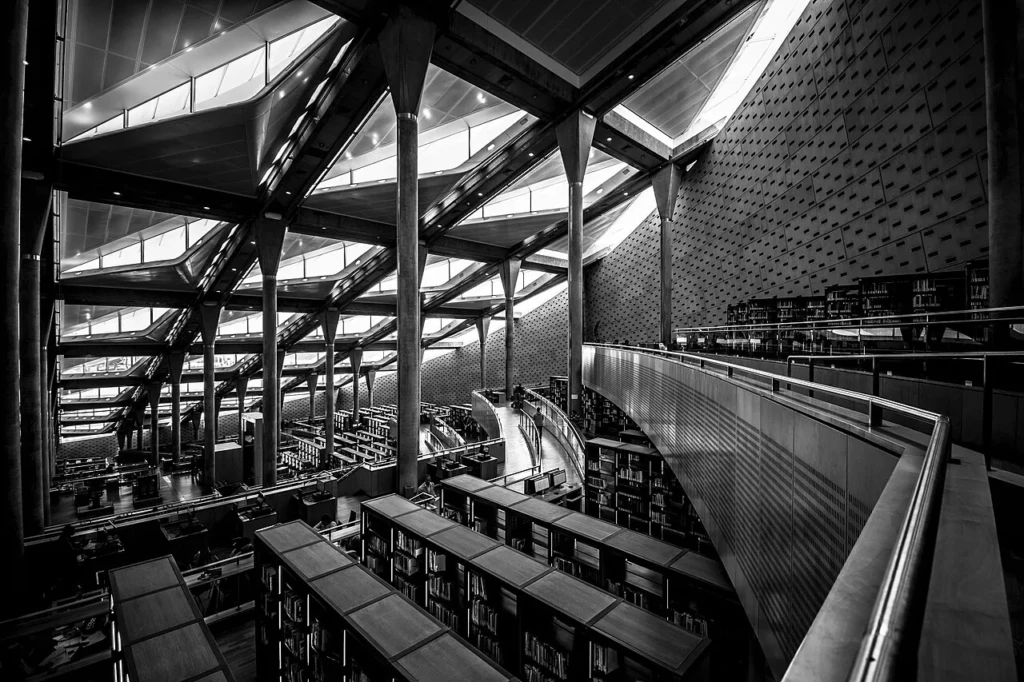
Inside, the 20,000-square-meter reading room steps down in eleven terraced levels under the slanted roof. At completion it was reported to be the largest reading room in the world. Students use it every day, so keep your voice low.
4. The Antiquities Museum
Established in 2001, the museum displays about 1,316 artifacts. Highlights include objects recovered from the seabed near the Eastern Harbor and Abu Qir Bay, with labels in English, Arabic and French. It is a compact collection and a good introduction to Alexandria’s Greek and Roman past.
5. The Manuscripts Museum
This museum, also established in 2001, is devoted to manuscripts, and the library has built a large collection of digitized manuscripts. Entry is included in the combined ticket.
6. Other spaces worth a look
- Taha Hussein Library: A library with materials for blind and visually impaired readers.
- Sadat Museum: Personal belongings of President Anwar Sadat.
- Culturama: A 180-degree interactive panoramic screen, patented in 2007 by CULTNAT.
- Planetarium: A separate attraction within the complex, with its own ticket window.
The complex has four museums, four art galleries for temporary shows and 15 permanent exhibitions, so you will not see everything in one visit. Ask your guide to focus on the parts that interest you most.
Opening Hours and Tickets
As listed on the Bibliotheca Alexandrina’s official website in October 2026, tours, museums and the planetarium run Sunday to Thursday from 9:30 AM to 5:00 PM, and on Saturday from 10:00 AM to 2:00 PM. The library is closed on Fridays. The main ticket window works Sunday to Thursday from 9:30 AM to 6:30 PM and Saturday from 9:45 AM to 1:45 PM. Check before you go, as hours can change.
The Antiquities Museum page lists slightly different times: Sunday to Thursday 9:30 AM to 4:45 PM and Saturday 10:00 AM to 1:45 PM, with the booth closing 15 minutes earlier. If the museums are your priority, arrive well before mid-afternoon.
| Ticket (non-Egyptian visitors) | Adult | Student | Senior (60+) |
|---|---|---|---|
| Main Library (includes guided tour) | EGP 150 | EGP 20 | EGP 150 |
| Combined ticket: Main Library, Antiquities Museum, Manuscripts Museum and free museums | EGP 300 | EGP 120 | EGP 300 |
| Antiquities Museum only | EGP 100 | EGP 50 | Not listed |
These are the prices listed on the library’s official admission page and Antiquities Museum page in October 2026; check before you go. Children aged 4 to 6 enter free, while those aged 6 to 16 need a library ticket and are limited to the Callimachus Triangle area. Visitors with special needs enter free. The Bibliotheca Alexandrina is run separately from the Ministry of Tourism and Antiquities, so its tickets are not part of the Ministry’s price list.
How to Get There and How Long It Takes
The library stands on the seafront in the Chatby district of Alexandria, near Alexandria University.
- From Cairo: Most visitors come on a full-day trip by road. Our Alexandria day trip allows around three hours’ drive each way, depending on traffic, so expect an early start and an evening return.
- Within Alexandria: A taxi or private car is the simplest option from hotels along the Corniche. Your driver or guide will confirm timing on the day.
- Overnight: Staying a night in Alexandria lets you visit the library on a quieter morning and see more of the city without rushing back to Cairo.
Best Time to Visit and Practical Tips
Come on a Sunday to Thursday morning if possible. Saturday hours are short, and Friday is closed, which matters if you are planning a weekend day trip from Cairo. For seasonal planning see our guide to the best time to visit Egypt.
- Bring ID. Student and senior prices depend on proof of status, so carry a valid card or passport.
- Keep noise down. The reading room is a working library used heavily by local university students.
- Check the guidelines. The official visiting page refers visitors to the library’s general guidelines for rules on bags and photography. Ask at the entrance before taking pictures.
- Combine tickets wisely. If you want both museums, the combined ticket is better value than paying separately.
- Dress: No formal dress code is published, but neat, modest clothing suits a public institution in Egypt. Our guide to what to pack and wear in Egypt has more advice.
How to Combine the Library with Nearby Sites
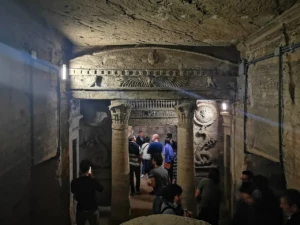
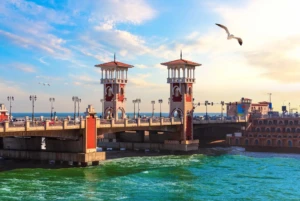
The library fits easily into a day of Alexandria’s classic sights. On the harbor stands the Citadel of Qaitbay, built in the 15th century on the site of the ancient Pharos lighthouse. Elsewhere in the city you find Pompey’s Pillar and the Roman-era Catacombs of Kom el-Shoqafa. A practical sequence is the catacombs and Pompey’s Pillar in the morning, the library around midday, and Qaitbay toward late afternoon.
Browse more of the city on our Alexandria tours page or see all our Egypt day tours and excursions. If you want Alexandria as part of a longer itinerary, these Delta tours include it:
- 4 Days Egypt Budget Tour – Cairo & Alexandria, from $390 per person (4 days / 3 nights)
- Cleopatra – 10-Day Cairo, Nile Cruise & Alexandria Tour, from $1,190 per person (10 days / 9 nights)
- Alexander The Great – 10 Days (Cairo, Nile Cruise & Alexandria), from $1,310 per person (10 days / 9 nights)
Visit with Delta Tours Egypt
Our Alexandria Over Day tour from Cairo is from $130 per person for one day, by private air-conditioned car with your own English-speaking guide. Its published itinerary covers Pompey’s Pillar, the Catacombs of Kom el-Shoqafa and the Citadel of Qaitbay. The Bibliotheca Alexandrina is not on the standard list, but because the car and guide are private, you can ask us to add it when you book. We will confirm timing so the visit falls within the library’s opening hours.
Frequently Asked Questions
Is the Bibliotheca Alexandrina the original Library of Alexandria?
No. The ancient library declined and disappeared in antiquity. The Bibliotheca Alexandrina is a modern library, inaugurated in 2002 near the presumed site of the original and created to carry on its spirit.
How much is the Bibliotheca Alexandrina ticket for foreigners?
As listed on the library’s official site in October 2026, foreign adults pay EGP 150 for the main library or EGP 300 for a combined ticket that adds the Antiquities and Manuscripts museums. Foreign students pay EGP 20 or EGP 120. Check before you go.
Is the Bibliotheca Alexandrina open on Fridays?
No. The official visiting page lists Friday as closed. Saturday hours are short, 10:00 AM to 2:00 PM, so Sunday to Thursday is the best time to visit.
How long do you need at the library?
Our planning suggestion is 1.5 to 2 hours for the building and guided tour. Allow 2.5 to 3 hours if you add the Antiquities and Manuscripts museums.
Can I visit the library on a day trip from Cairo?
Yes. Alexandria is a long day trip by road, with around three hours’ drive each way. On a private day tour you can include the library alongside the catacombs, Pompey’s Pillar and Qaitbay if you confirm it in advance.
Who designed the Bibliotheca Alexandrina?
The Norwegian architecture firm Snøhetta won the international competition in 1988. Its design is a tilted disc with a glass roof facing the sea and a granite wall carved with scripts from around the world.
Pairing the library with Alexandria’s Roman and medieval sites gives you the city’s full story in one day. To plan it, start with our private Alexandria day trip from Cairo, and tell us you would like the library included.
Featured image: Bibliotheca Alexandrina. Photo: Cecioka / Wikimedia Commons, CC BY-SA 4.0