The Pyramid of Unas: The First Pyramid Texts & Complete Visitor Guide (2026/2027)
The Pyramid of Unas: Home to the World’s Oldest Pyramid Texts
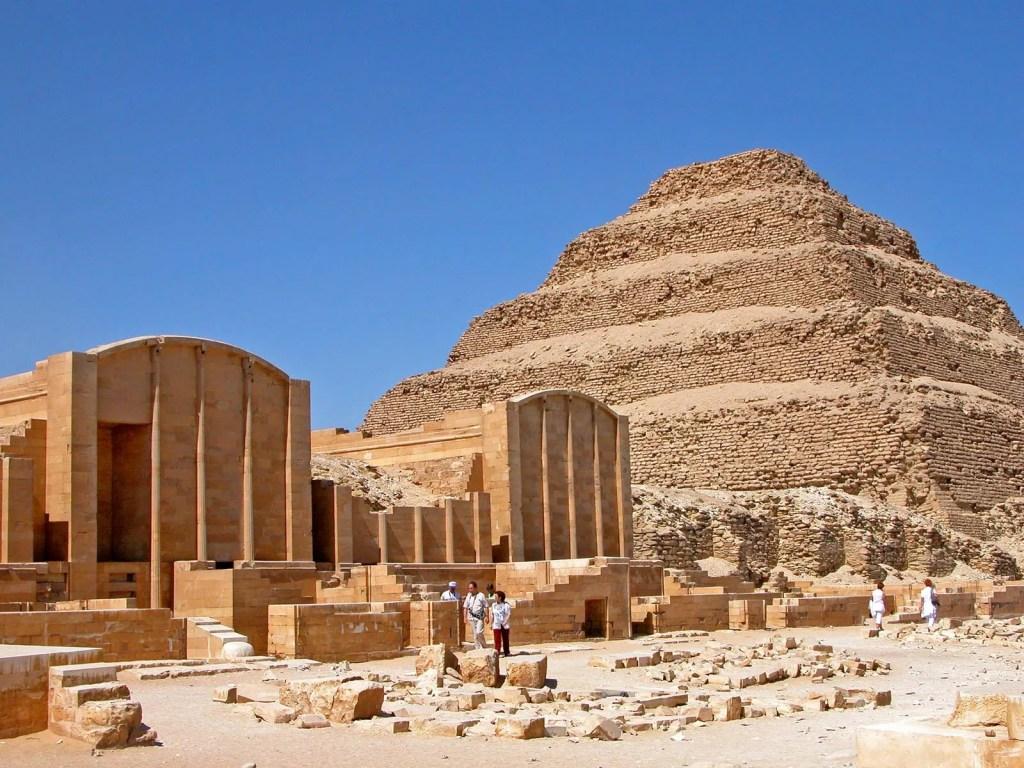
Hidden within the vast Saqqara Necropolis lies one of ancient Egypt’s most remarkable yet often overlooked monuments. At first glance, the Pyramid of Unas appears modest compared to the towering pyramids of Giza or even the nearby Step Pyramid of Djoser. Time has reduced much of its outer limestone casing, leaving what resembles a low hill rising from the desert.
Yet beyond its weathered exterior lies one of the greatest archaeological treasures ever discovered.
The Pyramid of Unas is famous for preserving the oldest known Pyramid Texts—the earliest surviving collection of religious inscriptions in human history. Carved directly into the walls of the burial chamber more than 4,300 years ago, these sacred hieroglyphs transformed Egyptian funerary beliefs and later influenced the Coffin Texts and the famous Book of the Dead.
Built for King Unas, the final ruler of Egypt’s Fifth Dynasty, the pyramid marks a turning point in royal burial traditions. Earlier pyramids focused primarily on monumental architecture, but the Pyramid of Unas introduced something revolutionary: written guidance intended to help the king navigate the afterlife and join the gods.
Today, visitors who descend into the pyramid can still see hundreds of beautifully carved hieroglyphs covering the walls of the burial chamber. Unlike many monuments where decoration has faded over time, these inscriptions remain astonishingly well preserved, offering a rare opportunity to stand inside one of the oldest religious texts ever created.
Whether you are passionate about archaeology, ancient religion, or Egyptian history, the Pyramid of Unas is one of the most rewarding monuments to explore in Saqqara.
Quick Facts About the Pyramid of Unas
| Feature | Details |
|---|---|
| Location | Saqqara, Egypt |
| Built For | Pharaoh Unas |
| Dynasty | Fifth Dynasty |
| Construction Date | c. 2375–2345 BC |
| Height (Original) | Approximately 43 meters (141 feet) |
| Architectural Style | True Pyramid |
| Famous For | The oldest Pyramid Texts in the world |
| Interior | Open to visitors (subject to regulations) |
| UNESCO Status | Part of the Memphis and its Necropolis World Heritage Site |
Who Was King Unas?
To understand why this pyramid is so significant, we first need to understand the king who commissioned it.
Unas was the last pharaoh of Egypt’s Fifth Dynasty, ruling during a period when the Old Kingdom had reached extraordinary levels of political organization, artistic achievement, and religious development.
Although his reign is believed to have lasted between 15 and 30 years, historical records about his military campaigns and political achievements are relatively limited. Instead, Unas is remembered for something far more enduring: transforming the way Egyptian kings prepared for eternity.
By the time Unas ascended the throne, pyramid construction had already been perfected. The great pyramids at Giza had stood for centuries, and royal builders possessed immense experience in designing monumental tombs.
Rather than focusing on building the largest pyramid, Unas introduced an innovation that proved even more influential—the decision to inscribe sacred religious texts directly onto the walls of his burial chambers.
This single decision would shape Egyptian funerary tradition for more than a thousand years.
Why the Pyramid of Unas Changed Egyptian History
At first glance, the Pyramid of Unas seems relatively modest.
Its original height of approximately 43 meters (141 feet) made it significantly smaller than the Great Pyramid of Giza, and much of its outer casing has disappeared over the centuries.
However, its importance has never depended on its size.
Instead, the Pyramid of Unas introduced one of the greatest religious innovations of the ancient world.
For the first time in Egyptian history:
- Sacred funerary texts were carved inside a royal pyramid.
- Hieroglyphic inscriptions became central to the king’s journey into the afterlife.
- Religious beliefs were permanently preserved in stone rather than transmitted only through oral tradition.
- The foundation was laid for later funerary literature, including the Coffin Texts and the Book of the Dead.
These inscriptions became known as the Pyramid Texts, and they remain one of the most important sources for understanding ancient Egyptian religion.
Without the Pyramid of Unas, historians would know far less about how the Egyptians understood death, rebirth, and eternal life.
The Evolution of Pyramid Construction
The Pyramid of Unas occupies an important place in the history of pyramid architecture.
Although smaller than earlier monuments, it represents the culmination of centuries of architectural and religious development.
| Pyramid | Dynasty | Greatest Innovation |
|---|---|---|
| Step Pyramid of Djoser | Third Dynasty | First pyramid ever built |
| Bent Pyramid | Fourth Dynasty | First smooth-sided pyramid experiment |
| Red Pyramid | Fourth Dynasty | First successful true pyramid |
| Great Pyramid of Khufu | Fourth Dynasty | Largest pyramid ever constructed |
| Pyramid of Unas | Fifth Dynasty | First Pyramid Texts |
By the reign of Unas, Egyptian architects no longer needed to prove they could build magnificent pyramids.
Instead, attention shifted toward the spiritual needs of the deceased king.
The result was one of the most important religious monuments ever created.
Architecture, Interior & the Birth of the Pyramid Texts
Although the Pyramid of Unas appears relatively modest from the outside, its true importance lies beneath the desert. Unlike earlier pyramids that impressed visitors with their enormous size, the Pyramid of Unas reveals its greatest treasures only after entering its narrow passageways.
For historians and archaeologists, the interior of the pyramid is among the most significant discoveries ever made in Egypt. It preserves not only remarkable examples of Old Kingdom architecture but also the oldest surviving religious writings in the world.
The Pyramid Complex of Unas
Like every royal pyramid of the Old Kingdom, the Pyramid of Unas was not built in isolation. It formed the heart of an extensive funerary complex designed to ensure the king’s eternal existence.
The original complex included:
- A Valley Temple connected to the Nile floodplain.
- A long causeway linking the valley to the pyramid.
- A Mortuary Temple where priests performed daily rituals.
- Storage magazines for offerings.
- Courtyards used during funerary ceremonies.
- The royal pyramid itself.
Although much of the complex has suffered damage over the centuries, archaeologists have uncovered beautifully carved reliefs depicting offering bearers, craftsmen, animals, and scenes of daily life. These decorations provide valuable insight into the artistic achievements of the late Fifth Dynasty.
The Entrance to the Pyramid
The entrance to the Pyramid of Unas is located on the north side, following the traditional orientation of Egyptian royal pyramids.
Visitors descend through a narrow limestone corridor that gradually leads beneath the monument.
Unlike the vast Grand Gallery inside the Great Pyramid of Giza, the passages within the Pyramid of Unas are relatively modest in scale. Their purpose was not to impress through size but to guide the king’s spirit toward eternal life.
As you move deeper underground, the atmosphere changes dramatically. The bright Egyptian sunlight disappears, the temperature becomes cooler, and the walls begin to reveal one of the greatest archaeological treasures ever discovered.
The Burial Chamber
At the heart of the pyramid lies the burial chamber, where King Unas was laid to rest more than 4,300 years ago.
The chamber itself is relatively simple in design, but its decoration makes it extraordinary.
Covering nearly every wall are finely carved hieroglyphic inscriptions known today as the Pyramid Texts. These texts were originally painted in green, the ancient Egyptian color of renewal, fertility, and rebirth. Although much of the pigment has faded, the beautifully carved hieroglyphs remain remarkably well preserved.
The king’s basalt sarcophagus still occupies its original position within the chamber, offering visitors a rare opportunity to stand in the very place where one of Egypt’s earliest religious masterpieces was created.
Looking around the chamber, it becomes clear that the inscriptions—not the architecture—were intended to be the true focus of the monument.
The Astronomical Ceiling
One of the most beautiful features of the burial chamber is its ceiling.
Rather than leaving the stone plain, Egyptian craftsmen decorated it with white stars carved against a dark background, symbolizing the eternal night sky.
For ancient Egyptians, the stars represented immortality.
The king hoped to join the Imperishable Stars, the circumpolar stars that never disappeared below the horizon. Because these stars were always visible, they became powerful symbols of eternal life and the everlasting nature of kingship.
This celestial decoration transformed the burial chamber into a symbolic gateway between Earth and the heavens.
The Pyramid Texts: The World’s Oldest Religious Writings
The greatest significance of the Pyramid of Unas lies in the inscriptions covering its walls.
Known collectively as the Pyramid Texts, these hieroglyphs represent the oldest surviving corpus of religious literature in human history.
Before the reign of Unas, religious knowledge was primarily transmitted through oral tradition and ritual. By carving these sacred spells into stone, the Egyptians ensured that the king would always have access to the words needed to overcome the dangers of the afterlife.
More than 700 individual utterances, prayers, hymns, and magical formulas have been identified across the Pyramid Texts found in various royal pyramids. The Pyramid of Unas preserves the earliest known version of these writings.
The texts served several important purposes:
- Protecting the king from evil forces.
- Guiding his journey through the underworld.
- Helping him ascend to the heavens.
- Reuniting him with the gods.
- Ensuring eternal life.
Rather than functioning as a single narrative, the Pyramid Texts are a collection of independent religious spells that could be used in different situations during the king’s journey after death.
What Do the Pyramid Texts Say?
Although written over four thousand years ago, many of the Pyramid Texts remain surprisingly vivid.
They describe the king:
- Climbing a celestial ladder into the sky.
- Flying like a falcon toward the heavens.
- Joining the sun god Ra on his daily journey.
- Sitting among the gods as an equal.
- Receiving food and offerings for eternity.
- Overcoming dangerous creatures guarding the afterlife.
- Becoming an eternal star in the northern sky.
One famous utterance proclaims that the king has not truly died but has instead become one with the divine realm, emphasizing the Egyptian belief that death marked a transformation rather than an end.
These inscriptions provide an unparalleled glimpse into how ancient Egyptians understood life, death, and the cosmos.
From Pyramid Texts to the Book of the Dead
The influence of the Pyramid Texts extended far beyond the reign of Unas.
During the Middle Kingdom, many of these spells were adapted into the Coffin Texts, allowing wealthy nobles—not just kings—to benefit from similar religious guidance.
Centuries later, these writings evolved again into the Book of the Dead, perhaps the most famous funerary text of ancient Egypt.
This remarkable progression illustrates how a religious innovation introduced inside one relatively small pyramid eventually shaped Egyptian beliefs for more than two thousand years.
The Pyramid of Unas therefore represents not only an architectural monument but also the beginning of one of history’s longest-lasting religious traditions.
Architecture Reflecting Changing Beliefs
The Pyramid of Unas also reflects a shift in Egyptian priorities.
Earlier pyramids emphasized size and engineering, demonstrating the power of the king through monumental architecture.
By contrast, the Pyramid of Unas places greater emphasis on the king’s spiritual journey.
Its inscriptions, celestial symbolism, and carefully planned interior reveal a growing belief that eternal life depended not only on the construction of a magnificent tomb but also on possessing the sacred knowledge required to navigate the afterlife.
This transition would influence every royal burial that followed.
Why Historians Consider the Pyramid of Unas Revolutionary
Although it is one of the smallest royal pyramids of the Old Kingdom, many Egyptologists regard the Pyramid of Unas as one of the most important monuments in Egypt.
Its importance lies in three remarkable achievements:
- It preserves the oldest religious writings ever discovered.
- It transformed Egyptian funerary beliefs by permanently recording sacred rituals in stone.
- It established a tradition that influenced Egyptian religion for over two millennia.
For anyone interested in the origins of religion, literature, or ancient civilization, the Pyramid of Unas offers insights that few monuments anywhere in the world can match.
Visiting the Pyramid of Unas Today
Although the Pyramid of Unas is smaller than many of Egypt’s famous pyramids, it offers something that few monuments can match—an opportunity to stand inside the world’s oldest decorated royal pyramid and read the earliest surviving religious writings ever carved in stone.
Many visitors arrive expecting a modest archaeological site. They leave having experienced one of the most historically significant monuments in Egypt.
Unlike the Step Pyramid of Djoser, which revolutionized architecture, or the Great Pyramid of Giza, which demonstrated extraordinary engineering, the Pyramid of Unas changed the way ancient Egyptians thought about eternity.
Can You Go Inside the Pyramid of Unas?
Yes.
One of the greatest attractions of the Pyramid of Unas is that visitors can often enter its interior, subject to the current regulations and conservation work of Egypt’s Ministry of Tourism and Antiquities.
Unlike many monuments where visitors can only admire the exterior, the Pyramid of Unas allows you to descend into the very chambers where King Unas prepared for his eternal journey more than four thousand years ago.
The experience is intimate, atmospheric, and unlike entering any other pyramid in Egypt.
Descending into the Pyramid
The journey begins at the northern entrance.
A gently descending limestone corridor leads visitors beneath the pyramid, following the same route originally intended for the king’s funeral procession.
As you continue downward:
- The temperature becomes noticeably cooler.
- Outside sounds disappear.
- The narrow passage creates a sense of anticipation.
- Ancient limestone blocks surround you on every side.
Unlike the Great Pyramid, there are no enormous galleries or towering chambers.
Everything here feels purposeful and symbolic.
The focus was never on creating monumental interior spaces—it was on protecting the king and preserving the sacred texts that would guide him into eternity.
The Antechamber
Before reaching the burial chamber, visitors pass through the antechamber.
Although relatively simple architecturally, this room serves as an important transition between the earthly world and the sacred burial chamber beyond.
Here, the first beautifully carved hieroglyphs begin to appear.
Many visitors find themselves slowing down almost immediately, realizing they are looking at inscriptions created more than 4,300 years ago.
Unlike museum displays protected behind glass, these texts remain exactly where ancient craftsmen carved them.
The experience creates an extraordinary connection with the ancient world.
The Burial Chamber Today
The burial chamber is undoubtedly the highlight of the visit.
Its walls are covered almost entirely by finely carved hieroglyphs arranged in carefully organized vertical columns.
Unlike the colorful wall paintings found inside New Kingdom tombs, the beauty here lies in precision rather than color.
Every inscription had a sacred purpose.
Together they formed an eternal guidebook for King Unas.
The basalt sarcophagus still occupies the center of the chamber.
Although the king’s mummy disappeared long ago, standing beside the original coffin allows visitors to appreciate the importance of this remarkable monument.
Looking upward, the star-covered ceiling completes the symbolic journey.
The chamber represents both a royal tomb and a miniature model of the universe.
What Makes the Interior So Special?
Many travelers ask whether the Pyramid of Unas is worth visiting after already seeing the pyramids at Giza.
The answer is absolutely yes.
Each pyramid offers a completely different experience.
Great Pyramid of Giza
- Famous for its engineering.
- Largest pyramid ever built.
- Grand Gallery.
- Monumental scale.
Step Pyramid of Djoser
- World’s first pyramid.
- Birthplace of monumental stone architecture.
- Imhotep’s revolutionary design.
Pyramid of Unas
- Oldest Pyramid Texts.
- Beautifully preserved hieroglyphs.
- Deep insight into Egyptian religion.
- Intimate underground experience.
Rather than competing with one another, these monuments tell different chapters of Egypt’s remarkable story.
Best Time to Visit
The Pyramid of Unas can be visited throughout the year, but conditions vary considerably.
October to April
This is the ideal period.
Benefits include:
- Pleasant temperatures.
- Comfortable walking conditions.
- Better lighting for photography outside.
- Easier exploration of the surrounding necropolis.
May to September
Summer temperatures can become extremely hot during the middle of the day.
If visiting during summer:
- Arrive early.
- Carry plenty of water.
- Wear light clothing.
- Plan indoor monuments during the hottest hours.
Fortunately, the pyramid’s underground chambers remain noticeably cooler than the surrounding desert.
Opening Hours
The Pyramid of Unas generally follows the opening hours of the Saqqara archaeological site.
| Season | Opening Hours |
|---|---|
| Summer | 8:00 AM – 5:00 PM |
| Winter | 8:00 AM – 4:00 PM |
Access may occasionally be restricted because of conservation work or archaeological projects.
Tickets
Entry to the Pyramid of Unas is usually included with access to the Saqqara archaeological area when the interior is open to visitors. Ticket policies may change over time, and some monuments within the necropolis require separate admission.
Booking through a licensed tour operator can simplify your visit by arranging transportation, entrance logistics, and an Egyptologist guide who can explain the significance of the inscriptions inside the pyramid.
Photography Tips
The Pyramid of Unas provides excellent opportunities for photography.
Outside
Best photographs include:
- The pyramid against the desert landscape.
- The surrounding funerary complex.
- Wide-angle views showing nearby monuments.
Morning light produces the softest shadows and the most balanced colors.
Inside
Photography conditions are more challenging.
The underground chambers have limited lighting, so consider:
- Increasing your camera’s ISO.
- Avoiding flash if prohibited.
- Holding the camera steady.
- Photographing the hieroglyphs from an angle to highlight their carved depth.
Always follow the current photography regulations at the site.
Accessibility
Visitors should be prepared for:
- Descending passageways.
- Uneven stone floors.
- Narrow corridors.
- Limited lighting.
The interior is not suitable for wheelchairs, and visitors with mobility concerns should assess whether they are comfortable walking through confined spaces.
Suggested Saqqara Route
To fully appreciate the evolution of ancient Egyptian architecture and religion, combine the Pyramid of Unas with nearby monuments.
Morning
- Step Pyramid of Djoser
- Entrance Colonnade
- Heb-Sed Court
Midday
- Serapeum
- Pyramid of Unas
Afternoon
- Mastaba of Mereruka
- Mastaba of Ti
- Imhotep Museum
Optional Extension
- Memphis
- Bent Pyramid
- Red Pyramid
This itinerary allows visitors to experience nearly a thousand years of architectural and religious development in a single day.
Why the Pyramid of Unas Is Often Overlooked
Despite its historical importance, the Pyramid of Unas receives only a fraction of the visitors attracted by the Step Pyramid or the Great Pyramid.
Several factors contribute to this:
- Its exterior appears less impressive than larger pyramids.
- Many visitors are unaware of the Pyramid Texts.
- Group tours often focus on more famous monuments.
Yet those who enter the pyramid often describe it as one of the highlights of their trip to Saqqara.
Standing inside the burial chamber, surrounded by the earliest surviving religious writings in history, offers an experience that cannot be replicated anywhere else in Egypt.
For travelers seeking a deeper understanding of ancient Egyptian civilization, the Pyramid of Unas is an essential stop.
The Legacy of the Pyramid of Unas
More than 4,300 years after its construction, the Pyramid of Unas remains one of the most influential monuments in human history.
Unlike the Great Pyramid of Giza, which is remembered for its extraordinary engineering, or the Step Pyramid of Djoser, which introduced monumental stone architecture, the Pyramid of Unas changed something far more profound—it transformed how ancient Egyptians prepared for eternity.
Its greatest legacy is not measured in meters of stone, but in words.
The sacred inscriptions carved inside the burial chamber became the foundation of Egyptian funerary literature for more than two thousand years and continue to provide historians with invaluable insights into one of the world’s earliest religious traditions.
A Turning Point in Ancient Egyptian Religion
Before the reign of King Unas, royal pyramids contained little or no written decoration.
Religious knowledge was preserved through rituals performed by priests and passed from generation to generation through oral tradition.
The Pyramid of Unas introduced a revolutionary idea.
Instead of relying solely on memory and ceremony, sacred knowledge was permanently carved into the walls of the king’s tomb.
This innovation ensured that the prayers, hymns, and protective spells needed for the king’s journey into the afterlife would remain with him forever.
It also preserved these beliefs for future generations, allowing modern scholars to study Egyptian religion in remarkable detail.
Without the Pyramid of Unas, much of our understanding of Old Kingdom spirituality would have been lost.
How the Pyramid Influenced Later Tombs
The success of the Pyramid of Unas quickly influenced later rulers.
Subsequent kings of the Sixth Dynasty adopted the practice of decorating their pyramids with similar religious inscriptions, expanding and refining the texts introduced during Unas’s reign.
Over time, these writings evolved into:
- The Pyramid Texts used in later royal pyramids.
- The Coffin Texts, which extended similar protections to wealthy nobles.
- The Book of the Dead, the most famous funerary text of ancient Egypt.
This remarkable progression demonstrates how one architectural innovation became the foundation of Egyptian religious tradition for nearly two millennia.
The Pyramid of Unas therefore represents the beginning of a literary and spiritual legacy rather than the end of an architectural era.
Why the Pyramid Still Fascinates Archaeologists
For archaeologists, the Pyramid of Unas is much more than an ancient royal tomb.
It is a unique historical archive.
Every hieroglyph carved inside its chambers provides evidence about:
- Religious beliefs.
- Royal ideology.
- Ancient Egyptian language.
- Artistic development.
- Funerary rituals.
- Concepts of the afterlife.
Unlike many monuments that have suffered extensive damage or loss of decoration, the inscriptions within the Pyramid of Unas remain remarkably complete.
This exceptional preservation allows researchers to study some of the earliest surviving examples of religious writing in extraordinary detail.
Even today, new research continues to improve our understanding of these inscriptions and their meaning.
Architecture Serving Religion
One of the most fascinating aspects of the Pyramid of Unas is how its architecture supports its religious purpose.
Unlike earlier pyramids, where size and engineering were the primary achievements, the Pyramid of Unas places greater emphasis on symbolism.
Every part of the interior contributes to the king’s spiritual journey.
The descending passage represents the transition from the earthly world into the realm of eternity.
The burial chamber serves as the sacred space where the king begins his transformation.
The star-covered ceiling symbolizes the heavens and the eternal cycle of the cosmos.
The hieroglyphic inscriptions provide the guidance needed to complete that journey successfully.
Together, these elements transform the pyramid into a carefully designed spiritual landscape rather than simply a royal tomb.
Common Myths About the Pyramid of Unas
Like many famous monuments, the Pyramid of Unas has inspired several misconceptions over the years.
Myth 1: The Pyramid of Unas Was Unimportant Because It Is Small
Reality
Although much smaller than the pyramids at Giza, the Pyramid of Unas is considered one of the most significant monuments in Egypt because it contains the earliest known Pyramid Texts.
Its historical importance far exceeds its physical size.
Myth 2: The Pyramid Texts Were Decoration
Reality
The inscriptions were not decorative.
Every column of hieroglyphs served a religious purpose, helping protect the king and guide him safely through the afterlife.
Myth 3: Only One Pyramid Contains Pyramid Texts
Reality
The Pyramid of Unas preserves the earliest known examples.
Later kings adopted similar inscriptions in their own pyramids, expanding the collection over time.
Myth 4: The Pyramid of Unas Is Just Another Pyramid in Saqqara
Reality
It is one of the most historically important monuments in the entire necropolis and one of the world’s earliest surviving religious libraries carved in stone.
Pyramid of Unas vs. Other Famous Pyramids
Each royal pyramid in Egypt represents a different stage in the evolution of ancient Egyptian civilization.
| Monument | Why It Is Famous |
|---|---|
| Step Pyramid of Djoser | World’s first pyramid and beginning of monumental stone architecture |
| Bent Pyramid | First attempt at a smooth-sided pyramid |
| Red Pyramid | First successful true pyramid |
| Great Pyramid of Khufu | Largest pyramid ever built and one of the Seven Wonders of the Ancient World |
| Pyramid of Unas | First pyramid decorated with the Pyramid Texts |
Rather than competing with each other, these monuments tell the complete story of how Egyptian architecture and religious thought evolved over hundreds of years.
Why Every History Lover Should Visit
The Pyramid of Unas offers an experience that is impossible to replicate elsewhere.
While many visitors remember Egypt for its enormous monuments, those who enter the Pyramid of Unas often leave with a deeper appreciation for the ideas that shaped ancient civilization.
Standing inside the burial chamber, surrounded by thousands of carefully carved hieroglyphs, you are not simply visiting a tomb.
You are standing inside one of humanity’s earliest surviving libraries of sacred knowledge.
For historians, linguists, archaeologists, and travelers alike, this makes the Pyramid of Unas one of the most meaningful monuments in Egypt.
Frequently Asked Questions
Why is the Pyramid of Unas famous?
The Pyramid of Unas is famous for containing the oldest known Pyramid Texts, the earliest surviving religious writings carved inside a royal tomb.
Who built the Pyramid of Unas?
The pyramid was built for King Unas, the last ruler of Egypt’s Fifth Dynasty, around 2375–2345 BC.
Can visitors enter the Pyramid of Unas?
Yes. When open to the public, visitors can descend into the pyramid and see the beautifully preserved hieroglyphic inscriptions inside the burial chamber.
Are the Pyramid Texts still visible?
Yes. Many of the inscriptions remain exceptionally well preserved and are among the oldest readable religious texts in the world.
Is the Pyramid of Unas worth visiting?
Absolutely. Although its exterior is modest, the interior is one of the most historically significant spaces in ancient Egypt and offers an unforgettable experience for anyone interested in archaeology or religion.
Plan Your Visit & Discover the Birthplace of Ancient Egyptian Sacred Literature
The Pyramid of Unas may not be the tallest pyramid in Egypt, but few monuments have had such a profound influence on human history.
Hidden beneath its weathered limestone lies the earliest surviving collection of religious writings ever carved in stone. The inscriptions inside its burial chamber shaped Egyptian funerary traditions for more than two thousand years and continue to provide historians with invaluable insights into the beliefs of one of the world’s greatest civilizations.
For travelers, the Pyramid of Unas offers something increasingly rare—a chance to step away from the crowds and experience one of Egypt’s most historically important monuments in an intimate and unforgettable setting.
Why Visit the Pyramid of Unas with Delta Tours Egypt?
The Pyramid of Unas is easy to overlook without understanding its significance.
From the outside, it appears far less impressive than the pyramids at Giza or even the nearby Step Pyramid of Djoser. Yet its true importance is hidden underground, where every wall tells the story of ancient Egyptian beliefs about life, death, and eternity.
At Delta Tours Egypt, our Egyptologist guides help visitors understand the remarkable history behind the monument. Rather than simply walking through the chambers, you’ll discover why the Pyramid Texts were created, how they influenced later funerary traditions, and why the Pyramid of Unas remains one of the most important archaeological sites in Egypt.
Our private tours include:
- Private hotel pickup and drop-off.
- Modern air-conditioned transportation.
- Licensed Egyptologist guide.
- Flexible itinerary.
- Visits to the Step Pyramid, Serapeum, and other highlights of Saqqara.
- Optional extensions to Memphis and Dahshur.
- Plenty of time for photography and exploration.
Whether you’re an archaeology enthusiast or visiting Egypt for the first time, we’ll ensure your experience at the Pyramid of Unas is both educational and unforgettable.
Recommended One-Day Itinerary
The Pyramid of Unas is best explored as part of a full-day tour of Saqqara and its surrounding monuments.
| Time | Activity |
|---|---|
| 08:00 | Depart Cairo or Giza |
| 09:00 | Step Pyramid of Djoser |
| 10:00 | Entrance Colonnade & Heb-Sed Court |
| 10:45 | Serapeum of Saqqara |
| 11:45 | Pyramid of Unas |
| 12:30 | Mastaba of Mereruka |
| 01:00 | Mastaba of Ti |
| 01:45 | Lunch |
| 03:00 | Memphis |
| 04:00 | Dahshur |
| 06:00 | Return to Cairo |
This itinerary allows visitors to experience the evolution of Egyptian architecture, religion, and royal burial traditions in a single day.