The Step Pyramid of Djoser: History, Architecture, Inside the Pyramid & Visitor Guide
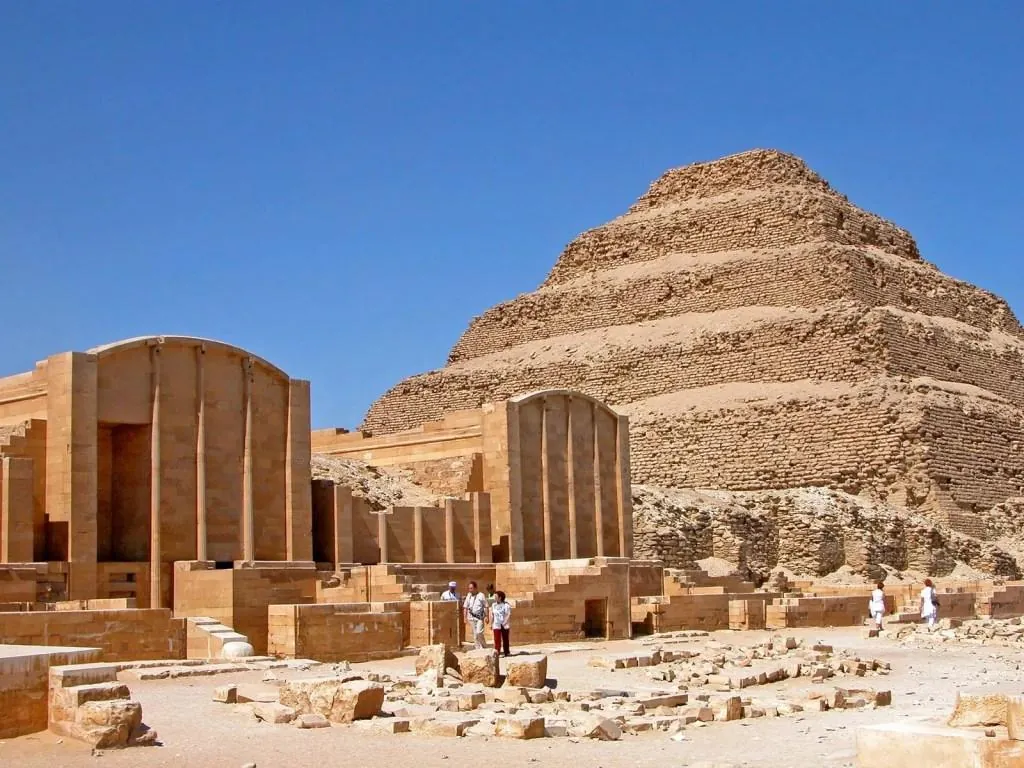
For thousands of years, the pyramids have symbolized the extraordinary achievements of ancient Egypt. Millions of travelers visit the Great Pyramid of Giza every year, admiring its immense size and remarkable engineering. Yet few realize that the story of pyramid construction did not begin at Giza.
It began nearly a century earlier at Saqqara, where one revolutionary monument forever changed the course of architecture.
The Step Pyramid of Djoser is widely recognized as the world’s first pyramid and the earliest monumental stone building ever constructed. Designed around 2670 BC during Egypt’s Third Dynasty, it marked a turning point in human history, introducing engineering techniques and architectural concepts that would eventually lead to the construction of the Great Pyramid of Giza and many of Egypt’s most iconic monuments.
More than a royal tomb, the Step Pyramid represented a bold new vision of kingship, religion, and eternity. It demonstrated that stone—not mudbrick—could be used to create monumental structures designed to last forever.
Today, more than 4,600 years after its completion, the Step Pyramid continues to inspire archaeologists, architects, historians, and travelers from around the world. Located within the vast Saqqara Necropolis, it remains one of Egypt’s most important archaeological treasures and an essential stop for anyone interested in understanding how the civilization of the pharaohs reached its architectural peak.
In this guide, you’ll discover the complete story of the Step Pyramid, from its construction and groundbreaking design to what you can see during your visit today.
Quick Facts About the Step Pyramid
| Feature | Details |
|---|---|
| Location | Saqqara, Egypt |
| Built For | King Djoser |
| Architect | Imhotep |
| Dynasty | Third Dynasty |
| Construction Date | c. 2670 BC |
| Height | Approximately 60 meters (197 feet) |
| Material | Limestone |
| Historical Importance | World’s first pyramid and first monumental stone building |
| UNESCO Status | Part of the Memphis and its Necropolis World Heritage Site |
Who Was King Djoser?
To understand the importance of the Step Pyramid, it is essential to understand the king who commissioned it.
Djoser ruled Egypt during the Third Dynasty, a period that marked the transition from Egypt’s early dynastic age into the flourishing Old Kingdom, often referred to as the “Age of the Pyramid Builders.”
Although the exact length of his reign remains debated, most historians believe Djoser ruled for approximately 19 to 28 years. During this time, Egypt experienced political stability, economic prosperity, and remarkable advances in administration, religion, and construction.
Unlike many rulers whose achievements have been lost to history, Djoser’s legacy is inseparable from one extraordinary project—the creation of the world’s first pyramid.
His reign transformed royal burial traditions forever. Previous kings had been buried beneath flat-roofed mastabas built primarily from mudbrick. Djoser sought something more ambitious, a monument that reflected both his divine status and Egypt’s growing power.
To achieve this vision, he turned to one of history’s greatest minds.
Imhotep: The Genius Behind the Step Pyramid
The success of the Step Pyramid was made possible by an extraordinary individual whose reputation would endure for thousands of years.
Imhotep served as Djoser’s chief architect, royal advisor, high priest, physician, and administrator. His combination of artistic vision, engineering skill, and intellectual brilliance made him one of the most influential figures in ancient history.
Rather than constructing another traditional mastaba, Imhotep developed an entirely new concept.
He began with a single rectangular mastaba before expanding and stacking additional layers one above another, eventually creating a six-tiered structure unlike anything the world had ever seen.
This innovative design transformed Egyptian architecture forever.
Centuries after his death, Imhotep’s achievements became so respected that he was deified and worshipped as a god of wisdom and medicine. The Greeks later identified him with Asclepius, the god of healing, making him one of the few non-royal Egyptians to receive divine status.
Without Imhotep’s revolutionary vision, the magnificent pyramids at Dahshur and Giza might never have existed.
Why the Step Pyramid Changed History
The Step Pyramid was much more than a royal tomb.
It represented a revolutionary leap in architecture, engineering, and symbolic design.
For the first time in history:
- Monumental buildings were constructed almost entirely from carefully cut limestone.
- Egyptian architects designed a complex intended to symbolize an eternal royal palace.
- Pyramid construction replaced traditional mastaba burials for Egyptian kings.
- Large-scale stone engineering became a defining feature of Egyptian civilization.
The Step Pyramid demonstrated that humans could create permanent monuments on an unprecedented scale.
Its influence extended far beyond Egypt, inspiring generations of architects and establishing principles of monumental construction that continue to fascinate engineers today.
More importantly, it laid the foundation for the evolution of pyramid architecture—from the experimental Bent Pyramid to the successful Red Pyramid and ultimately the Great Pyramid of Giza, one of the Seven Wonders of the Ancient World.
The Architecture That Changed the World
Standing before the Step Pyramid today, it is easy to admire its impressive size and elegant simplicity. Yet what appears to be a single monument is actually the centerpiece of one of the most ambitious architectural projects of the ancient world.
The Step Pyramid was never intended to stand alone.
It formed the heart of an enormous ceremonial complex designed to ensure King Djoser’s eternal rule in the afterlife. Covering approximately 15 hectares (37 acres) and surrounded by a limestone enclosure wall nearly 1.6 kilometers (one mile) in length, the complex included temples, courtyards, shrines, ceremonial buildings, underground galleries, and symbolic palaces.
No structure of this scale had ever been attempted before.
Even today, archaeologists consider the Step Pyramid Complex one of humanity’s earliest masterpieces of urban planning and monumental architecture.
From a Mastaba to the World’s First Pyramid
One of the most remarkable aspects of the Step Pyramid is that it was not originally designed as a pyramid.
Archaeological evidence suggests that Imhotep’s project evolved through six major construction phases, with each stage expanding on the previous one.
Phase One – A Traditional Mastaba
The project began as a large square mastaba built from limestone instead of the mudbrick traditionally used for royal tombs.
Although relatively simple in appearance, this decision alone marked a significant technological breakthrough. It demonstrated that finely cut stone could replace less durable building materials for monumental construction.
Phase Two – Expansion
Rather than completing the mastaba, Imhotep enlarged it, creating a more imposing royal monument.
This reflected an increasingly ambitious vision for Djoser’s eternal resting place.
Phase Three – The First Steps
Instead of expanding outward again, additional layers were built on top of the original mastaba.
The monument began taking on its distinctive stepped appearance.
Final Construction
By the end of the project, six massive stone layers rose one above another, creating a pyramid approximately 60 meters (197 feet) high.
This innovative approach introduced a completely new architectural form that would eventually evolve into the smooth-sided pyramids of later dynasties.
The Step Pyramid was therefore not a single design but the result of continuous experimentation, making it one of the earliest examples of large-scale architectural innovation in human history.
Why Six Steps?
Visitors often wonder why the pyramid has six distinct levels rather than smooth sides like the pyramids at Giza.
The answer lies in the evolution of Egyptian engineering.
At the time of Djoser’s reign, architects had never attempted to construct a true pyramid. Stacking progressively smaller mastabas proved to be the safest and most practical method for reaching unprecedented heights while maintaining structural stability.
The six tiers may also have held symbolic meaning.
Many Egyptologists believe the ascending steps represented a staircase to the heavens, allowing the king’s spirit to climb toward the gods and join the eternal celestial realm.
Whether practical, symbolic, or both, the stepped design became one of the defining features of early pyramid architecture.
The Limestone Enclosure Wall
Before visitors even reached the pyramid itself, they entered an enormous sacred enclosure unlike anything previously built in Egypt.
Constructed from fine white limestone, the surrounding wall originally stood approximately 10 meters (33 feet) high and featured more than 1,600 decorative niches.
Although the wall appears to contain numerous gateways, almost all were false doors.
Only a single entrance allowed access into the sacred royal precinct.
This design reflected an important aspect of Egyptian religious belief.
False doors symbolized passage between the world of the living and the world of the dead, allowing the king’s spirit to move freely while preventing unwanted intruders from entering the sacred space.
The Entrance Colonnade
The ceremonial entrance remains one of the most impressive architectural achievements of the entire complex.
Visitors pass through a long limestone corridor lined with 40 fluted columns, each carefully carved to resemble bundled papyrus reeds.
Although they imitate wooden construction, these columns were cut entirely from stone.
This was revolutionary.
Rather than simply copying nature, Imhotep demonstrated that stone architecture could reproduce familiar forms while creating buildings of far greater permanence.
Today, the Entrance Colonnade provides one of the most memorable first impressions anywhere in Egypt.
Walking beneath these towering columns offers visitors a glimpse into the grandeur that once surrounded the royal court over four thousand years ago.
The Heb-Sed Court
Emerging from the colonnade, visitors enter one of the largest ceremonial spaces within the complex—the Heb-Sed Court.
The Heb-Sed Festival was among the most important royal ceremonies in ancient Egypt.
Traditionally celebrated after a pharaoh had ruled for thirty years, it reaffirmed the king’s physical strength and divine authority.
During the festival, the ruler participated in ritual races and religious ceremonies designed to demonstrate that he remained fit to govern Egypt.
Although historians are uncertain whether Djoser actually celebrated a Heb-Sed Festival during his lifetime, the court ensured he could symbolically repeat the ceremony forever in the afterlife.
The surrounding shrines were largely symbolic rather than functional, representing the various regions of Egypt united under the pharaoh’s eternal rule.
Today, the open courtyard offers one of the finest viewpoints of the Step Pyramid itself.
The Mortuary Temple
Situated along the northern side of the pyramid lies the Mortuary Temple, where priests carried out rituals honoring the deceased king.
Every day, offerings of food, drink, incense, and prayers were presented to sustain Djoser’s spirit in eternity.
Although much of the original decoration has disappeared, the temple illustrates how closely religion and architecture were connected in ancient Egypt.
The monument was never intended merely as a tomb—it functioned as an eternal palace where the king would continue receiving worship long after his death.
The South Tomb
Among the most intriguing structures within the complex is the South Tomb.
Unlike the main burial chamber beneath the Step Pyramid, this separate monument appears to have served a symbolic religious function.
Its underground corridors are decorated with beautiful blue faience tiles designed to imitate woven reed mats found in royal palaces.
The craftsmanship remains extraordinary.
Even after more than four millennia, many of these decorative elements continue to impress visitors with their vibrant color and remarkable preservation.
Although scholars continue debating the South Tomb’s exact purpose, it demonstrates the extraordinary attention to symbolism throughout the entire complex.
The Underground Labyrinth
Perhaps the greatest surprise lies beneath the pyramid itself.
Hidden underground is an immense network of passages stretching for nearly six kilometers (almost four miles).
These tunnels include:
- The royal burial chamber.
- Storage rooms filled with funerary offerings.
- Corridors decorated with blue faience tiles.
- Stone-lined galleries.
- Chambers intended for members of the royal family.
- Symbolic rooms representing different parts of the royal palace.
Originally, thousands of stone vessels were stored within these galleries, many dating from earlier Egyptian dynasties.
Their presence suggests that Djoser intentionally connected himself with Egypt’s earliest kings, reinforcing his legitimacy and divine authority.
Even today, much of this underground world remains inaccessible to visitors and continues to be studied by archaeologists.
An Engineering Achievement Unlike Any Before
The Step Pyramid was not simply the tallest building of its age—it represented an entirely new way of thinking about construction.
To complete the monument, ancient builders had to:
- Quarry enormous quantities of limestone.
- Transport heavy stone blocks across the desert.
- Develop new methods for lifting materials to increasing heights.
- Maintain structural stability throughout multiple construction phases.
- Coordinate thousands of skilled workers, craftsmen, and laborers.
These achievements laid the technological foundations for every major pyramid that followed.
Without the lessons learned at Saqqara, monuments such as the Bent Pyramid, the Red Pyramid, and the Great Pyramid of Giza might never have been possible.
Can You Go Inside the Step Pyramid? Everything You Need to Know Before Visiting
For many visitors, seeing the Step Pyramid from the outside is only part of the experience.
The question almost everyone asks is:
“Can you actually go inside the Step Pyramid?”
The answer is yes—but access depends on current conservation work and regulations from Egypt’s Ministry of Tourism and Antiquities.
After an extensive restoration project lasting more than fourteen years, parts of the Step Pyramid reopened to visitors, allowing them to descend into one of the oldest monumental structures ever built.
Walking inside the pyramid is unlike entering the Great Pyramid of Giza. Rather than vast galleries and soaring chambers, the Step Pyramid offers a more intimate glimpse into the earliest stage of pyramid architecture.
For history lovers, it is one of the most unforgettable experiences in Egypt.
Inside the Step Pyramid
The entrance leads visitors through a descending passage that reaches the heart of the monument.
As you move deeper underground, it becomes immediately clear that this pyramid was built during an experimental period of Egyptian engineering.
The corridors are narrower, the layout more complex, and the architecture reflects the transition from simple mastaba tombs to monumental pyramid construction.
At the center lies the royal burial shaft, originally cut approximately 28 meters (92 feet) into the bedrock.
The shaft was lined with massive blocks of pink granite imported from Aswan—an extraordinary logistical achievement considering the distance of nearly 900 kilometers (560 miles).
Although the original burial equipment disappeared long ago, standing inside the chamber offers a powerful sense of connection with one of humanity’s earliest monumental buildings.
Visitors often describe the atmosphere as quiet, mysterious, and deeply moving.
The Underground World Beneath the Pyramid
What many travelers never realize is that the visible pyramid represents only a small portion of the entire monument.
Beneath the desert lies an astonishing underground complex extending nearly six kilometers (almost four miles).
This hidden world contains:
- Long corridors.
- Storage chambers.
- Ritual rooms.
- Family burial galleries.
- Blue faience-tiled chambers.
- Stone-lined passageways.
- Ancient storage areas for funerary offerings.
Archaeologists believe thousands of stone vessels were originally stored here, many inherited from earlier Egyptian rulers.
These objects reinforced Djoser’s connection with Egypt’s earliest kings and emphasized the continuity of royal authority.
Even after more than four millennia, researchers continue studying these passages, and some areas remain inaccessible to the public for conservation reasons.
The Blue Faience Chambers
Among the most beautiful spaces discovered beneath the Step Pyramid are the famous Blue Faience Chambers.
Their walls were once covered with thousands of small blue-glazed tiles carefully arranged to imitate woven reed mats used inside royal palaces.
The brilliant blue color symbolized rebirth, water, and eternal life.
Although visitors cannot access every chamber today, these remarkable decorations demonstrate the extraordinary artistic skill of ancient Egyptian craftsmen.
Many Egyptologists consider these chambers among the finest surviving examples of decorative architecture from the Old Kingdom.
Was Djoser Buried Here?
Surprisingly, no one can answer this question with complete certainty.
The burial chamber was clearly designed for King Djoser, yet archaeologists found little evidence of his original mummy.
Over thousands of years, tomb robbers entered the monument and removed many valuable objects.
Some historians believe Djoser’s remains were disturbed during antiquity.
Others suggest later events may have relocated or destroyed the royal burial.
Despite these uncertainties, the Step Pyramid remains unquestionably Djoser’s funerary monument and the centerpiece of his vast mortuary complex.
How Was the Step Pyramid Built?
One of the greatest mysteries surrounding the Step Pyramid is not why it was built—but how.
Constructing the world’s first monumental stone building required innovations that had never before been attempted.
Although many details remain unknown, archaeologists believe the construction process included several key stages.
Quarrying the Stone
The limestone used to build the pyramid was extracted from nearby quarries around Saqqara.
Workers cut enormous blocks using copper tools, stone hammers, wooden wedges, and simple but effective engineering techniques.
Transporting the Blocks
Once cut, the blocks were loaded onto wooden sledges and dragged across prepared surfaces.
Many researchers believe workers poured water onto the sand to reduce friction, allowing large stones to move more efficiently.
Experiments conducted in modern times support this theory.
Building Higher and Higher
As construction progressed through its six phases, builders needed increasingly sophisticated methods for lifting heavy blocks.
Although no ramps survive today, most archaeologists believe a combination of straight, zigzagging, and surrounding earthen ramps helped transport materials to higher levels.
Whatever methods were used, they proved remarkably successful.
Without these innovations, later pyramids—including the Great Pyramid of Giza—would never have been possible.
Restoration of the Step Pyramid
The Step Pyramid has survived more than 46 centuries, but time, earthquakes, weathering, and structural instability gradually weakened parts of the monument.
To preserve this priceless landmark, Egyptian authorities launched one of the most ambitious restoration projects ever undertaken at Saqqara.
The work included:
- Reinforcing unstable ceilings.
- Repairing damaged limestone blocks.
- Stabilizing underground passages.
- Improving visitor safety.
- Conserving decorative elements.
- Installing modern lighting in selected areas.
Following years of careful conservation, the monument reopened, allowing visitors to experience one of humanity’s oldest architectural masterpieces while ensuring its protection for future generations.
Visitor Information
Opening Hours
The Step Pyramid follows the opening hours of the Saqqara archaeological site: 8:00 AM to 4:00 PM daily, all year, as listed on the official Egyptian Ministry of Tourism and Antiquities site in October 2026.
Hours may vary during public holidays or special events, so it’s always worth confirming before your visit.
Tickets
The general Saqqara site ticket (EGP 600 for foreign adults, EGP 300 for students) covers the Step Pyramid complex. Going inside the pyramid needs a separate interior ticket (EGP 280; students EGP 140), and the Southern Tomb in the Djoser complex has its own ticket (EGP 300; students EGP 150). An inclusive Saqqara ticket costs EGP 1,400 (students EGP 700). These prices are as listed on the official Egyptian Ministry of Tourism and Antiquities site in October 2026; prices change, so check before you go. Some monuments within the necropolis may also have temporary access restrictions.
Because ticket policies can change, it’s advisable to check the latest official information or book through a trusted tour operator who can handle the arrangements.
How Long Should You Spend Here?
Most visitors spend:
- 45–60 minutes exploring the Step Pyramid Complex.
- 20–30 minutes inside the pyramid (when access is available).
- 3–5 hours if combining it with the Serapeum, Mastaba of Mereruka, Mastaba of Ti, and the Imhotep Museum.
- A full day if continuing to Memphis and Dahshur.
Photography Tips
The Step Pyramid offers outstanding photography opportunities throughout the day, but the quality of light changes significantly.
Best Time for Photography
- Early Morning (8:00–10:00 AM): Soft light, fewer visitors, cooler temperatures.
- Late Afternoon: Warm golden tones and dramatic shadows across the limestone blocks.
Best Viewpoints
- Entrance Colonnade.
- Heb-Sed Court.
- South side of the pyramid.
- Elevated viewpoints overlooking the Saqqara plateau.
- The enclosure wall with the pyramid rising above it.
A wide-angle lens is ideal for capturing the scale of the complex, while a telephoto lens works well for architectural details and carvings.
Visitor Tips
To make the most of your visit:
- Wear comfortable walking shoes suitable for uneven ground.
- Bring water, especially during warmer months.
- Carry a hat and sunscreen.
- Allow enough time to explore beyond the pyramid itself.
- Visit with a licensed Egyptologist to fully appreciate the historical significance of the complex.
- Combine your visit with Memphis and Dahshur for a complete understanding of the evolution of pyramid architecture.
The Birth of Monumental Stone Architecture
Before Djoser’s reign, Egyptian buildings were constructed primarily from mudbrick, wood, and reeds.
These materials were practical but temporary.
Imhotep completely transformed this approach.
For the first time, an entire royal funerary complex was built almost entirely from finely cut limestone.
This decision changed architecture forever.
Stone buildings could now survive for thousands of years.
The Step Pyramid proved that monumental architecture could be both technically possible and symbolically eternal.
Every major Egyptian temple, pyramid, and monument built afterward followed the path first established at Saqqara.
From the Step Pyramid to the Great Pyramid
The evolution of pyramid construction can be traced through a remarkable sequence of monuments.
| Pyramid | Dynasty | Importance |
|---|---|---|
| Mastaba Tombs | First & Second Dynasties | Traditional royal tombs before pyramids |
| Step Pyramid of Djoser | Third Dynasty | First pyramid ever built |
| Bent Pyramid | Fourth Dynasty | First attempt at a smooth-sided pyramid |
| Red Pyramid | Fourth Dynasty | First successful true pyramid |
| Great Pyramid of Giza | Fourth Dynasty | Largest and most advanced pyramid ever constructed |
The Step Pyramid was the experimental beginning of a journey that culminated in one of the Seven Wonders of the Ancient World.
Without Imhotep’s innovations, Egyptian architecture would have evolved very differently.
Step Pyramid vs. Great Pyramid of Giza
Many travelers wonder which pyramid they should prioritize.
The truth is that they complement each other rather than compete.
| Feature | Step Pyramid | Great Pyramid |
|---|---|---|
| Built For | King Djoser | King Khufu |
| Dynasty | Third Dynasty | Fourth Dynasty |
| Height | 60 m (197 ft) | 146.6 m (481 ft) |
| Architect | Imhotep | Believed to be Hemiunu |
| Design | Six-step pyramid | Smooth-sided true pyramid |
| Historical Importance | First pyramid ever built | Largest pyramid ever built |
| Best For | History lovers and archaeology enthusiasts | First-time visitors to Egypt |
If the Great Pyramid represents the peak of Egyptian engineering, the Step Pyramid represents the beginning of that extraordinary journey.
Visiting both allows travelers to witness nearly a century of architectural innovation.
Fascinating Facts About the Step Pyramid
Even visitors familiar with ancient Egypt are often surprised by these remarkable facts.
It is the world’s first pyramid.
No earlier civilization had attempted anything similar on such a monumental scale.
It is the oldest monumental stone building on Earth.
Large stone structures existed before Djoser, but none approached the complexity, scale, or engineering ambition of the Step Pyramid Complex.
It introduced an entirely new architectural concept.
Rather than simply enlarging a mastaba, Imhotep invented a completely new building type that would define Egyptian architecture for centuries.
The complex contains nearly six kilometers of underground passages.
Most visitors only see a fraction of the monument.
Hidden beneath the pyramid lies an enormous underground world that remains one of Egypt’s greatest archaeological achievements.
It inspired every pyramid that followed.
From Sneferu’s experiments at Dahshur to Khufu’s masterpiece at Giza, every later pyramid owes something to the innovations first introduced at Saqqara.
The Legacy of Imhotep
Although kings normally received the greatest recognition in ancient Egypt, the Step Pyramid elevated its architect to an almost legendary status.
Imhotep became one of the few individuals in Egyptian history to be remembered for thousands of years after his death.
His accomplishments extended far beyond architecture.
Ancient records describe him as:
- Chief architect.
- High priest.
- Royal advisor.
- Physician.
- Astronomer.
- Scholar.
Centuries later, he was worshipped as a deity associated with wisdom and healing.
The Greeks identified him with Asclepius, their own god of medicine.
Today, Imhotep remains one of history’s earliest named architects and one of the most influential engineers the world has ever known.
Why Every History Lover Should Visit
Many visitors arrive expecting to see an ancient pyramid.
They leave having witnessed the birthplace of monumental architecture.
The Step Pyramid offers something that no other site in Egypt can provide:
It tells the story of how everything began.
Rather than seeing the final achievement of pyramid construction, visitors experience the experimentation, innovation, and creativity that made later wonders possible.
For archaeologists, architects, engineers, historians, and curious travelers alike, the Step Pyramid is not simply another monument.
It is one of the most important milestones in human civilization.
The Step Pyramid is the centrepiece of our private Giza, Saqqara and Dahshur tour, and Saqqara is also part of longer packages such as Timeless Egypt. See all our Cairo tours.
Frequently Asked Questions
Is the Step Pyramid older than the Great Pyramid?
Yes. The Step Pyramid was completed nearly a century before the Great Pyramid of Giza and represents the first stage in the evolution of pyramid architecture.
Why is the Step Pyramid famous?
The Step Pyramid of Djoser is famous for being the world’s first pyramid and the earliest monumental stone building ever constructed. It introduced architectural techniques that influenced every pyramid built afterward.
How old is the Step Pyramid?
It was built around 2670 BC, making it more than 4,600 years old.
Why is it called the Step Pyramid?
Its six stacked levels resemble a giant staircase, distinguishing it from the smooth-sided pyramids built during the Fourth Dynasty.
Who designed the Step Pyramid?
The monument was designed by Imhotep, one of ancient Egypt’s greatest architects, engineers, and scholars.
Can you go inside the Step Pyramid?
Yes, when access is permitted. Entry depends on conservation work and regulations in place at the time of your visit, and the interior needs its own ticket (EGP 280 for foreign adults as listed on the official site in October 2026).
How long should I spend exploring the Step Pyramid?
Allow at least one hour for the pyramid complex itself, or four to five hours if you plan to explore the wider Saqqara Necropolis.
Is the Step Pyramid suitable for children?
Yes. Families with children interested in history often find it fascinating, especially when visiting with an experienced Egyptologist who can explain the stories behind the monuments.
Discover the Birthplace of Pyramid Architecture with Delta Tours Egypt
The Step Pyramid is more than an archaeological site—it is the starting point of one of the greatest stories ever told.
Exploring it with a knowledgeable Egyptologist allows you to appreciate not only its impressive architecture but also the vision, innovation, and symbolism that transformed ancient Egypt.
At Delta Tours Egypt, our private Giza, Saqqara and Dahshur tour includes the Step Pyramid, the Bent and Red Pyramids and Giza, and a tailor-made itinerary can add the Serapeum, the Mastaba of Mereruka or Memphis. You’ll enjoy private transportation, flexible scheduling, and expert guidance, ensuring you experience the site at your own pace while uncovering the remarkable history behind every monument.
Whether you’re visiting Egypt for the first time or returning to explore beyond the famous landmarks, the Step Pyramid is an unforgettable destination—and one that deserves a place on every well-planned itinerary.
Recommended One-Day Itinerary
If you’re visiting from Cairo, this itinerary allows you to explore the complete story of Egypt’s earliest pyramids.
| Time | Activity |
|---|---|
| 08:00 | Depart your hotel in Cairo or Giza |
| 09:00 | Explore the Step Pyramid Complex |
| 10:30 | Visit the Serapeum |
| 11:30 | Discover the Mastaba of Mereruka |
| 12:15 | Explore the Mastaba of Ti |
| 01:00 | Visit the Imhotep Museum |
| 02:00 | Lunch at a local restaurant |
| 03:00 | Explore Memphis |
| 04:00 | Visit the Bent Pyramid and Red Pyramid at Dahshur |
| 06:00 | Return to Cairo |
This route follows the chronological evolution of Egyptian pyramid building, making it one of the most rewarding day trips from Cairo.
Continue Exploring Ancient Egypt
If you enjoyed learning about the Step Pyramid, continue your journey with these guides: