Saqqara, Egypt: The Complete Visitor Guide to the World’s First Pyramid Complex (2026/2027)
Saqqara, Egypt: The Complete Visitor Guide to the World’s First Pyramid Complex
Introduction
Long before the iconic Pyramids of Giza dominated the Egyptian skyline, another remarkable monument forever changed the course of human history.
Welcome to Saqqara, one of Egypt’s most extraordinary archaeological treasures and the birthplace of pyramid architecture.
Located around 30 kilometers (19 miles) south of Cairo on the western bank of the Nile, Saqqara served as the main necropolis of the ancient city of Memphis for more than 3,000 years. Today, it stretches across nearly seven kilometers of desert and contains hundreds of monuments, including pyramids, royal tombs, temples, mastabas, underground galleries, and some of the oldest stone buildings ever constructed.
At the heart of the site stands the Step Pyramid of King Djoser, the world’s first monumental stone structure. Designed by the legendary architect Imhotep during Egypt’s Third Dynasty around 2670 BC, it marked the beginning of pyramid construction and laid the foundation for later masterpieces such as the Bent Pyramid, the Red Pyramid, and eventually the Great Pyramid of Giza.
Yet Saqqara is far more than the Step Pyramid.
It is an open-air museum where visitors can explore beautifully decorated tombs, descend into ancient burial chambers, admire the mysterious Serapeum, discover the Pyramid Texts inside the Pyramid of Unas, and witness archaeological discoveries that continue to reshape our understanding of ancient Egypt.
Unlike Giza, which impresses with its monumental scale, Saqqara rewards curiosity. Every corner of the necropolis reveals another chapter of Egyptian civilization, from the earliest dynasties to the Greco-Roman period.
Whether you are a first-time visitor to Egypt, a history enthusiast, a photographer, or someone seeking a deeper understanding of one of the world’s oldest civilizations, Saqqara offers an experience unlike any other.
In this guide, you’ll discover everything you need to know before visiting Saqqara, including its fascinating history, the top attractions, opening hours, ticket information, travel tips, nearby sites, and how to make the most of your visit.
Why Visit Saqqara?
Many visitors ask a simple question:
“If I’m already visiting the Pyramids of Giza, is Saqqara worth visiting?”
The answer is an emphatic yes.
While Giza is famous for its grandeur, Saqqara tells the story of how pyramid building began.
It offers a completely different perspective on ancient Egypt, allowing visitors to witness the evolution of architecture, religion, engineering, and royal burial traditions over thousands of years.
Saqqara is where you’ll find:
- The world’s first pyramid.
- The world’s oldest monumental stone complex.
- The earliest known large-scale limestone architecture.
- The famous Pyramid Texts, considered the oldest surviving religious writings in history.
- Hundreds of richly decorated tombs with remarkably preserved reliefs and inscriptions.
- Ongoing archaeological excavations that continue to uncover new discoveries almost every year.
Unlike many archaeological sites, Saqqara never feels repetitive. Each monument has its own story, architectural style, and historical significance.
For travelers interested in understanding how Egypt’s greatest monuments evolved, there is simply no better place to visit.
Where Is Saqqara?
Saqqara lies on the edge of the Western Desert, approximately:
- 30 km (19 miles) south of downtown Cairo
- 17 km (10 miles) south of the Giza Pyramids
- 6 km (4 miles) from Memphis
- 10 km (6 miles) from Dahshur
Its strategic location makes it easy to combine with nearby attractions in a single day, particularly Memphis and Dahshur, creating one of the most rewarding historical excursions from Cairo.
Quick Facts About Saqqara
| Feature | Information |
|---|---|
| Location | Giza Governorate, Egypt |
| Distance from Cairo | About 30 km |
| UNESCO Status | Part of the Memphis and its Necropolis World Heritage Site |
| Founded | Around 3000 BC |
| Most Famous Monument | Step Pyramid of Djoser |
| Architect | Imhotep |
| Best Time to Visit | October to April |
| Recommended Visit | 4–6 hours |
| Suitable for Families | Yes |
| Suitable for Photographers | Excellent |
The Story of Saqqara
To understand Saqqara, you first need to understand Memphis, the ancient capital of Egypt.
Founded by King Menes around 3100 BC, Memphis became the political, administrative, and religious heart of the unified Egyptian kingdom. As the city grew in power, its rulers required a royal burial ground worthy of their status.
That burial ground became Saqqara.
For more than three millennia, kings, queens, nobles, priests, military commanders, artisans, and officials chose to be buried here, believing the sacred desert west of the Nile represented the realm of the dead and the gateway to eternal life.
The earliest burials consisted of simple underground graves, but over time these evolved into mastabas—large rectangular structures built from mudbrick and later stone.
This architectural evolution reached its greatest breakthrough during the reign of King Djoser.
His royal architect, Imhotep, transformed the traditional mastaba into a revolutionary six-tiered monument that became the Step Pyramid.
For the first time in history, humans constructed an enormous stone building designed to endure forever.
That single innovation changed architecture across the ancient world and inspired every pyramid that followed.
The Step Pyramid of Djoser: Where Pyramid History Began
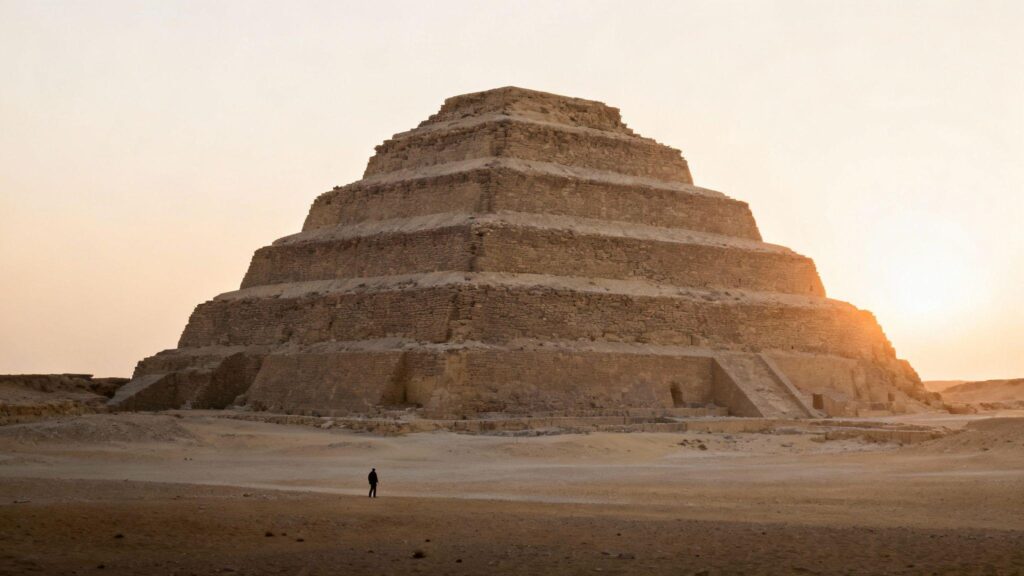
No visit to Saqqara is complete without standing before the Step Pyramid of Djoser, one of the most revolutionary buildings ever constructed.
Today it may appear modest compared to the Great Pyramid of Giza, but over 4,600 years ago it completely transformed architecture, engineering, and royal burial traditions. Before its construction, Egyptian kings were buried beneath flat-roofed tombs known as mastabas. These rectangular structures served as funerary monuments but lacked the monumental scale that later came to symbolize the pharaohs’ divine status.
Everything changed during the reign of King Djoser, the second ruler of Egypt’s Third Dynasty.
His trusted advisor and architect, Imhotep, envisioned something never attempted before. Rather than building a single mastaba, he stacked six progressively smaller mastabas on top of one another, creating the world’s first pyramid.
Standing approximately 60 meters (197 feet) high, the Step Pyramid became the tallest man-made structure on Earth at the time. More importantly, it introduced the concept of monumental stone architecture that would eventually lead to the construction of the Bent Pyramid, the Red Pyramid, and finally the Great Pyramid of Giza.
Although the Step Pyramid looks simple from a distance, its historical importance cannot be overstated. It marks the moment when Egypt entered an architectural golden age that would define the civilization for thousands of years.
Today, after years of careful restoration, visitors can once again appreciate the pyramid and its surrounding complex while gaining a deeper understanding of how ancient Egyptian engineering evolved.
The Step Pyramid Complex
The pyramid itself is only one part of a much larger ceremonial landscape.
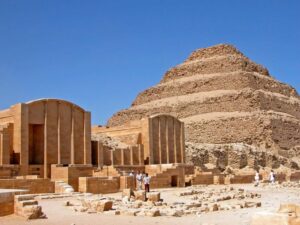
Surrounding it is the Step Pyramid Complex, covering approximately 15 hectares (37 acres) and enclosed by a massive limestone wall. This is considered the oldest surviving large-scale stone architectural complex in the world.
The complex was designed to serve not only as Djoser’s eternal resting place but also as a symbolic palace where the king could continue ruling in the afterlife.
Within its walls, visitors can explore ceremonial courtyards, temples, shrines, underground passages, and symbolic buildings that reveal how closely religion, architecture, and kingship were intertwined in ancient Egypt.
Highlights include:
- The grand entrance colonnade.
- The Heb-Sed Festival Courtyard.
- The South Tomb.
- The mortuary temple.
- Ceremonial chapels.
- Underground galleries stretching for several kilometers.
Every structure had a purpose, reinforcing the pharaoh’s divine authority and ensuring his successful journey into eternity.
The Heb-Sed Court
One of the most fascinating areas inside the complex is the Heb-Sed Court.
The Heb-Sed Festival was an important royal ceremony celebrated after a pharaoh had ruled for thirty years. During this ritual, the king demonstrated his physical strength and renewed his divine right to rule Egypt.
Although Djoser never lived long enough to celebrate multiple festivals, the entire court was constructed so he could symbolically perform the ceremony forever in the afterlife.
As you walk through the open courtyard today, it’s easy to imagine priests, officials, and royal attendants gathering thousands of years ago for one of Egypt’s most important religious celebrations.
The Entrance Colonnade
Your journey into the complex begins through an extraordinary limestone colonnade.
This entrance corridor consists of 40 beautifully carved columns, each designed to resemble bundles of papyrus reeds, one of the sacred plants of ancient Egypt.
Unlike earlier mudbrick architecture, these columns were carved entirely from limestone, demonstrating the remarkable technical skills developed during Djoser’s reign.
Although they imitate natural materials, they represent one of humanity’s earliest experiments in monumental stone construction.
Even after more than four millennia, the entrance remains one of the most impressive architectural spaces in Egypt.
The South Tomb
While the Step Pyramid receives most of the attention, many Egyptologists consider the South Tomb one of the complex’s greatest mysteries.
Located near the southern end of the enclosure, this structure contains underground chambers decorated with stunning blue faience tiles designed to imitate woven reed mats found inside royal palaces.
Scholars continue to debate its exact purpose.
Some believe it symbolized Djoser’s connection with Upper Egypt.
Others argue it functioned as a symbolic burial chamber or a repository for sacred royal objects.
Whatever its original role, the South Tomb provides invaluable insight into early royal funerary architecture.
The Underground Labyrinth
Hidden beneath the Step Pyramid lies an astonishing network of underground passages extending nearly six kilometers (almost four miles).
These tunnels contain:
- Royal burial chambers.
- Storage rooms.
- Ritual spaces.
- Decorative blue-tiled corridors.
- Stone sarcophagi.
- Chambers once filled with funerary offerings.
Many sections remain inaccessible to the public, and archaeological work continues today.
The sheer scale of this underground city demonstrates the extraordinary ambition of Djoser’s builders.
It also reminds visitors that much of ancient Egypt still lies hidden beneath the desert sands.
The Pyramid of Unas
While many visitors come only for the Step Pyramid, they often overlook one of Saqqara’s greatest historical treasures.
The Pyramid of Unas, built nearly two centuries later during Egypt’s Fifth Dynasty, appears relatively small from the outside.
Inside, however, it contains something that changed the study of ancient religion forever.
Covering the burial chamber walls are the Pyramid Texts—the oldest known religious writings in human history.
These sacred inscriptions were intended to guide the deceased king safely through the afterlife, protect him from danger, and help him join the gods.
Many of the beliefs recorded here later influenced the Coffin Texts and eventually the famous Book of the Dead.
For visitors interested in ancient religion, mythology, or hieroglyphics, the Pyramid of Unas is one of the most significant monuments in all of Egypt.
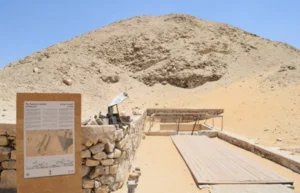
The Pyramid of Teti
Another remarkable monument is the Pyramid of King Teti, founder of Egypt’s Sixth Dynasty.
Although its exterior has suffered greatly over the centuries, its interior still preserves beautifully carved Pyramid Texts and provides another opportunity to descend inside a royal pyramid.
Around Teti’s pyramid lies an extensive necropolis filled with elaborately decorated tombs belonging to high-ranking officials.
These tombs offer some of the finest examples of Old Kingdom daily-life scenes, depicting farming, fishing, hunting, music, craftsmanship, and religious ceremonies with remarkable detail.
For many visitors, these private tombs are every bit as fascinating as the pyramids themselves because they reveal how ordinary Egyptians lived—not just how kings were buried.
Why the Step Pyramid Still Matters Today
More than 4,600 years after its construction, the Step Pyramid continues to inspire architects, historians, archaeologists, and travelers from around the world.
It represents:
- The birth of monumental stone architecture.
- The world’s first pyramid.
- The beginning of Egypt’s pyramid age.
- A masterpiece of engineering.
- One of humanity’s greatest architectural achievements.
Without Djoser’s vision and Imhotep’s genius, there would likely have been no Great Pyramid of Giza as we know it today.
Every pyramid built afterward owes something to the innovations first introduced at Saqqara.
Beyond the Step Pyramid: Hidden Treasures & Essential Visitor Information
While the Step Pyramid is undoubtedly Saqqara’s most famous monument, limiting your visit to this single structure means missing many of the archaeological site’s greatest treasures. Over the last century—and especially during recent excavations—Saqqara has revealed extraordinary tombs, underground galleries, sacred temples, and remarkable discoveries that have transformed historians’ understanding of ancient Egypt.
A well-planned visit should allow enough time to explore these remarkable sites, each offering a unique perspective on Egyptian civilization.
The Serapeum of Saqqara
One of the most mysterious and fascinating places within Saqqara is the Serapeum, an underground necropolis unlike any other in Egypt.
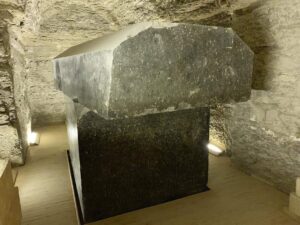
Discovered in 1851 by the French archaeologist Auguste Mariette, the Serapeum consists of a vast network of tunnels carved deep into the limestone bedrock. These galleries served as the burial place of the sacred Apis Bulls, animals worshipped as earthly manifestations of the god Ptah, the patron deity of nearby Memphis.
Each bull was carefully selected for its distinctive markings and lived a privileged life within temple precincts. Upon its death, priests mummified the animal with extraordinary care before placing it inside an enormous granite sarcophagus weighing up to 70 tons.
Walking through the dimly lit corridors of the Serapeum is one of the most unforgettable experiences in Egypt. Massive empty sarcophagi line the passageways, raising questions that continue to intrigue archaeologists and engineers alike:
- How were these enormous granite boxes transported from Aswan, nearly 900 kilometers away?
- How were they lowered into the underground chambers?
- What construction techniques allowed such extraordinary precision over 2,500 years ago?
Although many theories have been proposed, the Serapeum remains one of Egypt’s greatest engineering mysteries.
For visitors interested in archaeology, engineering, or ancient religion, this monument is an absolute highlight.
The Mastaba of Mereruka
If the pyramids reveal how kings prepared for eternity, the Mastaba of Mereruka reveals how Egypt’s highest officials lived.
Mereruka served as the vizier—the most powerful official after the pharaoh—during the reign of King Teti. His tomb is the largest private mastaba ever discovered in Egypt, containing more than 30 decorated chambers.
The walls are covered with beautifully preserved reliefs showing scenes from everyday Egyptian life, including:
- Farming and harvesting
- Fishing along the Nile
- Hunting in marshlands
- Furniture making
- Jewelry production
- Musicians and dancers
- Religious ceremonies
- Family life
These scenes are more than decorative—they are invaluable historical records that help historians reconstruct daily life over four thousand years ago.
Unlike royal monuments, which emphasize divine power, Mereruka’s tomb celebrates the prosperity and achievements of an elite Egyptian family.
For many visitors, these intricate carvings become one of the most memorable parts of their visit.
The Mastaba of Ti
Another masterpiece hidden within Saqqara is the Mastaba of Ti.
Ti served as an important royal official during Egypt’s Fifth Dynasty, and his tomb is renowned for some of the finest relief carvings from the Old Kingdom.
The artistic quality is astonishing.
Scenes depict fishermen pulling heavy nets from the Nile, craftsmen carving statues, cattle crossing rivers, and lively banquets attended by family members and servants.
Unlike many museum displays, these carvings remain exactly where they were created thousands of years ago, allowing visitors to experience ancient Egyptian art in its original setting.
Many Egyptologists consider the Mastaba of Ti one of the finest examples of Old Kingdom private funerary art.
The Imhotep Museum
Before leaving Saqqara, many visitors overlook one of the site’s most valuable attractions—the Imhotep Museum.
Named after the brilliant architect who designed the Step Pyramid, the museum provides essential context for everything you have explored throughout the necropolis.
Its collection includes:
- Original statues
- Excavated reliefs
- Stone vessels
- Burial equipment
- Architectural fragments
- Ancient tools
- Recent archaeological discoveries
- Scale models explaining the Step Pyramid complex
The museum is relatively small compared with Cairo’s larger museums, but its carefully curated displays make it one of the best introductions to Saqqara’s history.
For first-time visitors, it is often ideal to visit the museum either before exploring the archaeological site or immediately afterward to better understand what they have seen.
Recent Archaeological Discoveries
Saqqara is not simply an ancient monument—it is one of the world’s most active archaeological sites.
Almost every year, new discoveries make international headlines.
Recent excavations have uncovered:
- Hundreds of sealed coffins.
- Colorfully painted sarcophagi.
- Wooden statues.
- Funerary masks.
- Bronze sculptures.
- Animal mummies.
- Hidden burial shafts.
- Previously unknown tombs.
- Ancient workshops used for mummification.
These discoveries continue to reshape our understanding of Egyptian religion, burial practices, and daily life.
For travelers, this means every visit to Saqqara has the potential to reveal something entirely new.
Unlike many historical sites that have been completely excavated, Saqqara still hides countless secrets beneath the desert.
Opening Hours
Saqqara is generally open every day of the week.
Typical opening hours are:
- Summer: 8:00 AM – 5:00 PM
- Winter: 8:00 AM – 4:00 PM
Opening times may vary during Ramadan, public holidays, or due to archaeological work.
Arriving early in the morning is highly recommended to enjoy cooler temperatures, softer light for photography, and fewer tour groups.
Tickets
Entry tickets generally include access to the main archaeological zone, while certain monuments may require additional tickets depending on current regulations.
Ticket prices are updated periodically by Egypt’s Ministry of Tourism and Antiquities, so visitors should always confirm the latest rates before traveling.
Many guided tours include entrance tickets within the overall package, making the visit simpler and more convenient.
How Long Should You Spend in Saqqara?
The ideal visit depends on your interests.
2–3 hours
- Step Pyramid
- Main complex
- Quick exploration
4–5 hours (Recommended)
- Step Pyramid
- Serapeum
- Mastabas
- Imhotep Museum
- Photography stops
Full Day
Combine Saqqara with:
- Memphis
- Dahshur
- Optional local lunch
- Camel ride or countryside experience
For most travelers, a full-day excursion covering Saqqara, Memphis, and Dahshur offers one of the richest historical experiences anywhere in Egypt.
How to Get to Saqqara
The easiest way to reach Saqqara is from Cairo or Giza.
Options include:
Private Tour (Recommended)
A private guided tour is the most comfortable and efficient option.
Benefits include:
- Hotel pickup and drop-off
- Air-conditioned transportation
- Licensed Egyptologist guide
- Flexible schedule
- Combined visits to Memphis and Dahshur
Taxi or Ride-Hailing Apps
Uber and local taxis can take you to Saqqara, but finding transportation back may be more challenging, especially later in the afternoon.
Rental Car
While possible, driving in Cairo can be challenging for visitors unfamiliar with local traffic conditions.
Suggested Itinerary
To experience Saqqara at its best:
08:00 – Depart Cairo.
09:00 – Explore the Step Pyramid Complex.
10:30 – Visit the Serapeum.
11:30 – Explore the Mastaba of Mereruka and the Mastaba of Ti.
12:30 – Visit the Imhotep Museum.
01:15 – Lunch at a nearby restaurant.
02:30 – Continue to Memphis.
03:30 – Visit Dahshur and explore the Bent and Red Pyramids.
05:30 – Return to Cairo.
This itinerary allows visitors to experience the complete story of Egypt’s earliest pyramids in a single unforgettable day.
The Best Time to Visit Saqqara
Saqqara can be visited throughout the year, but choosing the right season and time of day can dramatically improve your experience.
October to April – The Ideal Season
The cooler months between October and April are widely considered the best time to visit Saqqara. Daytime temperatures are comfortable, making it easier to explore the vast archaeological site on foot. Clear skies also provide excellent conditions for photography, while the softer sunlight enhances the colors of the limestone monuments.
This period coincides with Egypt’s peak tourism season, so expect more visitors, particularly during Christmas, New Year, and Easter.
May to September – Hot but Rewarding
Summer temperatures often exceed 38°C (100°F), especially around midday. While the heat can be intense, there are advantages to visiting during this period:
- Fewer tourists.
- Easier access to monuments.
- Better opportunities for uninterrupted photography.
- More flexible schedules with private guides.
If traveling in summer, begin your visit as early as possible and carry plenty of water, sunscreen, and a hat.
What Time of Day Is Best?
If you have complete flexibility, the best visiting hours are:
8:00 AM – 10:30 AM
The advantages include:
- Cooler temperatures.
- Soft golden light.
- Fewer tour groups.
- Better photography conditions.
- More comfortable walking.
Late afternoon can also be beautiful, especially for photographers, as the warm desert light creates dramatic shadows across the Step Pyramid.
What Should You Wear?
Saqqara is an open desert archaeological site with very little natural shade.
Comfort is essential.
We recommend:
- Lightweight breathable clothing.
- Comfortable walking shoes.
- Sunglasses.
- Wide-brimmed hat or cap.
- Sunscreen.
- Reusable water bottle.
Winter mornings can be surprisingly cool, so carrying a light jacket is advisable between November and February.
Visitors are encouraged to dress respectfully, particularly if combining Saqqara with visits to nearby mosques or churches later in the day.
Photography Tips
Saqqara is one of Egypt’s most photogenic archaeological sites.
Unlike the busy Giza Plateau, visitors often enjoy more space to compose unique photographs.
Some of the best photography locations include:
The Step Pyramid
Capture the pyramid from the entrance causeway for a classic perspective that highlights all six tiers.
The Heb-Sed Court
The open courtyard creates dramatic compositions with the pyramid rising in the background.
The Entrance Colonnade
The repeating limestone columns produce striking symmetrical photographs.
The Desert Panorama
Several elevated viewpoints reveal the immense scale of the Saqqara Necropolis stretching toward Dahshur and the edge of the Nile Valley.
Mastaba Reliefs
Many tombs preserve intricate carvings depicting scenes from daily life. These are excellent subjects for close-up photography.
Always respect local regulations regarding flash photography and restricted areas inside tombs.
Accessibility
Visitors should be aware that Saqqara is a vast archaeological site with uneven desert terrain.
Walking distances can be considerable, and some monuments involve steps or narrow passages.
For travelers with limited mobility:
- Private vehicles can access several key areas.
- Many main monuments are reachable with minimal walking.
- A private guide can tailor the route to individual needs.
- Comfortable footwear is highly recommended.
While some underground monuments may be difficult to access, the main highlights remain enjoyable for most visitors.
Nearby Attractions
One of Saqqara’s greatest advantages is its location.
Several world-famous archaeological sites are just a short drive away, making it easy to create an unforgettable full-day itinerary.
Memphis
Only a few minutes north of Saqqara lies Memphis, the first capital of ancient unified Egypt.
Highlights include:
- The colossal statue of Ramses II.
- The Alabaster Sphinx.
- Open-air museum.
- Ancient temple remains.
Memphis provides essential historical context before exploring Saqqara.
Dahshur
A short drive south brings visitors to Dahshur, home to two of Egypt’s most remarkable pyramids.
Bent Pyramid
One of the best-preserved pyramids in Egypt, famous for its unusual change in angle.
Red Pyramid
Often considered Egypt’s first successful “true pyramid,” visitors can even descend inside its burial chambers.
Together, Saqqara, Memphis, and Dahshur tell the complete story of pyramid development before the construction of Giza.
The Giza Pyramids
Many travelers choose to combine Saqqara with the iconic Giza Plateau over two days.
After learning how pyramid architecture began at Saqqara, visiting the Great Pyramid of Giza becomes an even richer experience.
The connection between these sites allows visitors to trace the remarkable evolution of ancient Egyptian engineering.
Is Saqqara Better Than Giza?
This is one of the most common questions travelers ask.
The truth is that the two sites offer completely different experiences.
| Saqqara | Giza |
|---|---|
| Rich archaeological diversity | Iconic world-famous pyramids |
| Fewer crowds | Larger visitor numbers |
| More decorated tombs | Monumental architecture |
| Better for history lovers | Better for first-time visitors |
| Extensive archaeological exploration | Classic Egypt experience |
If your schedule allows, visiting both sites provides the most complete understanding of Egypt’s pyramid age.
Frequently Asked Questions
Is Saqqara worth visiting?
Absolutely.
Saqqara is one of Egypt’s most historically significant archaeological sites and offers experiences unavailable anywhere else, including the world’s first pyramid and beautifully preserved Old Kingdom tombs.
How long should I spend in Saqqara?
Plan at least four hours.
History enthusiasts often spend an entire day exploring the necropolis and nearby monuments.
Can I visit Saqqara without a guide?
Yes.
However, many of Saqqara’s greatest stories remain hidden without expert interpretation.
A licensed Egyptologist transforms the visit from sightseeing into an unforgettable journey through ancient history.
Is Saqqara suitable for children?
Yes.
Older children interested in history, archaeology, or ancient civilizations usually find the Step Pyramid and underground monuments particularly fascinating.
Can I visit Saqqara, Memphis, and Dahshur in one day?
Yes.
This is actually one of the most popular day trips from Cairo and offers a comprehensive introduction to the evolution of pyramid architecture.
Why Visit Saqqara with Delta Tours Egypt?
Saqqara is far more than a stop on a sightseeing itinerary—it is one of the most important chapters in the story of ancient Egypt. Exploring it with an expert guide helps bring that story to life, from the genius of Imhotep to the symbolism carved into tomb walls that are more than four thousand years old.
At Delta Tours Egypt, our private Saqqara tours are designed to give you more than just transportation between monuments. You’ll travel with a licensed Egyptologist, enjoy a flexible itinerary at your own pace, and have the opportunity to combine Saqqara with Memphis, Dahshur, or the Giza Pyramids in a single seamless day.
Whether you’re passionate about archaeology, traveling with family, or seeking a luxury private experience, we’ll help you discover why Saqqara remains one of Egypt’s greatest hidden treasures.
Continue Exploring Egypt
If you’re planning to discover more of Egypt’s incredible heritage, these guides are the perfect next step:
- Step Pyramid of Djoser
- Who Was Imhotep?
- The Serapeum of Saqqara
- The Bent Pyramid of Dahshur
- The Red Pyramid
- Memphis, Egypt Travel Guide
- The Great Pyramid of Giza
- Cairo Travel Guide
- Luxury Egypt Tours
- Private Cairo Day Tours
Final Thoughts, Travel Planning, FAQs & SEO Optimization
Why Saqqara Deserves a Place on Every Egypt Itinerary
When most travelers dream of Egypt, they immediately picture the Great Pyramids of Giza. While those monuments are unquestionably extraordinary, they represent only the culmination of a much longer story.
That story begins at Saqqara.
Here, among the desert sands southwest of Cairo, visitors can witness the birthplace of pyramid architecture, walk through the world’s oldest monumental stone complex, descend into royal pyramids, admire beautifully preserved tombs, and explore archaeological discoveries that continue to reshape our understanding of one of history’s greatest civilizations.
Saqqara offers something increasingly rare in modern travel: the opportunity to experience a world-famous archaeological site without feeling overwhelmed by crowds. It rewards curiosity, encourages exploration, and provides a richer understanding of ancient Egypt than almost any other destination in the country.
Whether you’re fascinated by engineering, architecture, religion, archaeology, or simply want to discover a side of Egypt many travelers overlook, Saqqara deserves to be far more than a quick stop—it deserves to be one of the highlights of your journey.
Suggested Full-Day Itinerary
If you have one day to explore Egypt’s earliest pyramids, this route provides the perfect balance of history and sightseeing:
08:00 AM – Depart your hotel in Cairo or Giza.
09:00 AM – Explore the Step Pyramid Complex.
10:30 AM – Visit the Serapeum.
11:30 AM – Discover the Mastaba of Mereruka and the Mastaba of Ti.
12:30 PM – Visit the Imhotep Museum.
01:15 PM – Lunch at a local restaurant.
02:30 PM – Explore Memphis, Egypt’s first capital.
03:30 PM – Continue to Dahshur to visit the Bent Pyramid and Red Pyramid.
05:30 PM – Return to Cairo.
This itinerary allows visitors to trace the complete evolution of pyramid construction—from the first experimental stone pyramid to the first true pyramid—before eventually visiting the Great Pyramid of Giza.
Planning Your Visit with Delta Tours Egypt
Saqqara is one of those places where expert interpretation makes a remarkable difference.
Many monuments appear simple at first glance, yet every wall relief, courtyard, underground chamber, and architectural detail tells part of a much larger story.
Our private Saqqara tours are designed for travelers who want to experience far more than a standard sightseeing excursion.
With Delta Tours Egypt, you’ll enjoy:
- Private air-conditioned transportation.
- Hotel pickup and drop-off in Cairo or Giza.
- A licensed Egyptologist guide.
- Flexible itinerary tailored to your interests.
- Opportunities to combine Saqqara with Memphis, Dahshur, or the Giza Pyramids.
- Ample time for photography and exploration without feeling rushed.
Whether you’re a first-time visitor or returning to Egypt, our goal is to help you understand the remarkable achievements of the ancient Egyptians while enjoying a comfortable and personalized travel experience.
Frequently Asked Questions
Is Saqqara included in most Egypt tours?
Many multi-day Egypt itineraries focus only on the Giza Pyramids. However, travelers interested in archaeology, history, and architecture often choose to add Saqqara because it offers a much deeper understanding of ancient Egyptian civilization.
Can you enter the Step Pyramid?
Access policies occasionally change depending on conservation work. When open, entering the Step Pyramid offers a fascinating glimpse into one of the oldest monumental structures ever built.
Which is older: Saqqara or Giza?
Saqqara is significantly older. The Step Pyramid of Djoser predates the Great Pyramid of Giza by several decades and marks the beginning of Egypt’s pyramid-building tradition.
Is Saqqara a UNESCO World Heritage Site?
Yes. Saqqara forms part of the UNESCO World Heritage Site known as “Memphis and its Necropolis – the Pyramid Fields from Giza to Dahshur.”
Is photography allowed?
Photography is generally permitted in most outdoor areas, although certain tombs or indoor monuments may have restrictions. Always follow the guidance of site staff and respect any posted regulations.
Can I combine Saqqara with the Giza Pyramids?
Yes. Many travelers combine both sites over one or two days. If you have enough time, adding Memphis and Dahshur creates one of the most rewarding historical journeys in Egypt.
Related Articles
To continue exploring Egypt’s remarkable heritage, we recommend reading:
Cairo
- Cairo Travel Guide
- Best Things to Do in Cairo
- Best Time to Visit Cairo
Saqqara
- The Step Pyramid of Djoser
- Who Was Imhotep?
- The Serapeum of Saqqara
- The Pyramid of Unas
- The Pyramid of Teti
- The Mastaba of Mereruka
- The Mastaba of Ti
Nearby Destinations
- Memphis Travel Guide
- Dahshur Travel Guide
- Bent Pyramid Guide
- Red Pyramid Guide
- Giza Plateau Guide
Continue Your Egypt Journey
- Grand Egyptian Museum Guide
- Egyptian Museum Cairo
- National Museum of Egyptian Civilization
- Luxury Egypt Tours
- Private Cairo Day Tours
- 10-Day Egypt Itinerary